








Despite its conspicuous melodrama and emotional manipulation, this highly popular Teochew film transcends its shortcomings through the deeply resonating power of qiaopi, diaspora, and the enduring historical pull of Nanyang.
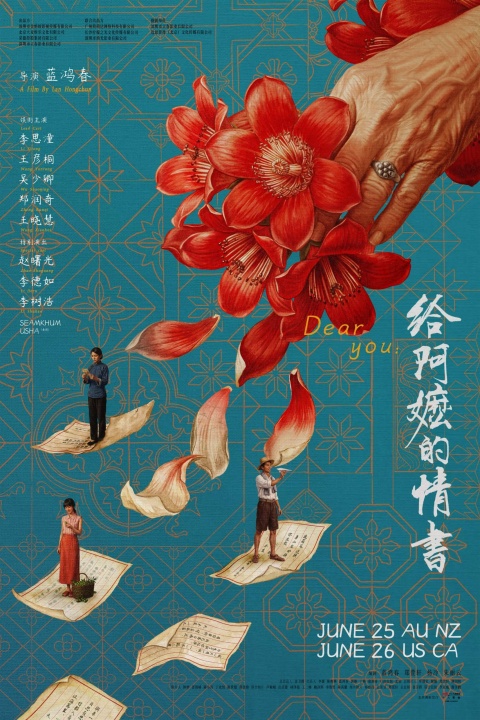
Review #3,094
Dir. Lan Hongchun
2026 | China | Drama | 118min | 1.85:1 | Teochew & Thai
NC16 (passed clean) for some coarse language. [Note: This film has been commercially censored by the local distributor at PG13 (edited)]
Cast: Li Sitong, Wang Yantong, Wu Shaoqing, Zheng Runqi, Wang Xiaohui
Plot: Xiaowei travels to Thailand to find his “billionaire grandfather” whose debt problems have kept them out of contact, but he unexpectedly finds that the one who has been corresponding with his grandmother for years is not her husband.
Awards: –
International Sales: Damai Entertainment (SG: Clover Films)
Accessibility Index
Subject Matter: Moderate – Cultural Roots; Family & Diaspora
Narrative Style: Slightly Complex
Pace: Normal
Audience Type: Mainstream
Viewed: In Theatres – GV VivoCity Max
Spoilers: No
Nanyang. Qiaopi. These are words that carry a multitude of emotions, laced with historical, geographical, cultural, social, and psychological meanings. My Dad occasionally wrote and mailed qiaopi (letters with money) back to relatives in China for my grandfather decades ago.
Out of sheer poverty, my grandfather, then a young boy, left Swatow some 70 to 80 years ago, together with his mother (my great-grandmother, whom I never met), and made their way to Nanyang (“Southern Ocean”, meaning Southeast Asia) to seek a new life.
After a voyage marked by rough seas, disease, and the constant possibility of death, they arrived in Singapore. Had the ship docked in Thailand, Malaysia, Indonesia, or elsewhere instead, I wouldn’t be Singaporean today.
But I still would have been Chinese, or specifically Teochew Chinese, no matter where I am in the world. That’s the thing about being part of a diaspora—the rootedness to one’s own lineage is purely psychological, and never physical.
Dear You has reignited debate in Singapore over our archaic dialect policy, much louder than ever before. You see, ironically, in my highly cosmopolitan country, films screened in Chinese dialects often get treated differently and dubbed over in Mandarin.
“The Teochew Chinese who came to Nanyang, they all had hard lives.”
Only limited screenings in their original language may be allowed, at the discretion of the authorities. Why, you might ask. Well, because exposure to dialects was considered “bad” for the Speak Mandarin Campaign, which was launched in 1979.
That’s the official reason, but skeptics would see it less as a pragmatic decision to instill a common language for the disparate Chinese clans, than as what some saw as an ideological attempt to weaken emotional ties to ancestral China in the next generation.
Perhaps this is why the “rare” opportunity to see the original Teochew version of Dear You has resonated with many in Singapore. This is despite the film’s rather obvious ways with emotional manipulation through the conspicuous mode of melodrama, though one that is thankfully tinged with moments of light-hearted comedy and cheeky innuendo.
Interestingly, I realised I was emotionally overwhelmed not fundamentally because of dramatic technique but because of a personal context that remains elusive to grasp.
Although I could never fathom the hardship and uncertainty of making ends meet in a new land—and the incredible courage and determination to plunge ahead in spite of everything—through the various qiaopi woven into the narrative of Dear You, I felt as though I was hearing my great-grandmother and grandfather speak across generations.
Every letter read aloud hit me like a slab of concrete. Even if the film is mostly set in Thailand, save for several flashbacks, it resonates. Well, because no matter where, it’s still Nanyang.
Grade: B+
Trailer:
Music:

