











A quietly devastating work, this Berlinale award-winner stuns and finds remarkable sensitivity in its treatment of sexual desire, dementia and love, elevated by immersive performances and riveting family dynamics.
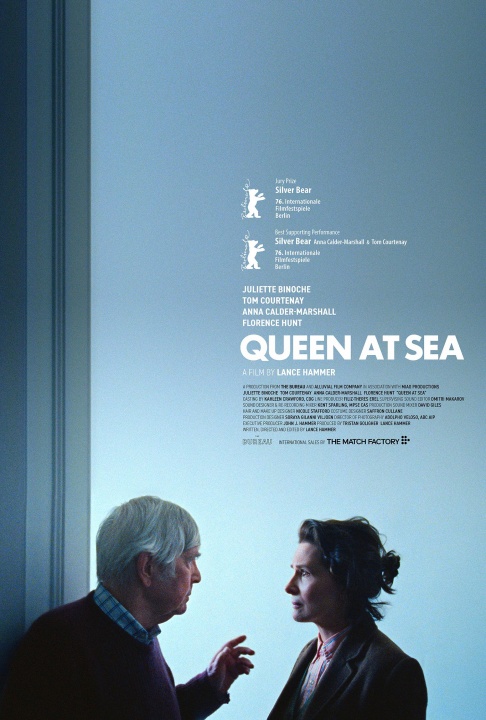
Review #3,098
Dir. Lance Hammer
2026 | UK | Drama | 121min | 1.66:1 | English & French
M18 (passed clean) for sexual scene
Cast: Juliette Binoche, Tom Courtenay, Anna Calder-Marshall, Florence Hunt
Plot: As dementia erodes a woman’s ability to communicate her inner life, her husband and daughter struggle to act in her best interest, navigating love and the fragile boundaries between care, protection, and autonomy.
Awards: Won Jury Prize & Best Supporting Performance (Berlinale)
International Sales: The Match Factory
Accessibility Index
Subject Matter: Slightly Mature – Dementia; Sexual Desire; Love & Family
Narrative Style: Straightforward
Pace: Slightly Slow
Audience Type: Slightly Arthouse
Viewed: Screener (as part of Singapore Film Society Showcase)
Spoilers: No
A stunning work, Queen at Sea tackles love and dementia in ways that are quietly revelatory. It’s an unassuming film, seemingly conventional in its form, with performances familiar enough to those who have seen pictures with similar themes.
I recall the recent likes of Florian Zeller’s emotionally overwhelming The Father (2020) and Gaspar Noé’s extraordinarily mounted Vortex (2021). Queen at Sea is firmly within that illustrious company, directed by Lance Hammer, who previously made only Ballast (2008), nearly two decades earlier.
Winner of the Jury Prize, with Best Supporting Performance awards for 89-year-old Tom Courtenay and 79-year-old Anna Calder-Marshall, Hammer’s devastating drama also features Juliette Binoche at her affecting best.
With such immersive performances from the trio, some viewers might be lulled into the acting masterclass without quite realising that Queen at Sea is more radical in its thematic treatment than it dares to admit.
It throws a curveball in the opening, as Binoche’s character, Amanda, inadvertently chances upon a sexual encounter between her stepfather (Courtenay) and her mother (Calder-Marshall), who has severe dementia. This opens a can of worms with unintended consequences.
“She communicates to me very clearly what she wants and what she doesn’t want.”
Hammer draws us expertly into the intimate moments between family members, as they rationalise their actions and decisions, often in “heated” arguments that never fall into the theatrics of melodrama. This is why Queen at Sea can feel so riveting in its verisimilitude.
Sexual desire and dementia are rarely ever mentioned in the same breath, but Hammer confronts this with remarkable sensitivity. To love someone is to desire them with deep passion; to care for someone with dementia, meanwhile, requires sacrifices that only a deep, lasting love can help cushion.
Hammer’s onto something here about the nature of “love”, however subtle—or, for some, distracting, particularly with the extended subplot of Sara (Florence Hunt), Amanda’s teenage daughter, which intercuts with the main narrative.
Hammer shows Sara enjoying the bliss of a burgeoning romance with her classmate—their “young love” in contrast with the “old love” of her grandparents. Amanda, who lives separately from her husband, represents the disillusionment of love, yet it is she who feels she can think most rationally, unclouded by the fog of desire.
Who’s really the queen at sea, and how rough or calm are these seas for her?
Grade: A-
Trailer:

