






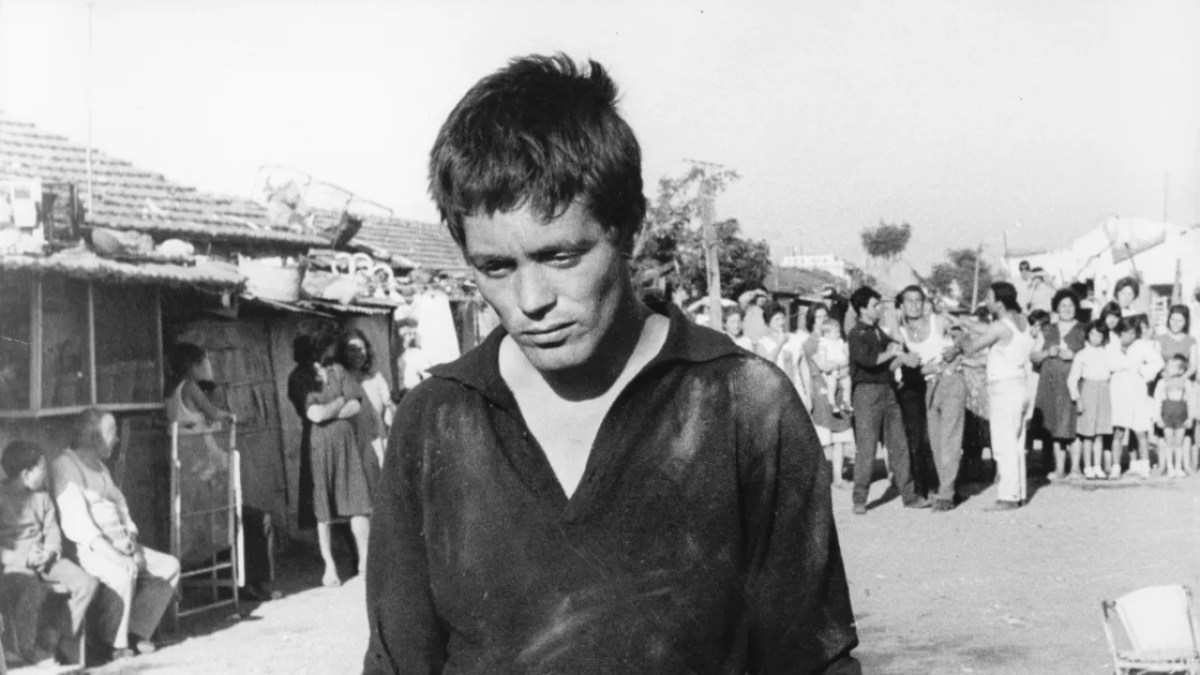
A pimpish young man who finds labour work to be ideological suspect tries to make ends meet by manipulating his lovers into sex workers in Pasolini’s harsh, unflinching debut feature, as his talky ‘neo-neorealist’ film offers a stinging commentary on Italy’s social and moral disintegration.
Review #3,075
Dir. Pier Paolo Pasolini
1961 | Italy | Drama | 117min | 1.37:1 | Italian
PG (passed clean) for some sexual references and coarse language (*Ought to be PG13)
Cast: Franco Citti, Franca Pasut, Silvana Corsini, Paola Guidi, Adriana Asti
Plot: A pimp with no other means to provide for himself finds his life spiralling out of control when his prostitute is sent to prison.
Awards: Nom. for Best Foreign Actor (BAFTAs); Official Selection (Venice)
Source/Distributor: Compass Film
Accessibility Index
Subject Matter: Moderate – Morality & Society; Working-Class; Prostitution
Narrative Style: Straightforward
Pace: Slightly Slow
Audience Type: Slightly Arthouse
Viewed: Criterion Blu-ray
Spoilers: No
I first saw Pier Paolo Pasolini’s debut feature, Accattone, when his retrospective was presented in Singapore back in 2014 (sans his final two features, Arabian Nights (1974) and Salo, or the 120 Days of Sodom (1975), which were still unceremoniously banned).
The festival played it on a scrappy DVD, which I thought was disrespectful to the audience. Because of the woeful presentation, I didn’t really get much out of it at the time. Twelve years later, I find myself revisiting it, now in a brand new 4K restoration, and it feels like encountering an entirely new film.
Starring Franco Citti as the titular character, Accattone charts the fatalistic path of a small-time pimp whose life spirals out of control when his injured prostitute is sent to prison for intentionally giving false testimony.
Citti, in his acting debut, clocked a BAFTA nomination for Best Foreign Actor. His performance is raw and carries much of the film, as his character exploits women for monetary gains, if only to survive in a merciless postwar Italy. He is perpetually starving, but finds labour work to be ideologically suspect.
His friends, equally hungry but who have more respect for each other, treat him as an outcast among outcasts. In fact, it has been said that the term ‘Accattone’ in Roman dialect refers to someone who lives off begging and petty crimes, and is even despised by criminals.
“Either the world kills me, or I kill it.”
Pasolini shows his writing-directing strengths from the onset, with Accattone functioning as a character study and a stinging commentary on the disintegration of Italy’s social and moral institutions, as reflected by Citti’s pimpish characterisation, and his manipulation of lovers into sex workers.
Shot in black-and-white, the film echoes the aesthetics and themes of Italian neorealist films from the prior decade—of poverty, class struggle, and fatalism.
But unlike such films as De Sica’s Bicycle Thieves (1948), where an emotional warmth permeates, Accattone has a very harsh tone and is bereft of hope. Even religion cannot provide salvation, as Pasolini slyly hints in several scenes. As such, it might feel rather challenging to connect to anyone’s plight, however dire. Some have called this ‘neo-neorealism’.
There are, however, moments of surreal interludes, as Accattone daydreams about the spectre of death hanging over him. Much of the film is also rather talky, though I don’t find the dialogue particularly engaging, even if some of the more caustic exchanges are mildly amusing.
When Accattone premiered in Rome, a neo-fascist group attacked the audience and damaged the cinema, a foreshadowing of even more controversy to come with Pasolini’s later films, and the brutal violence that would ultimately end his life fourteen years later.
Grade: B+
Trailer:
Music:


[…] Accattone (1961) […]
LikeLike
[…] Accattone (1961) […]
LikeLike