








Revolutionary, overrated, or somewhere in between, Welles’s extraordinary debut turns power, ego, and misery into an enigmatic cradle-to-grave portrait of a larger-than-life figure—‘European’ in its artistic style, but fiercely American in its spirit of derring-do.
Review #3,079
Dir. Orson Welles
1941 | USA | Drama, Mystery | 119min | 1.37:1 | English
PG (passed clean)
Cast: Orson Welles, Joseph Cotten, Dorothy Comingore, Ray Collins, George Coulouris
Plot: Newspaper magnate Charles Foster Kane is taken from his mother as a boy and made the ward of a rich industrialist. As a result, every well-meaning, tyrannical or self-destructive move he makes for the rest of his life appears in some way to be a reaction to that deeply wounding event.
Awards: Won 1 Oscar – Best Original Screenplay. Nom. for 8 Oscars – Best Picture, Best Director, Best Leading Actor, Best Cinematography, Best Editing, Best Art Direction, Best Original Score, Best Sound
Distributor: Warner
Accessibility Index
Subject Matter: Moderate – Cradle-to-Grave Portrait; Larger-than-life; Power & Ego
Narrative Style: Slightly Complex
Pace: Normal
Audience Type: Slightly Mainstream
Viewed: Criterion 4K Blu-ray
Spoilers: No
For a long time, I appreciated Citizen Kane, but didn’t think it was that good. Don’t trust anyone who says it’s the greatest film ever made (‘greatest’ is an absurd notion when set against the vast tides of history); heck, it’s not even Orson Welles’s most accomplished work in my opinion.
For sure, it was an extraordinary feature debut by a hotshot in his mid-twenties, who proclaimed to Hollywood, with visual and aural flamboyance, that he was a force of reckoning that would shake up the industry, after influential stints in theatre and radio.
In fact, much of Citizen Kane didn’t quite feel like a typical Classical Hollywood entry, though it had since been co-opted into that fertile golden age of American filmmaking as a breathtaking anomaly. Some have argued that it was more ‘European’, artistically speaking, and perhaps a foreshadowing of Welles’s exilic journey to that very continent by the end of the ‘40s.
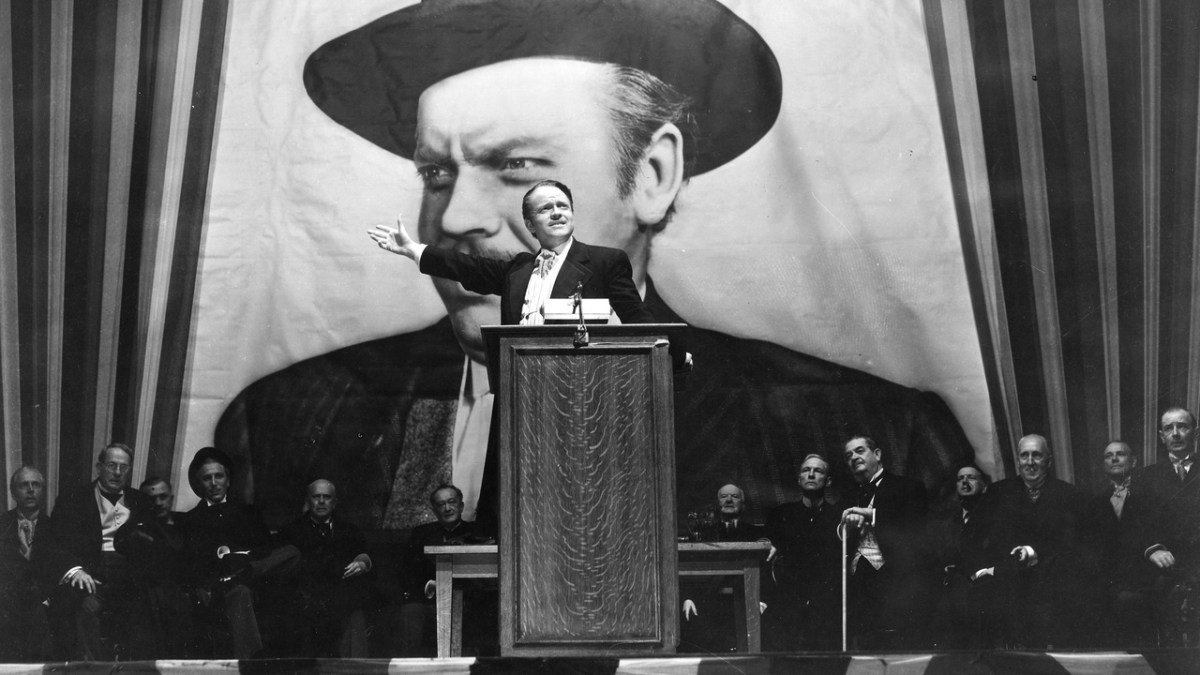
At its heart, Citizen Kane is very much American in spirit, featuring a larger-than-life figure whose cradle-to-grave story, both the public successes and private ruinations, is told in an enigmatic non-linear structure.
Fictional, though loosely based on newspaper publishing tycoon William Randolph Hearst (who detested Welles’s film to the ends of the world), Charles Foster Kane was played by Welles himself, which, considering all the film’s remarkable aspects, arguably still is the one least talked about.
“I am, have been, and will be only one thing – an American.”
His performance embodied the double-edged sword of unchecked American power, or as Cuban novelist and critic Guillermo Cabrera Infante wrote in a 1958 article: Kane was a “… smiler with a knife under the capitalist cloak, the new baron with a right of first flower over thought…”
It is hard to find any sympathy for a character whose punishment had been self-inflicted, a ballooning figure of misery and bitterness. Yet, the genius of Welles was in asking us to disavow any emotional attachment to his protagonist; instead, we ‘feel’ for Kane vicariously through others who loved and despised him.
With inventive cinematography by Gregg Toland, whose play with light and shadow, and more specifically, long takes and deep focus photography, left French critic Andre Bazin waxing lyrical about putting faith in ‘realism’, there is much to marvel at in Citizen Kane’s film language.
It’s also a visual effects-heavy film, a stunning showcase of everything from optical illusions, matte paintings, fake newsreels, and even a shrieking cockatoo that might be the first jump scare ever in a non-horror picture. Revolutionary, overrated, or somewhere in between, Welles’s immortal work will continue to be philosophised and scrutinised for a very long time.
Grade: A
Trailer:
Music:
 Eternality Tan
[…] Citizen Kane (1941) […]
LikeLike
[…] Citizen Kane (1941) […]
LikeLike
[…] Citizen Kane (1941) […]
LikeLike
[…] Citizen Kane (1941) […]
LikeLike
[…] Citizen Kane (1941) […]
LikeLike
[…] Citizen Kane (1941) […]
LikeLike