







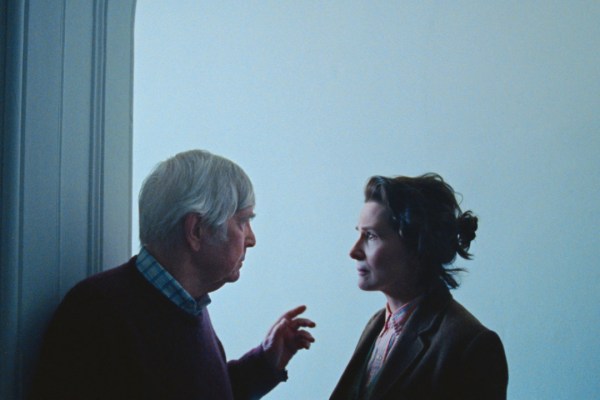

Complex, abstract and utterly existential, Resnais’ first feature in colour deals with the past, present and future as battlegrounds of half-truths, and edited in a fragmented ‘shards-like’ style, as a woman’s ex-lover pays her a visit.
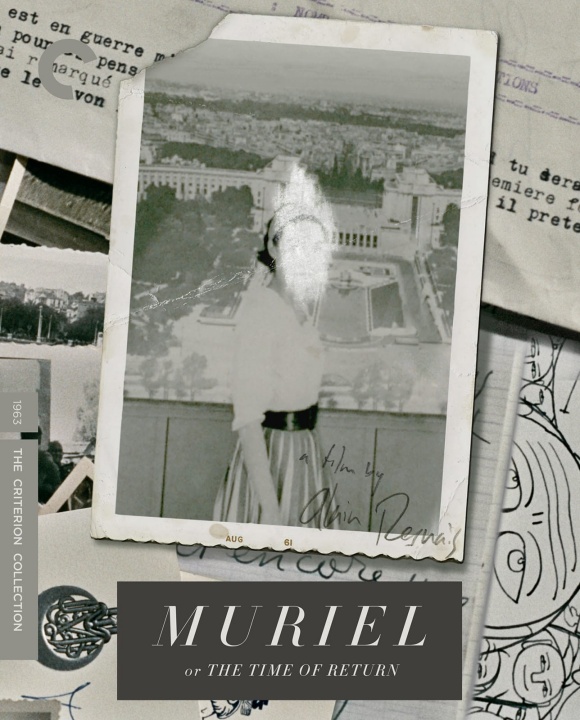
Review #2,951
Dir. Alain Resnais
1963 | France | Drama | 116min | 1.66:1 | French
Not rated – likely to be PG13 for some thematic material
Cast: Delphine Seyrig, Jean-Pierre Kerien, Jean-Baptiste Thierree, Nita Klein, Claude Sainval
Plot: In Boulogne-sur-Mer, the past of widowed antique shop owner Helene comes back to haunt her when a former lover reenters her life. Meanwhile, her stepson Bernard is tormented by his own ghosts, related to his service in France’s recently ended war in Algeria.
Awards: Won Best Actress & Nom. for Golden Lion (Venice)
Source: Argos Films
Accessibility Index
Subject Matter: Time & Memory; Past Traumas; Existence
Narrative Style: Complex
Pace: Slightly Slow
Audience Type: General Arthouse
Viewed: Criterion Blu-ray
Spoilers: No
A follow-up to Hiroshima mon amour (1959) and Last Year at Marienbad (1961), two of the most enigmatic films of the French New Wave, Muriel, or the Time of Return was Alain Resnais’ first feature in colour.
It was shot with rare organic warmth by the renowned cinematographer Sacha Vierny, whose later collaborations included the works of Luis Bunuel (Belle de jour, 1967), Andrzej Zulawski (The Public Woman, 1984), and particularly Peter Greenaway (The Cook, the Thief, His Wife & Her Lover, 1989).
Resnais, however, didn’t let Vierny’s images linger on for long, as his ‘shards-like’ editing style gave us a film even more fragmented than anything Godard had ever done.
But that is the point of Muriel, as elusive and ambiguous a picture as any in its treatment of time and the spatial-temporal uncertainties associated with depicting psychological realities.
Helene (Delphine Seyrig in a Venice Best Actress performance) is an antique furniture saleswoman who works from home, living together with her stepson Bernard, who remains haunted by his time fighting in the Algerian War.
“What’s the time?”
When Alphonse, Helene’s ex-lover from the WWII period, pays a visit to the beautiful seaside town of Boulogne where she resides, past, present and future become battlegrounds of half-truths.
In fact, the Battle of Boulogne in 1940 was one of the key battles that defended the fishing port from the unfortunately successful German invasion.
Resnais took pains to include montages of the urban landscape, as old and new architecture combined to give a sense of ambivalence—a locale that seemed to be unable to move forwards or backwards in time.
Scarred by the two wars the French were involved in, physical building defects become manifestations of wounded souls; at the same time, new constructions become alien blemishes that threaten to erode history. The titular ‘Muriel’, implied to be an Algerian victim of torture, is also never seen.
Resnais took all of these—elusive spectres, psychological afflictions, painful memories, and the inability to find oneself in a place and time that was transforming—and fashioned one of his most complex if abstract existential treatises in his filmography.
Grade: A-
Trailer:

