




Product Review – BenQ W2700 4K HDR Home Projector (Part 1)

PART 1: OUT OF THE BOX AND INTO 4K

Reviewed by Michael Lim, Filmmaker & Curator

(Part 2 of the article is available here)

Joining the range of the latest BenQ projectors is a recent model released a few months back to much fanfare – the BenQ W2700. The BenQ W2700 is the next level up from the previous model W1700 which I reviewed last year. It is more of an upgrade with new improvements that make the W2700 stands out even more, enabling BenQ to be the No. 1 4K projector brand in 2019 in Asia-Pacific with the biggest market share (according to BenQ).

Out of the box, we can already experience a refreshed look with a brand new design which is sure to please. I like the new rectangular capsule design which looks modern and sleek to fit any home and its polished front panel finishing as well. The new back panel places all the inputs and outputs strategically all in one row conveniently.

One particular new little feature which is minor but important is that there are now 2 HDMI 2.0 ports to support two inputs for 4K. Previously, the W1700 could only handle one 4K and one full HD input separately. With this new model, both HDMI inputs now support 4K which is a nice touch. Another port of interest is the USB 3.0 port, which is also a media player, making it convenient to play 4K content directly to the projector.

One new feature on the W2700 is the ability to raise a cover over the lower portion of the lens (see below), which will reduce reflections from a table surface or, if ceiling mounted, from reflective ceilings to ensure the best possible image quality. Weight-wise it is almost the same as the W1700 at 4.2kg.

w2700 1

More importantly, from the moment I hit the start button, that’s when things get exciting. The power-up speed has been improved from the W1700 as the lamp powers up. The menu design is more or less the same as that of the W1700, which makes it an easy upgrade to operate. One hopes in future versions that BenQ may improve on its menus to include perhaps apps to include streaming content but that’s only in my wish list.

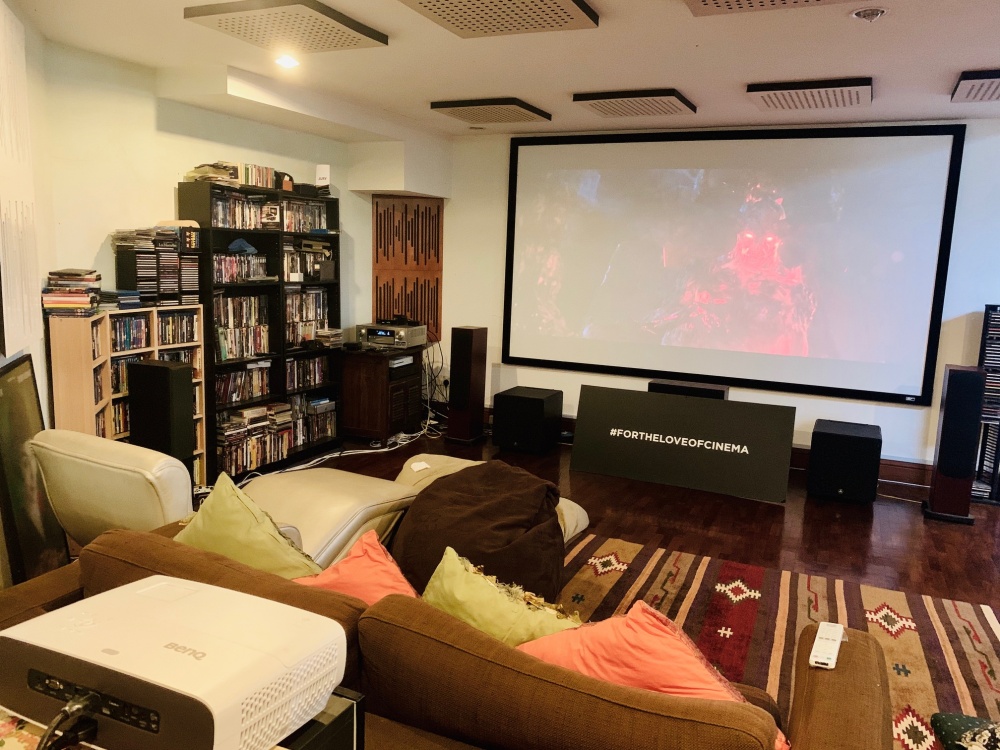
As usual to view 4K HDR content, you need the appropriate 4K HDR-supported equipment. In my viewing room, I am using the Oppo 203 as my 4K Ultra-HD source player. In my previous review, I used an Xbox One S. It was a simple swap around between the W1700 and W2700 in the setup. In fact, the BenQ is the No.1 short-throw 4K home projector in the market according to BenQ. It is an easy swap for those who have a 1080p projector*.

*BenQ W1070/W1070+/W2000/W1110/W1090

This means that users of those models can do an immediate swap around with minimum fuss or without even changing ceiling mounts – this is excellent news for upgraders. There’s also a vertical shift and 1.3 zoom for the lens with auto keystone to help as well.

w2700-front

PICTURE QUALITY
I was quite surprised as to whether I would be able to detect any significant picture differences between the BenQ W1700 and W2700. In comparison, the W2700 has slightly less lumens of 2000 compared to the W1700 which has 2200, but more significantly it was the added contrast ratio of 30,000: 1 that gives the pictures a greater punch along with the CinematicColour with 95% DCI-P3. I will get to more tech specifications in Part 2 of this article.

The degree of black reproduction has definitely improved and colours appear more vivid in range than the W1700, which is saying a lot since that for me was already a benchmark for an entry level 4K projector.

I used the UHD of Mission Impossible: Fallout as a reference video for my viewing. The projector handled the subtle nuances of the black areas in the halo jump sequences quite nicely, and bright day action scenes such as the motorcycle chase in Paris looked stunning. The colour reproduction came close to what I recollected when I first viewed the movie at the cinemas as well. The HDR 10 was very effective. The UHD also has a well-mixed Dolby Atmos track to accompany the visuals as well which is decoded by my slightly older Denon receiver in 11.2.

Christopher Nolan’s Dunkirk was another reference UHD which I used. The beach scenes were very detailed and I could almost see and feel the grains of sand on the beach. Flesh tones were quite even throughout.

One drawback of the projector was that I found the fan noise a little noisy although it is within acceptable range. I didn’t use the internal speakers during the initial testing but there are two 5W speakers placed at the back which sounded better than the W1700.

w2700

OVERALL IMPRESSION
The BenQ W2700 is definitely a well thought of advancement over the W1700. The design of the projector, picture quality and colour reproduction have been improved . Overall, BenQ has done once again an excellent job of looking after improving its projector and I can look forward to seeing what they plan to do in the future as well.

It is slightly more expensive than the W1700 but well worth the price if it is in your budget range. Currently it is retailing at SGD$2,699 in Singapore. However, if that’s still above your price point, the BenQ 1700 is still available at a lower price.

I will be reviewing some of the other features of the projector including the 3D function as well as writing in more detail about the CinematicColour 95% DCI-P3 and what it means in Part 2 of this article.


Outguess ET 2019 – Oscar Prediction Contest

The 6th Outguess ET Oscar Prediction Contest is back!

I will share my predictions on the weekend of 23-24 Feb. The Oscars ceremony will be shown live on the morning of 25 Feb (SGT).

Instructions:

  1. Open to people residing in Singapore only.
  2. Copy and paste the below categories onto a Word document.
  3. Indicate clearly for each category whom you think will win the Oscar (‘Will Win’) and one dark horse (‘Dark Horse’).
  4. Submit the Word document to eternalitytan@gmail.com with the subject header ‘Outguess ET 2019’ latest by 22 Feb, 11:59pm.

How to win:

  • Predicting correctly ‘Will Win’ earns 3 points
  • Predicting correctly ‘Dark Horse’ earns 1 point.
  • Score more points than me. A tie doesn’t count.
  • If there is more than one winner, the participant who submitted his or her predictions earlier (based on email time-code) will win.

If you win, choose one of the following prizes:

  • Prize A (worth USD20) – 1x Amazon Gift Card
  • Prize B (worth SGD30) – 1x Criterion Collection Blu-ray
  • Prize C (worth SGD25-35) – up to 5x DVDs from my Carousell page

Here are the categories in contention:
Best Picture
Best Foreign Language Feature
Best Animated Feature
Best Documentary Feature
Best Director
Best Leading Actor
Best Leading Actress
Best Supporting Actor
Best Supporting Actress
Best Original Screenplay
Best Adapted Screenplay
Best Cinematography
Best Film Editing
Best Production Design
Best Costume Design
Best Hair & Makeup
Best Original Score
Best Original Song
Best Sound Mixing
Best Sound Editing
Best Visual Effects
Best Live Action Short
Best Animated Short
Best Documentary Short

Have fun and good luck!

Waltz with Bashir: An Inquiry into Reality

(Written in 2009, and first published 25 Dec 2009)

The Film
First premiered at Cannes in May 2008, Waltz with Bashir subsequently won a Golden Globe for Best Foreign Language Film and earned an Oscar nomination in a similar category.

Directed and written by Ari Folman, an Israeli who is not exactly prolific in his work, Waltz with Bashir is only his third film in 12 years after Clara Hakedosha (1996) and Made In Israel (2001).

Continue reading →

Musings #2: 5 Great Singaporean Films of the 2010s (so far…)

(This article was first published for CatchPlay on 7 Aug 2017)

The 2010s has been a strong decade for Singapore cinema, with the emergence of younger talented filmmakers, and established voices holding the fort. We are probably witnessing the biggest wave in recent years, not just because of the work of one or two trailblazers, but a group of directors whose eclectic output suggests an assured future for our country’s increasingly vibrant film industry. This article traces five key Singaporean films—and great ones to boot—of the 2010s, well, so far…

Continue reading →

“Hero”: Placing Asian Cinema Within National and International Boundaries

(Written in 2013, and first published on 1 Jan 2014)

Zhang Yimou remains to be the most famous of mainland Chinese filmmakers working today, yet his greatest works were made during the early phase of his career in the early 1990s with critically-acclaimed sociopolitical films such as Ju Dou (1990), Raise the Red Lantern (1991) and To Live (1994).

In 2002, two years after the international success of Crouching Tiger, Hidden Dragon (2000), Zhang released Hero, his first-ever martial arts film starring some of the biggest names in Chinese cinema, including Jet Li, Tony Leung, Maggie Cheung and Zhang Ziyi.

Continue reading →

Musings #1: Commercial Censorship of Movies in Singapore

This personal opinion piece was first published on 10 February 2018.

UPDATE (as of 13 February 2018): Lady Bird will be released theatrically in M18 (Nudity & Sexual Scene) – Passed Clean

There are two main kinds of film censorship – artistic and commercial.  In Singapore, whenever there is Artistic Censorship (AC), we are happy to push the blame to our local classification (read: censorship) body. 

Almost all the time, the censors get it wrong.  There had been so many cases – too many to name.  Some cases were very infuriating, not least because it conflated political censorship with AC.  The most recent example was Radiance of Resistance (2016), pulled from the Singapore Palestinian Film Festival last month.

Continue reading →