





Visually stunning, contemplative and disruptive, Denis’ brilliant take on toxic masculinity—for men, and by men—revolves around one French Foreign Legion sergeant’s attraction and repulsion towards a new recruit.

Review #2,862
Dir. Claire Denis
1999 | France | Drama | 93 min | 1.66:1 | French
NC16 (passed clean) for some nudity
Cast: Denis Lavant, Michel Subor, Gregoire Colin
Plot: Foreign Legion officer Galoup recalls his once glorious life, training troops in the Gulf of Djibouti. His existence there was happy, strict and regimented, until the arrival of a promising young recruit, Sentain, plants the seeds of jealousy in Galoup’s mind.
Awards: Won Reader Jury of the Berliner Zeitung – Special Mention (Berlinale); Won KNF Award – Special Mention (Rotterdam); Nom. for Cinema of the Present – Lion of the Year (Venice);
Source: Lagardere Studios
Accessibility Index
Subject Matter: Moderate – Toxic Masculinity; Men Against Men; Jealousy & Desire; French Legionnaires
Narrative Style: Slightly Complex
Pace: Slightly Slow
Audience Type: Slightly Arthouse
Viewed: Criterion Blu-ray
Spoilers: No
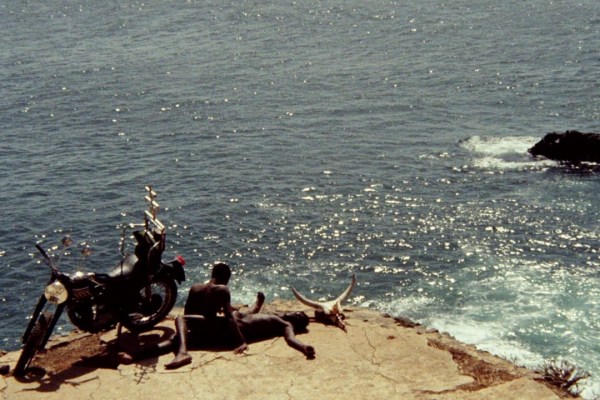
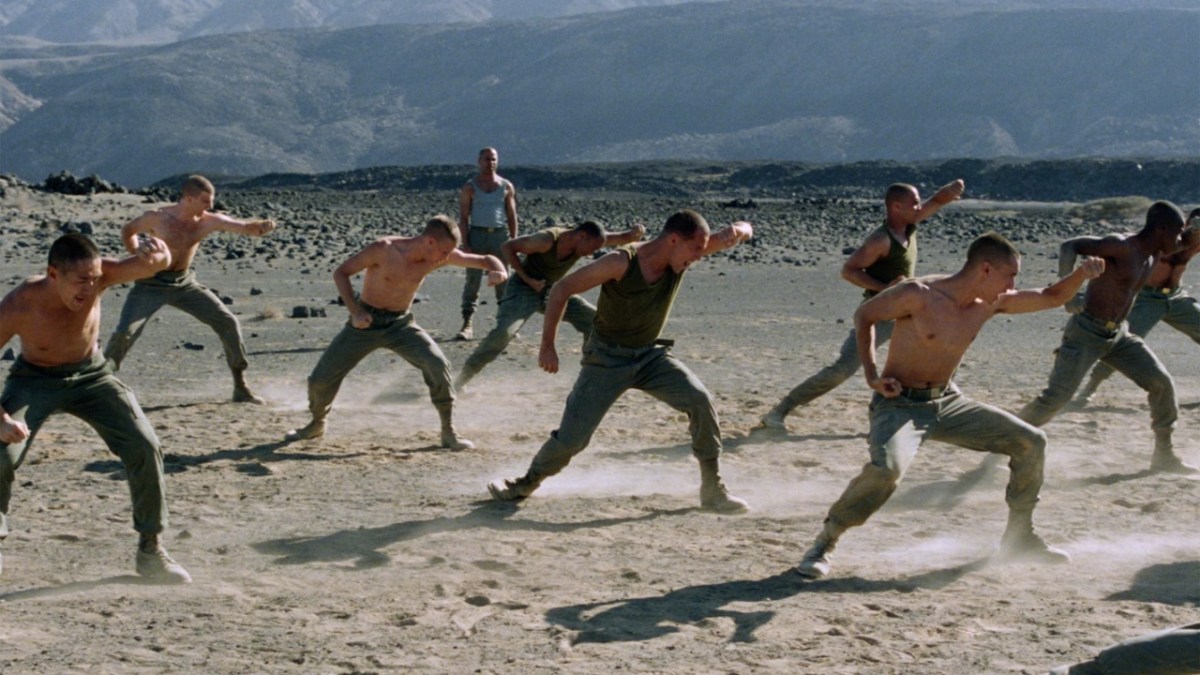
Soldiers train in a remote area in Africa. In this foreign land, and under disciplined and rigourous supervision, dark thoughts and emotions start to take shape in one of them.
That is all to Beau travail, but Claire Denis somehow wrings out something much more than just ‘plot’, which she has more often than not done so with natural skill in many of her films.
Some critics have called Beau travail a tone poem—sure, it’s tonal (even in the Eisenstein’s theories of montage sense) and poetic, but it is also reflective and a fever dream.
Denis Lavant plays Galoup, who recalls the time when he led a platoon of men in the French Foreign Legion in Djibouti. In this regimented unit, Galoup begins to feel something towards a new recruit who sparks jealousy in him.
At the same time, Galoup also strongly admires his immediate superior, but the latter rarely returns his gratitude, seeing Galoup as just another of his dispensable men.
“Maybe freedom begins with remorse.”
So he feels psychologically squeezed like a burnt patty in a burger (or perhaps just like any other mid-level manager facing pressures from above and below), and because of the strict codes of masculinity where hierarchy, power and dignity are precisely operationalised, Galoup has to resort to physicality (i.e. more training, more sweating, more body-to-body contact) to ‘vent’ his feelings.
In this sun-kissed environment of golden sands and azure waters, personal sentiment is best kept in check. Homoeroticism is kept to a minimum, hinted rather than expressively depicted or rejected, though Denis’ recurring use of a dark, aggressive operatic choir piece from Benjamin Britten (‘Excerpts from Billy Budd’) suggests both attraction and repulsion aren’t necessarily mutually exclusive.
As Beau travail deals with the effects of colonialism, we can also recognise how peculiarly anachronistic these ‘legionnaires’ are in the eyes of the locals, seemingly training for a non-existent war in an already independent country.
Considered a masterwork by most Denis aficionados, Beau travail is visually stunning, contemplative, and disruptive even, inasmuch as it deconstructs what it means to be a man trying to be a man in a man’s world. Or to put it in another way, it’s about toxic masculinity—for men, and by men.
Grade: A-
Trailer:
Music:
 Eternality Tan
[…] Beau travail (1999) […]
LikeLike
[…] Beau travail (1999) […]
LikeLike
[…] right after Beau travail (1999), which has long been considered essential viewing in Claire Denis’ remarkable filmography, […]
LikeLike