



This Venice Golden Lion winner is a powerful treatise on the plight of women in Iran, told through a refreshing bead-like narrative and shot in neorealist style.
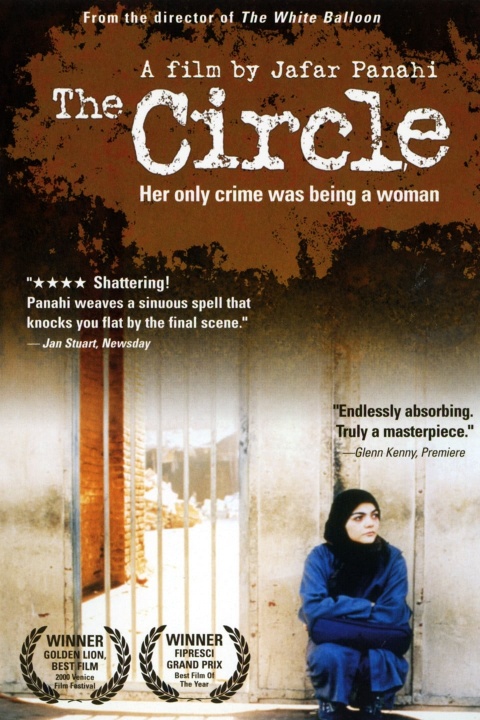
Review #1,367
Dir. Jafar Panahi
2000 | Iran | Drama | 91 min | 1.85:1 | Persian
PG (passed clean) for some mature themes
Cast: Maryiam Palvin Almani, Nargess Mamizadeh, Mojgan Faramarzi
Plot: Various women struggle to function in the oppressively sexist society of contemporary Iran.
Awards: Won Golden Lion, FIPRESCI Prize & Best Actress (Venice)
International Sales: Celluloid Dreams
Accessibility Index
Subject Matter: Moderate – Oppression of Women; Sexism
Narrative Style: Straightforward
Pace: Slightly Slow
Audience Type: Slightly Arthouse
Viewed: DVD
First Published: 13 Nov 2016
Spoilers: No
Before Taxi Tehran (2015), which won the Golden Berlin Bear, The Circle was director Jafar Panahi’s most highly-awarded work with a Golden Lion win at the Venice Film Festival in 2000.
It certainly is one of his most piercing films, a firing shot of sorts that reverberates with a resounding ring-in-the-ear in its no-holds-barred treatise on the plight of women in Iran.
As the beginning credits roll, we hear the painful cries of a woman giving birth, before the wonderful cries of the baby fill the air with momentary joy. It is also a moment of truth. The woman receives news that it is a girl, and it seems like the world has just crumbled in front of her.
It is an unforgettable opening as it attempts to reveal through unforgiving circumstances the state of women’s existence in a repressive country policed by men.
There’s no doubt that Panahi is a superb director. Shot in a neorealist style with a raw aesthetic, the camera traverses the streets and buildings of a city in Iran, following the little stories of women caught in predicaments, be they slight or serious, and almost always centering on their inability to function as normal human beings except through clandestine means.
Panahi’s women in The Circle may take on a more extreme depiction—most are on the run from prison (where they are kept for some time for ‘crimes’ that men would normally get away with), as they struggle on the streets without an ID.
But they have social support from each other, their circle as it were, silently defiant in the face of authority and being an agent of their own limited freedom.
The movie title also suggests a like-for-like replacement in an ever-growing ring of disenfranchised women. One escapes, but another is captured. The walls of captivity become borderless; it is merely a prison in a larger prison.
This is why it is a shrewd strategy by Panahi to adopt a bead-like narrative structure, as he follows the story from one woman to another.
The Circle remains to be a controversial work in modern Iranian cinema, and with his follow-ups Crimson Gold (2003) and Offside (2006), the left-leaning filmmaker would continue his social realist modus operandi for many years to come.
Even his subsequent house arrest in 2011 and a 20-year ban from filmmaking yielded several more superb slyly political films.
Grade: A-
Trailer:


Great reviews as always. I have not heard of this movie before but your review has definitely given me a reason to check it out. I appreciate Iranian movies and over the last few years have become especially impressed with the work of Asghar Farhadi. Farhadi’s films offer an insightful glimpse at the cultures of Iran. For instance, the plot of “The Circle” reminds me a lot of Farhadi’s movie “A Separation”. It tells a similar story capturing the plight of women in Iran that face devastating separations. I absolutely loved “A Separation” and consider it to be one of the greatest foreign movies ever made. I don’t normally find time to watch foreign movies these days but will definitely keep “The Circle” on my watchlist of films to see. Thanks for the recommendation.
Here’s why I loved “A Separation”:
LikeLike
Farhadi’s body of work is certainly exceptional. I particularly love Fireworks Wednesday, About Elly and A Hero.
LikeLiked by 1 person
I like a lot of Jafar Panahi movies, but I haven’t seen this one yet.
LikeLike
I see… He’s one of my contemporary world cinema heroes. I still have a few of his earlier works yet to catch.
LikeLiked by 1 person
Absolutely. I’ve enjoyed everything I’ve seen from him so far. Same here about his older works I haven’t seen yet.
LikeLiked by 1 person