







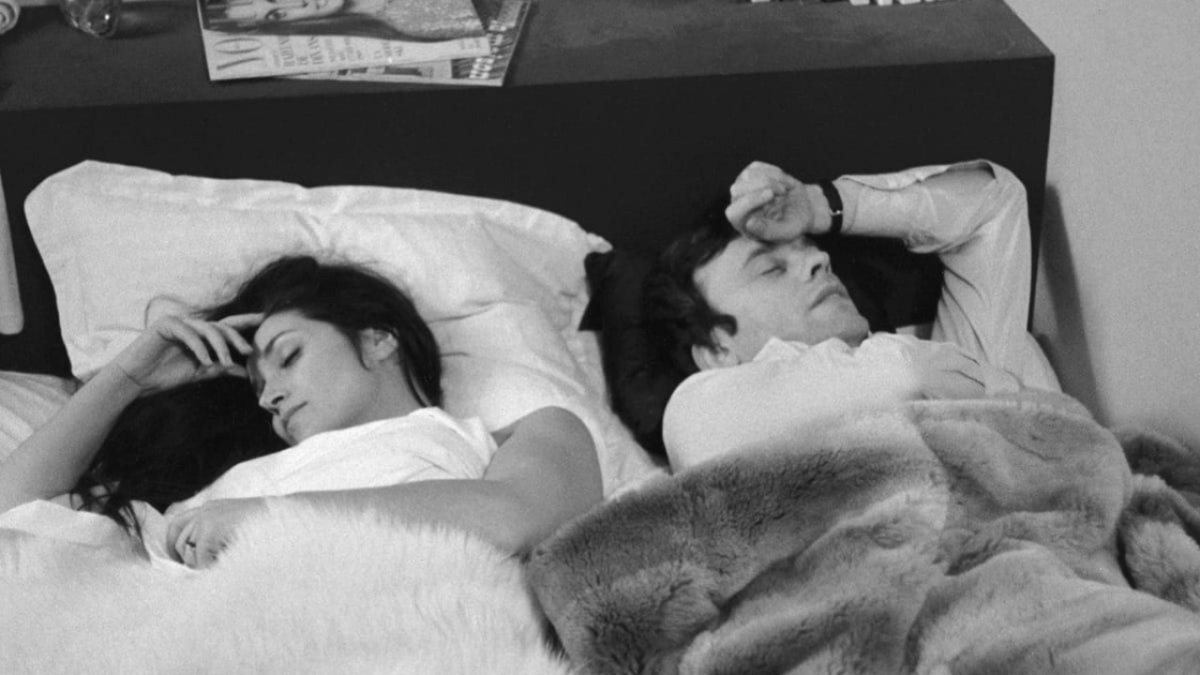
Rohmer’s Oscar-nominated international breakthrough sees a reticent Catholic man navigate Pascal’s wager, sexual temptation and self-doubt during a wintry night of talk with a seductive divorcee, shot in striking black-and-white by Nestor Almendros.

Review #3,040
Dir. Eric Rohmer
1969 | France | Drama, Romance | 111min | 1.37:1 | French
PG (passed clean) for some sexual references
Cast: Jean-Louis Trintignant, Francoise Fabian, Marie-Christine Barrault, Antoine Vitez
Plot: A devout Catholic man’s rigid principles are challenged during a one-night stay with Maud, a divorced woman with an outsize personality.
Awards: Nom. for Palme d’Or (Cannes); Nom. for 2 Oscars – Best Foreign Language Film & Best Writing
Distributor/Source: Les Films du Losange
Accessibility Index
Subject Matter: Moderate – Love & Relationship; Religion & Temptation
Narrative Style: Straightforward
Pace: Slightly Slow
Audience Type: Slightly Arthouse
Viewed: Criterion Blu-ray
Spoilers: No
My Night at Maud’s was something of an international breakthrough for French New Wave icon Eric Rohmer, with two Oscar nominations for Best Foreign Language Film and Best Writing, speaking to how the film was accessible to Stateside audiences who, at the time, were contending with the bold and uncompromisingly fertile ground that was New Hollywood.
At the same time, Rohmer’s work also prefigured the cultural impact of American filmmaker Woody Allen, particularly his post-Annie Hall (1977) phase, insofar as both auteurs shared a similar modus operandi—films filled with wall-to-wall conversational dialogue, philosophical and existential musings, and the complexity of human relationships, though most of Allen’s movies tend to operate more whimsically (or crudely) as comedies.
My Night at Maud’s sees Rohmer channelling the everyday hopes and anxieties of men and women. In this case, Jean-Louis Trintignant plays an unnamed man (let’s call him Jean-Louis) who chances upon a woman, whom he thinks is wife material, during mass in the local Catholic church.
He also has a chance encounter with a friend he hasn’t seen for more than a decade, who asks Jean-Louis to join him at the apartment of his on-off lover, Maud.
“Sometimes it’s better that things be impossible.”
Maud is an unabashedly seductive divorcee, and with Jean-Louis being a staunch Catholic, the cold, wintry night of conversation about everything, from mathematician-philosopher Blaise Pascal’s famous ‘wager’ theory to ‘morals’ and ‘chances’, becomes laden with sexual tension that only Rohmer could deliver without resorting to the kind of sordid dialogue that, say, Allen’s films primarily relied on.
As such, My Night at Maud’s beautifully crystallises the precarious balance between risky self-agency and crippling stasis that Man is continually burdened with.
Shot in striking black-and-white in Clermont-Ferrand (also the birthplace of Pascal) by Nestor Almendros (who first worked with the director in 1967’s La collectionneuse), this third of Rohmer’s six moral tales has the quality of a lived-in experience, with its intimist approach perhaps most sharply depicted here than in any other work of his.
My Night at Maud’s is about the spectacle of life in its smallest moments—as the reticent Jean-Louis decides on what the future will bring, he must also connect all the dots of probabilities and say the right thing at the right time.
Grade: A-
Trailer:
 Eternality Tan