
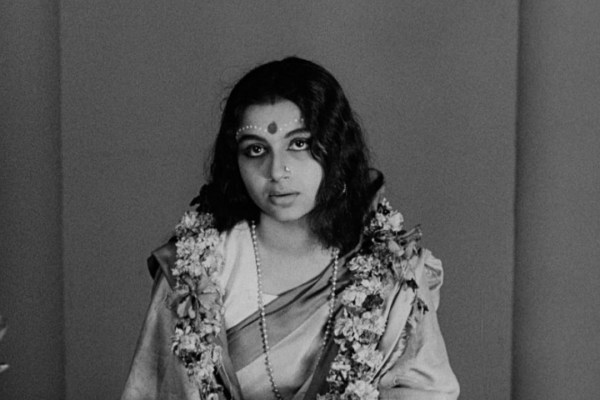






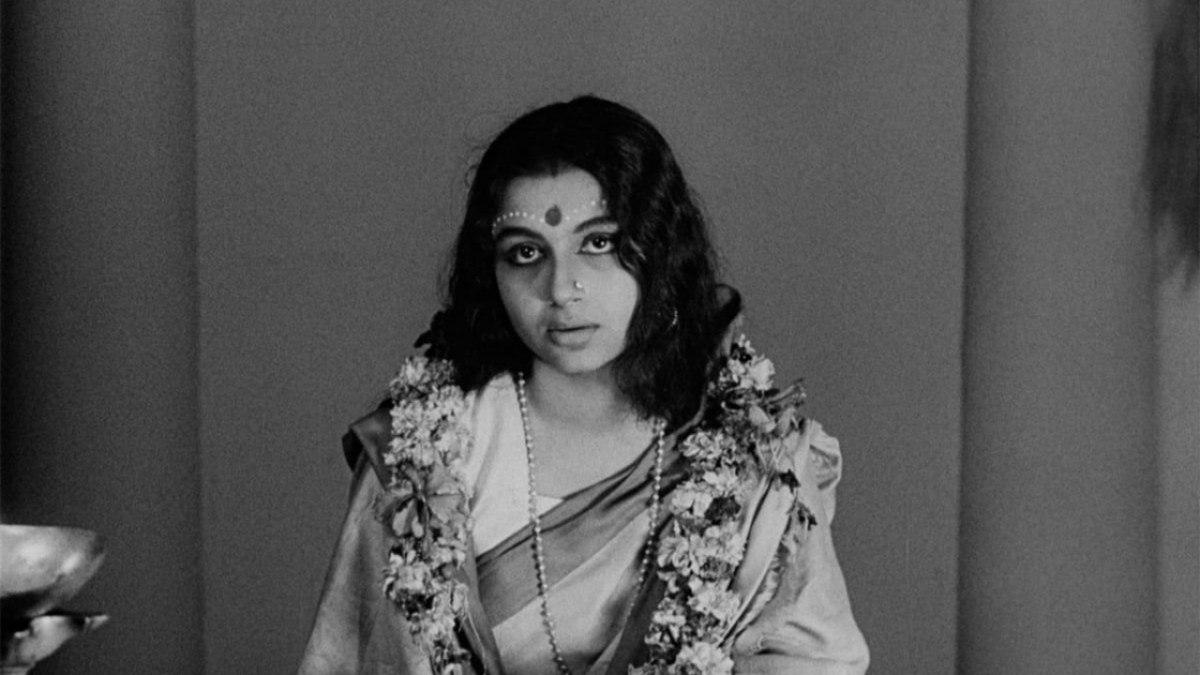
A family patriarch is convinced after a night’s dream that his daughter-in-law is the incarnation of the Goddess Kali, in Ray’s quietly devastating attack on religious dogma, with 15-year-old Sharmila Tagore’s haunting gaze at the center of a tug-of-war between blind faith and rationalism.

Review #3,070
Dir. Satyajit Ray
1960 | India | Drama | 99min | 1.37:1 | Bengali
Not rated – likely to be PG13 for some mature themes
Cast: Sharmila Tagore, Soumitra Chatterjee, Chhabi Biswas, Karuna Banerjee, Purnendu Mukherjee
Plot: A devout upper-class Hindu has a vision in a dream that his daughter-in-law is the human incarnation of the Goddess Kali and begins worshipping her.
Awards: Nom. for Palme d’Or (Cannes)
Source/Distributor: Chhayabani Pte Ltd
Accessibility Index
Subject Matter: Moderate – Tradition vs. Modernity; Blind Religious Faith; Rationalism; Psychological Oppression
Narrative Style: Straightforward
Pace: Slightly Slow
Audience Type: Slightly Arthouse
Viewed: Criterion Blu-ray
Spoilers: No
It’s comforting to get back to exploring more Satyajit Ray, and here we have, in the early phase of his career, Devi (also known as The Goddess), a film that tackles head-on the tension between deeply-rooted faith in religious salvation and more modern (and thus learned) understandings of mortality.
It’s the classic age-old tug-of-war between tradition and modernity, which Ray so wonderfully explored in his earlier landmark ‘Apu’ trilogy (1956-1959), and more astonishingly in my favourite Ray, The Music Room (1958).
Devi is decidedly less layered and lighter in plot, and thus a tad less rewarding in comparison, but what makes it still so memorable are two aspects for me: Firstly, thematically, it remains rich, thought-provoking, and psychologically intense—ingredients that elevate a work about the perils of blind faith into a tragedy of Greek proportions.
Played by Chhabi Biswas (who’s also blind to his whims and fancies in The Music Room), the family patriarch becomes hastily convinced after a night’s dream that his daughter-in-law is the incarnation of the Goddess Kali. He sets out to subject her to worship, as throngs of villagers begin to believe through word-of-mouth that she could heal people with incurable illnesses.
“No medicine has the power of the Goddess.”
This is where we come to the second aspect: 15-year-old Sharmila Tagore, who plays that poor woman with some of the saddest eyes in world cinema… that gaze outwards into seeming nothingness, like in a trance, possibly tormented, yet debilitatingly unsure—well, what if she really is a deity?
As the occasional silent tear rolls down her cheek, Tagore’s pitiful character also tells us something about the worst of ultra-religious men—even in the purported presence of the divine, they could still make a ‘goddess’ do anything for them.
Ray’s sly, political attack on the dogma of theology rears its ugly, demonic head as Devi careens into an inevitable denouement that does no one any good. The highly educated husband-son in the middle of it all, played with chronic perplexity by Soumitra Chatterjee, has little to guide him, least of all the rationalism that has profoundly marked his adult life.
Grade: A-
Promo Clip:
Music:
 Eternality Tan