







A couple discovers an underground subculture of car crash sexual fetishists in Cronenberg’s most transgressive work, an audacious masterclass of psychosexual filmmaking that portends the post-millennial existential despair and aberrant nihilism.

Review #3,052
Dir. David Cronenberg
1996 | Canada | Drama, Thriller | 100min | 1.66:1 | English
R21 (edited) for numerous explicit sex scenes
Cast: James Spader, Holly Hunter, Elias Koteas, Deborah Kara Unger, Rosanna Arquette
Plot: After getting into a serious car accident, a TV director discovers an underground subculture of scarred, omnisexual car-crash victims, and he begins to use car accidents and the raw sexual energy they produce to try to rejuvenate his sex life with his wife.
Awards: Won Jury Special Prize & Nom. for Palme d’Or (Cannes)
Distributor: Warner
Accessibility Index
Subject Matter: Mature/Disturbing: Sexual Fetishes; Car Crash; Existential Despair & Nihilism
Narrative Style: Slightly Complex
Pace: Normal
Audience Type: Cult Arthouse
Viewed: Criterion Blu-ray
Spoilers: No
The uncut version of the film was reviewed.
‘Sex drive’ is given new meaning in one of cinema’s most daring works, miserably derided at Cannes when it premiered, though it won a Jury Special Prize for its sheer audacity.
When Howard Shore’s sensual, if menacing, ambient electric guitar score begins, you know you’ll be spiralling down a perverse rabbit hole that is impossible to wake up from.
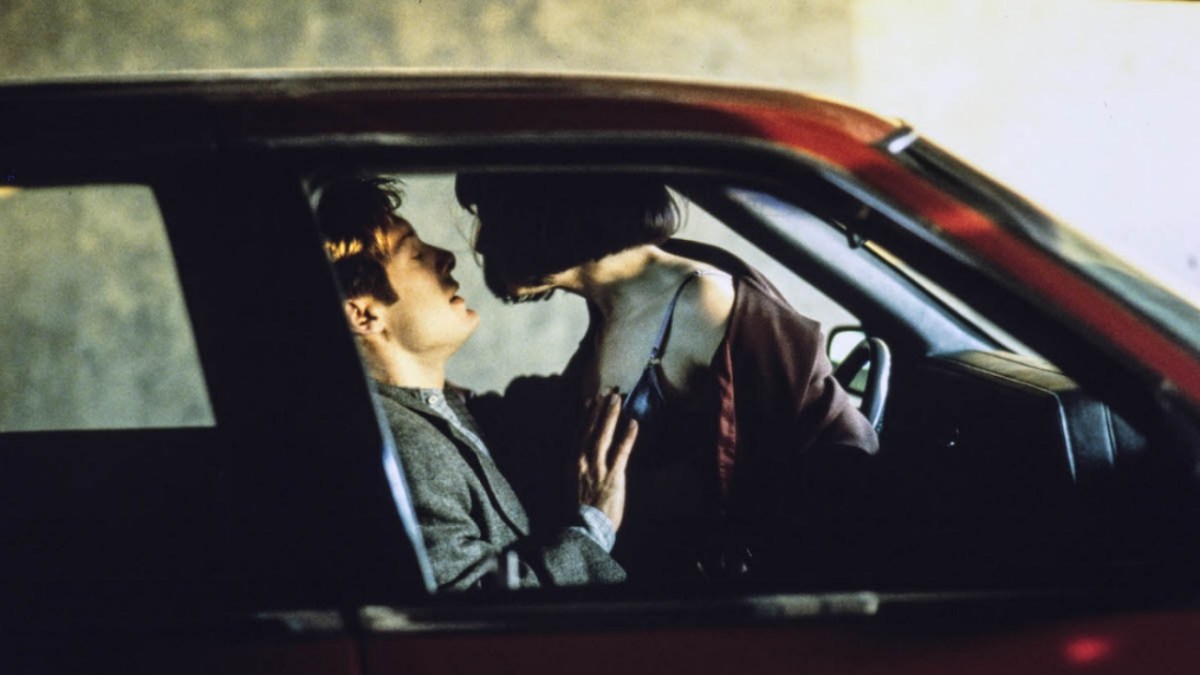
And indeed, director David Cronenberg opens the film with several sex scenes, showing a married couple separately having intimate encounters with strangers.
Played by James Spader and Deborah Kara Unger, we learn that their characters are having trouble enjoying their sex life, hence they agree to seek some kind of outside stimulus.
Their wish, however, is realised beyond their wildest dreams when Spader’s James unexpectedly gets into a car accident, leading him to meet Helen (Holly Hunter), who, in turn, leads him into an underground subculture of car crash sexual fetishists.
As provocative as it sounds, Cronenberg’s adaptation of J.G Ballard’s (of Empire of the Sun fame) 1973 novel gives cultists the film they so deserve—a transgressive work built upon a series of clinically-shot sex scenes and car crashes until it all conjoins in some psychosexual flesh-metal hybrid.
“Just fix it enough to get it rolling. Don’t clean it, don’t touch anything else.”
Over the decades, Crash has since developed some kind of formidable reputation as one of the greatest films of the ‘90s, portending the post-millennial existential despair that could only be deferred with more extreme doses of nihilistic content.
Seeing what’s readily scrollable and algorithmized on the web and socials today—full of the violent and sexual ‘stimuli’ that Ballard and Cronenberg not so much forewarned but foreclosed any prospect of salvation from—one could see Crash as both prophetic and highly disconcerting.
One wonders how Ballard’s work would be updated for the present moment, marked by self-driving Tesla cars and A.I. humanoids—what else can our fetishistic desires evolve into when metal is already the new flesh?
The invention of the gas-powered automobile roughly coincided with the birth of the cinema in the late 19th century. With this historical context in mind, Crash becomes, about a century later, its logical terminus.
No wonder, just a year later, the protagonist in Kiarostami’s Taste of Cherry (1997) decides to drive around to find someone willing to help him end his life—the car, once an emerging fixture of assembly-line capitalism, is now that reliable safe space for aberrant thoughts.
Grade: A
Trailer:
Music:
 Eternality Tan