





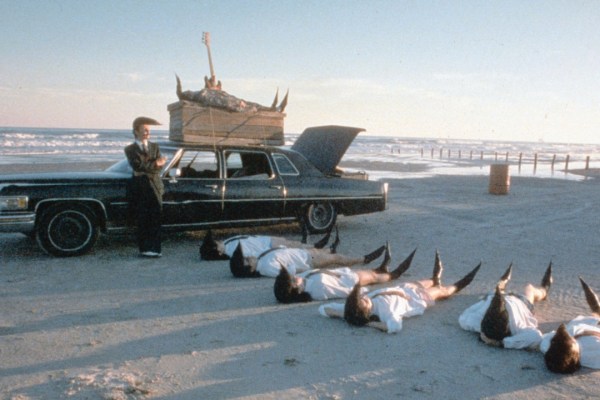

A narratological and tonal detour from his earlier output, Yang’s biting satire exposes the anxieties and hypocrisies of several young adults living in a modernising Taipei that has conditioned its people to celebrate the transactional and exploitative aspects of work, relationships and life.

Review #2,899
Dir. Edward Yang
1994 | Taiwan | Drama, Comedy, Romance | 125min | 1.85:1 | Mandarin & Min Nan
NC16 (passed clean) for some coarse language
Cast: Chen Shiang-Chyi, Chen Yi-wen, Danny Deng, Elaine Jin, Weiming Wang
Plot: Over the course of a few days, the paths of a group of young friends, lovers, and acquaintances in Taipei crisscross, prompting them to arrive at realizations about their lives.
Awards: Nom. for Palme d’Or (Cannes); Won 3 Golden Horses – Best Original Screenplay, Best Supporting Actor, Best Supporting Actress; Nom. for 9 Golden Horses – Best Feature Film, Best Director, Best Leading Actress, Best Cinematography, Best Film Editing, Best Art Direction, Best Makeup & Costume Design, Best Original Film Score, Best Sound Effects
Source: Kailidoscope / Taiwan Film and Audiovisual Institute
Accessibility Index
Subject Matter: Moderate – Friends & Lovers; Intertwining Lives; Art vs. Commercialism
Narrative Style: Slightly Complex
Pace: Slightly Slow
Audience Type: Slightly Arthouse
Viewed: Oldham Theatre (as part of the Edward Yang Retrospective)
Spoilers: No
Edward Yang’s lesser-known two films made in between A Brighter Summer Day (1991) and Yi Yi (2000) have seen new 4K restorations touring around the globe at various festivals.
With a full retrospective-cum-exhibition mounted by the Asian Film Archive till the end of the year, Yang’s achievements in cinema with just a handful of pictures will likely resonate with a new generation of cinephiles.
A Confucian Confusion is a narratological and tonal detour from his more serious and weighty films but despite being positioned as a comedy—a biting satire no less—Yang’s blending of his observational style with lively dialogue reveals hard societal truths and unexpected pathos through the micro-dynamism of human interactions.
Here, he takes pains to expose the anxieties and hypocrisies of several young adults living in a modernising Taipei. Whether friends, colleagues, family, lovers or just acquaintances, everyone is put to the ultimate test: how do we live a true life, without pretence? Which face should we show, and to whom?
“While I was reading your financial statement, I felt deeply moved.”
Considering this was a time when the widespread penetration of social media was at least a decade away, Yang shows what it might feel like to judge and perceive others—and be judged and perceived in return by those around us.
A Confucian Confusion works like a two-way mirror—we see some version of ourselves today (and from our past) in at least one of the characters in the multifarious ensemble cast.
More so than in any of his other films, Yang also makes salient points about the nature of art and art-making in a society conditioned to celebrate commercial triumphs.
As an interesting parallel, the moulding of human relationships could also be thought of as ‘art-making’, but when they are grounded in transactional and exploitative means rather than genuine care, it makes life confusing and hurtful to live. A Confucian Confusion crystallises all of that in what could be Yang’s most underrated work.
Grade: A
Trailer:
Music:
 Eternality Tan
[…] Confucian Confusion, A (1994) […]
LikeLike