





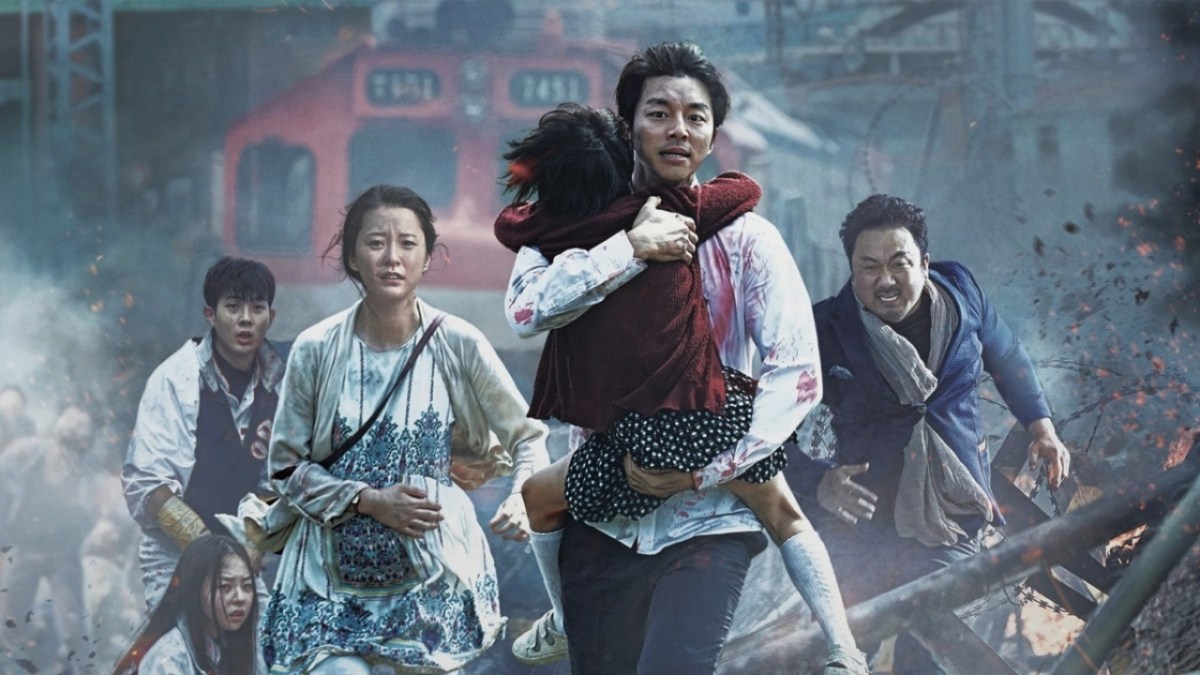
With generous doses of horror and comedy, though with some way-too-sappy scenes of melodrama, this ‘zombies-on-a-train’ flick is no doubt a crowd-pleasing marker of Asian blockbuster success.

Review #2,894
Dir. Yeon Sang-ho
2016 | South Korea | Action, Horror, Thriller | 118min | 1.85:1 | Korean & English
NC16 (passed clean) for violence
Cast: Gong Yoo, Kim Su-an, Jung Yu-mi, Ma Dong-seok, Choi Woo-shik
Plot: When a zombie virus pushes Korea into a state of emergency, those trapped on an express train to Busan must fight for their own survival.
Awards: Official Selection (Cannes)
International Sales: Contents Panda
Accessibility Index
Subject Matter: Moderate – Zombie Apocalypse; Survival; Selfishness vs. Selflessness
Narrative Style: Straightforward
Pace: Normal
Audience Type: Mainstream
Viewed: Netflix
Spoilers: No
It took me eight years to get to this. I can see why it became such a huge international hit; at the same time, it also laid down a legitimate marker for blockbuster success at a time when Asian commercial filmmaking had been making considerable inroads into the larger popular culture sphere.
While Bong Joon-ho’s Snowpiercer (2013), also set on a moving train in a far more dystopian world, was less successful, though spawning a much-talked-about series (2020-2024), the concept of entrapment with little possibility of escape is eternally intriguing but not new.
Train to Busan turns it into a high-octane thriller with generous doses of requisite horror and comedy. It is entertaining for sure, and for audiences who tend to read more into its critique on the worst of human behaviour in the most abject of circumstances, there is something in there to latch onto (and to feel angry about), though director Yeon Sang-ho rightly (for the sake of his audiences) balances it with moments of heroism, courage and sacrifice, and perhaps some way-too-sappy scenes of melodrama.
“At a time like this, only watch out for yourself.”
Zombies on trains are a modern evolution of what has come before, from the ‘digital video’ zombie in, say, Danny Boyle’s 28 Days Later (2002), to the ‘found footage’ zombie in REC (2007) and the ‘surveillance’ zombie in the self-reflexive The Cabin in the Woods (2011).
It’s only natural that its ‘attraction’ as a cinematic cult object would turn more spectacular with audiences’ desires for more exciting thrills, as evident in, for instance, World War Z (2013), and certainly, Train to Busan.
A crowd-pleaser in the very best sense, the shrewdest decision by the filmmakers was to incorporate a young kid as one of the film’s protagonists (similar to Bong’s later Okja (2017)), a human being with innocence and compassion that makes it somewhat less ‘gory’ and ‘bleak’ a journey, because we see the changing environment from societal order to chaos through her eyes.
Although no one in the right mind would organise an international film festival in the midst of a zombie apocalypse, cinephiles should feel somewhat reassured that in this film the safest city in all of South Korea has been designated to be Busan.
Grade: B
Trailer:
Music:
 Eternality Tan
[…] by Jung Yu-mi, known more for her roles in Silenced (2011) and Train to Busan (2016), Sunhi is a 30-something filmmaking student hoping to do graduate studies in the […]
LikeLike