








An epic of intimate, heart-wrenching moments as Kinoshita’s incredibly moving anti-war film centers on a teacher newly posted to a class of first-graders in a poor Japanese seaside village during the late 1920s.

Review #2,826
Dir. Keisuke Kinoshita
1954 | Japan | Drama | 156 min | 1.33.1 | Japanese
Not rated – likely to be PG13
Cast: Hideko Takamine, Hideki Goko, Itsuo Watanabe, Makoto Miyagawa, Takeo Terashita
Plot: In 1928, schoolteacher Hisako Oishi takes a post on the island of Shodoshima teaching a group of twelve first-grade students. In the following years, they face poverty, the rise of nationalism, and finally war.
Awards: Won Best Foreign Film (Golden Globes); Nom. for Golden Lion (Venice)
Distributor: Shochiku
Accessibility Index
Subject Matter: Moderate – Teacher-Student Relationship; Rural Communities; Japanese Nationalism
Narrative Style: Straightforward
Pace: Slightly Slow
Audience Type: Slightly Arthouse
Viewed: Japanese Film Festival Online
Spoilers: No
You are guaranteed to cry buckets with this film, though it won’t do the work justice by labelling it a tearjerker. Some may accuse director Keisuke Kinoshita of milking sentimentality out of almost every scene. That might be true if it were a lesser picture with no grand aims.
Often overshadowed by, for instance, Akira Kurosawa’s Seven Samurai and Kenji Mizoguchi’s Sansho the Bailiff, both released in the same year, Twenty-Four Eyes could put up a fair case against The Ballad of Narayama (1958) as Kinoshita’s greatest film.
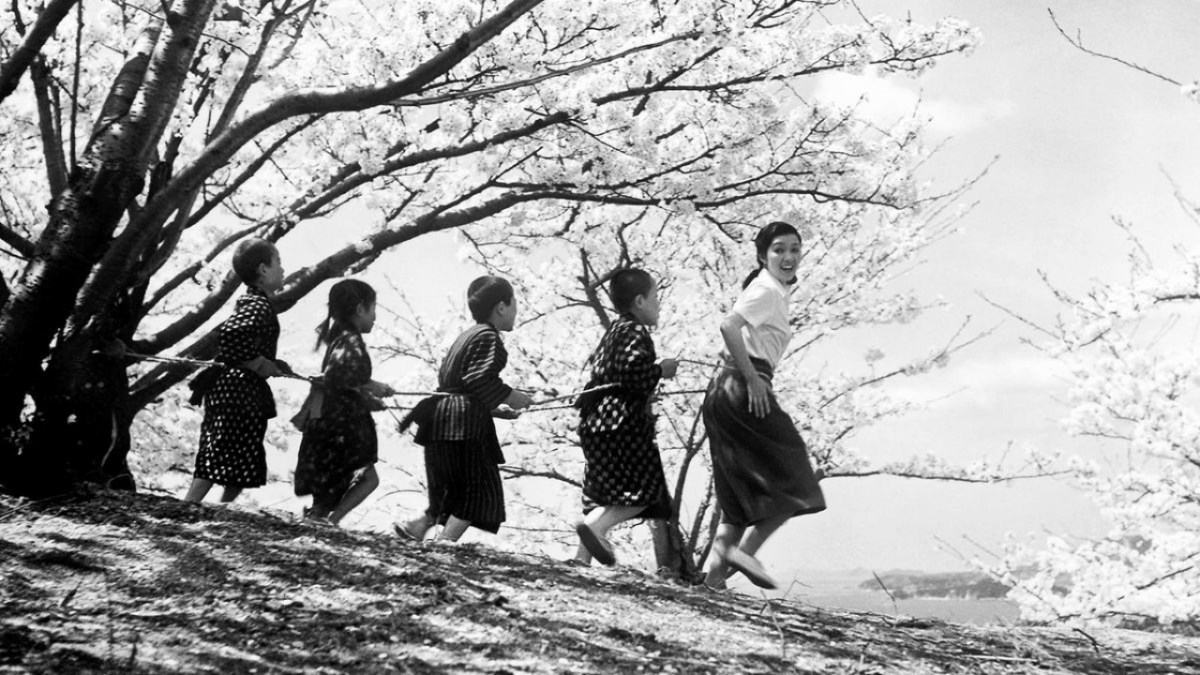
It is an epic of intimate, heart-wrenching moments, best encapsulated by its visual composition, which alternates in a Zen-like style, extreme wide landscape shots of the island (e.g. the sea, undulating hills, little kids walking mile after mile like tiny ants on a mission) and medium shots-cum-close-ups of the faces that adorn this sparsely populated island.
One of them is a newly posted teacher, Miss Oishi (Hideko Takamine, who frequently collaborated with Kinoshita and Mikio Naruse), who makes a lasting impression on the first-graders that she has been asked to teach.
“Teachers have a duty. We prepare our students to serve the nation.”
It would have been a simple tale of life in the countryside except that the film is set in the late 1920s. As the occasional text on screen tells us, these people will witness the tumultuous years of Japanese history.
The boys would grow up patriotic (or brainwashed if Miss Oishi had her way) and dying (needlessly) for their country. The girls would also suffer financially as death and poverty force them into dire circumstances.
Through this historical weight of WWII, Twenty-Four Eyes gathers its sheer emotional heft (what is sentimentality when there is profound despair and sadness in retrospect?).
Whether through the lively interactions between teacher and student(s), silent glances, or the subtle dabbing of tears, Kinoshita shows us the humanistic filmmaker that he was. At the same time, his anti-war message cuts deep.
It also features arguably the most moving use of ‘Auld Lang Syne’ in Japan’s Golden Age cinema this side of Yasujiro Ozu’s Early Spring (1956).
Grade: A
Trailer:
Music:
 Eternality Tan