







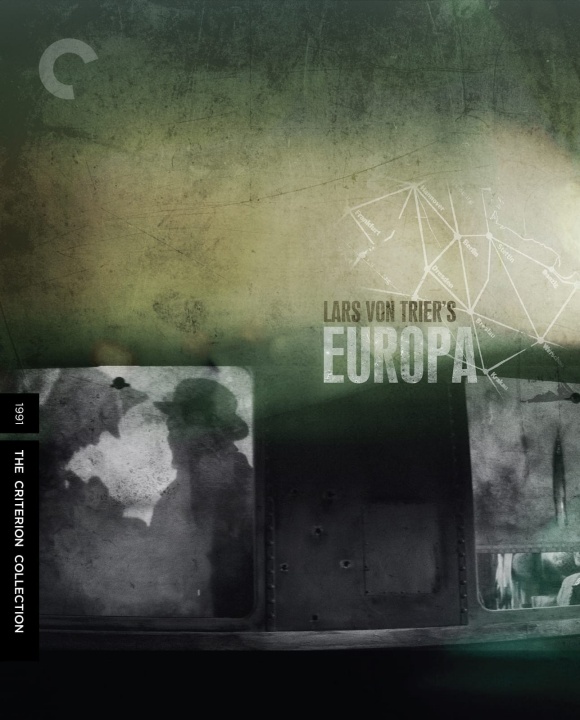
A stylish, aesthetic tour de force, particularly in the use of rear projection techniques, this noir-ish melodrama about an American train conductor in 1945 Germany tells of the precarious postwar atmosphere of remnant Nazism.
Review #2,756
Dir. Lars von Trier
1991 | Denmark | Drama, Thriller | 112 min | 2.39:1 | English, German & other languages
NC16 (passed clean) for sexual scene and some violence
Cast: Jean-Marc Barr, Barbara Sukowa, Udo Kier
Plot: Just after WWII, an American takes a railway job in Germany, but finds his position politically sensitive with various people trying to use him.
Awards: Won Jury Prize, Technical Grand Prize & Best Artistic Contribution (Cannes)
Source: TrustNordisk
Accessibility Index
Subject Matter: Moderate – Postwar Germany; Nazism; Deception
Narrative Style: Slightly Complex
Pace: Slightly Slow
Audience Type: Slightly Arthouse
Viewed: Criterion Blu-ray
Spoilers: No
The last title of Lars von Trier’s ‘Europe’ trilogy, which consisted of The Element of Crime (1984) and Epidemic (1987), Europa was perhaps the most recognisable of the trio of films, and also marked the end of the early phase of the Danish provocateur’s career before Breaking the Waves (1996) and The Idiots (1998) turned heads further and elevated him into a bonafide enfant terrible of European cinema.
Max von Sydow’s opening narration lulls us, like hypnosis, into the story of Leopold, an American who enters Germany in 1945 to become a train conductor for the Zentropa (which would become the name of the film production company that von Trier co-founded) line, courtesy of connections with a German relative.
The conditions are bleak as the Germans are still reeling from losing the war and Leopold will soon find out that he cannot escape from this precarious postwar atmosphere of remnant Nazism, one that threatens to bury him alive the deeper into ‘Europa’ he goes.
“Every time you hear my voice, with every word and every number, you will enter into a still deeper layer—open, relaxed and receptive.”
An aesthetic tour de force, Europa was shot in both colour and black-and-white, but even more intriguingly, von Trier combined both seamlessly in many scenes through the use of rear projection techniques, giving the film a ghostly sense of ephemerality.
Furthermore, part of the film score was a homage variation of Bernard Hermann’s music for Vertigo (1958), signalling a thematic association that draws attention to a similar obsessive—and potentially destructive—romance between a man and a woman.
While there are some leaps of temporal logic, most apparent in the ‘ticking time bomb’ climax, Europa operates best as a stylish fable, even when the narrative tends to conform to conventions of the melodrama and classical noir.
As stealthy pro-Nazi resistance fighters manipulate discreetly behind the scenes, Leopold’s train chugs on relentlessly, until it can’t.
Grade: B+
Trailer:
Music:
 Eternality Tan