






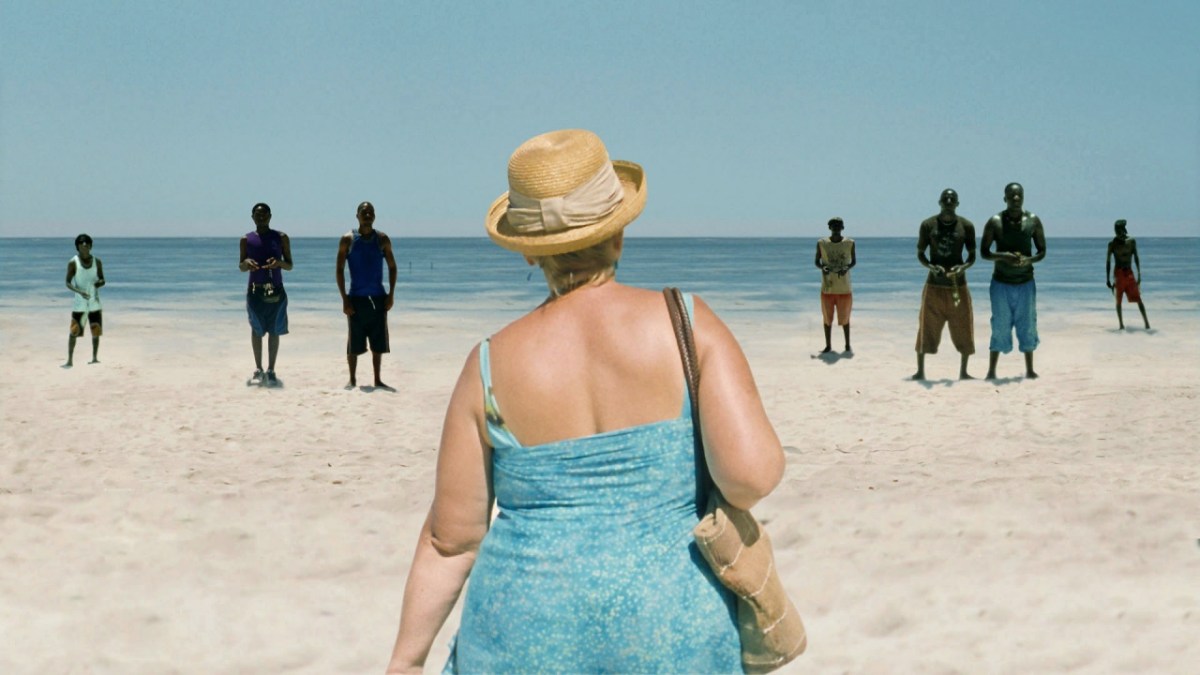
An Austrian woman goes to Kenya in search of intimacy and connection as Seidl, in his usual provocative mode, explores ‘sex tourism’ as both a curse and an antidote to sheer human loneliness.

Review #2,733
Dir. Ulrich Seidl
2012 | Austria, Germany | Drama | 121 min | 1.85:1 | German, English & Swahili
R21 (passed clean) for sexual scenes and explicit nudity
Cast: Margarethe Tiesel, Peter Kazungu, Inge Maux
Plot: Teresa, a 50-year-old Austrian mother, travels to the paradise of the beaches of Kenya, seeking out love from African boys. But she must confront the hard truth that love is a business.
Awards: Nom. for Palme d’Or (Cannes)
International Sales: Coproduction Office
Accessibility Index
Subject Matter: Slightly Mature – Love & Loneliness; Sexual Transaction
Narrative Style: Slightly Complex
Pace: Slightly Slow
Audience Type: General Arthouse
Viewed: MUBI
Spoilers: No
I first saw Paradise: Love in the cinema when it played as part of the German Film Festival in Singapore. Suffice to say, I was shocked to my core. It was the first time I had ever caught explicit nudity on screen, portrayed in sexual situations with such casualness that it felt like the most ordinary thing to see.
I was also surprised that the film was passed clean by my country’s notorious censorship board. Maybe African men with erect penises in close proximity to large-breasted white European women seemed too surreal a sight to be deemed pornographic.
But it is these men who will provide pleasure, intimacy and comfort to Teresa (Margarete Tiesel in a brave and devastating performance). Teresa is an incredibly lonely Austrian woman, a mother to a teenage daughter who rarely lifts her head from her phone.
In a desperate search for human connection, she visits Kenya for a holiday, hoping to recharge and realign her mental and emotional states. There, along with other fellow German-speaking acquaintances, she discovers ‘love’.
“I want to be looked at into the soul.”
Under provocateur Ulrich Seidl’s hands, the ‘love’ in Paradise: Love is transactional. The Kenyans need money while the tourists desire to be fondled sensually. It is an exchange marked by sheer despair.
Part of the ‘Paradise’ trilogy, Love may be shot in Seidl’s usual distancing, observational style yet despite its unsentimental approach, there is a strange humanness to how the characters respond fallibly to the stimuli of flesh and cash.
As such, this mutually exploitative form of ‘sex tourism’ becomes both a curse and an antidote. I couldn’t appreciate the film back then, but it opened my eyes to how bleak cinema can be.
More than a decade on, and being more familiar now with Seidl’s modus operandi, I find Paradise: Love to be an essential piece in his oeuvre.
Grade: A-
Trailer:
 Eternality Tan
[…] not as immediately compelling as Paradise: Love (2012), Faith takes pride in being defiantly offensive, which would thrill arthouse viewers looking […]
LikeLike
[…] in his identifiable style of static long takes, Hope eschews the cultural vibrance of Love (2012) and the utter solemnity of Faith (2013) for a more plainly ‘forward-looking’ […]
LikeLike