
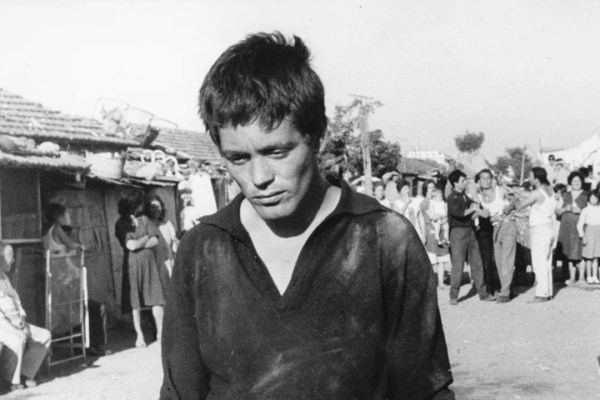








One of Tarr’s best-known works as a quiet Hungarian town experiences an unprecedented disruption when a mysterious attraction arrives, in what appears to be a potent political and moral allegory on the evil that lurks within peoples and systems.
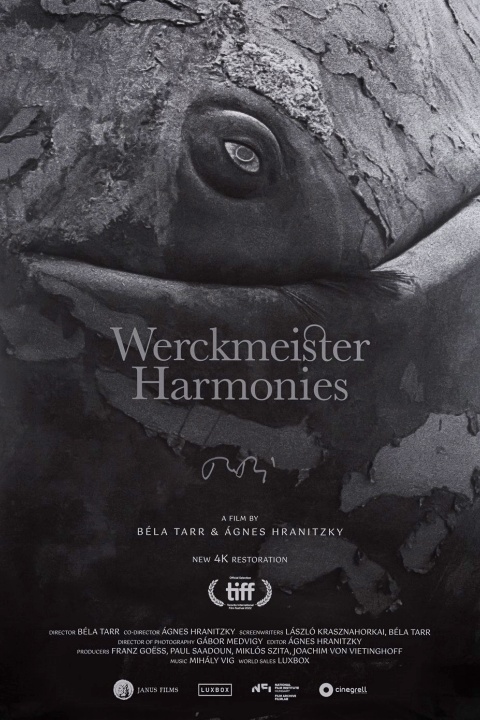
Review #2,727
Dir. Bela Tarr & Agnes Hranitzky
2000 | Hungary | Drama, Mystery | 146 min | 1.66:1 | Hungarian & Slovak
M18 (passed clean) for some nudity
Cast: Lars Rudolph, Peter Fitz, Hanna Schygulla
Plot: A naive young man witnesses an escalation of violence in his small hometown following the arrival of a mysterious circus attraction.
Awards: Won Reader Jury of the Berliner Zeitung (Berlinale); Nom. for C.I.C.A.E. Award (Cannes)
Distributor: Luxbox
Accessibility Index
Subject Matter: Moderate – Morality; Violence; Politics & Society; Small Town
Narrative Style: Slightly Complex
Pace: Slow
Audience Type: General Arthouse
Viewed: Oldham Theatre (as part of Singapore International Film Festival)
Spoilers: No
It has been ten years since I last saw a Bela Tarr film, The Turin Horse (2011), which I couldn’t really get into even if there was something to appreciate in its austerity and formal rigour.
Werckmeister Harmonies is a much more interesting film in comparison, and also one of Tarr’s best-known works. It is also a superb introduction to the Hungarian director’s aesthetical style and modus operandi.
One of the most recognisable names in the arena of slow cinema, and particularly holding the fort for East European cinema, Tarr immerses us in his highly technical long takes from the get-go as the lead character, Janos, philosophizes on the harmonious rotations of the Sun, Earth and Moon, using people in a bar for his practical demonstration.
Any lesser filmmaker might have faltered in the execution of this absurd scene, but Tarr takes it to a place where the poetical and allegorical reside—and meet.
From rotating humans to a mysterious large whale in a town square (that people can pay to see) to a frightening, violent mob marching on the streets (which recalls the relentless and fatalistic intensity of the 1976 Mexican masterpiece, Canoa: A Shameful Memory), Tarr and his co-director/editor/wife Agnes Hranitzky turns these ‘attractions’ into ‘disruptions’.
“And just imagine, in this infinite sonorous silence, everywhere is an impenetrable darkness.”
In this quiet small town, the seed of unprecedented change has been sown, one marked by an evil that lurks within peoples and systems. Werckmeister Harmonies asks us to think about how the human tendency to be triggered by uncertainty, deception and manipulation can lead to collective anxieties.
The sometimes grating music by Mihaly Vig can be a distraction, which I found too explicit in its garnering of the viewer’s pathos, though it is something that I can live with considering how potent the film is.
Drilled down to its allegorical essence, Werckmeister Harmonies is about the moments in political history when civilisations are about to crumble.
As the Sun, Earth and Moon continue to rotate, these townsfolks could not have been more forewarned—a dead whale on land, capitalised and mythologised, is the biggest red flag there is. Well, political ideologies can be brought and bought, and they can be wielded like a devil’s fork.
Grade: A-
Trailer:
Music:
 Eternality Tan
Great review, thanks!
I’d love to hear your insights about Satantango. It was a life-changing experience for me.
LikeLiked by 1 person
Would love to tackle that one someday!
LikeLike