







Seemingly existing outside of time, Rivette’s performative revenge tale featuring women pirates and sorceresses is one of his boldest experiments in film form, culminating in an occult-like finale of dancing bodies in trance.

Review #2,668
Dir. Jacques Rivette
1976 | France | Drama | 135 min | 1.85:1 | French & English
Not rated – likely to be NC16 for some mature themes
Cast: Bernadette Lafont, Geraldine Chaplin, Kika Markham
Plot: After her brother was killed by a notorious all-female pirate gang, Morag dedicates her life to bringing the murderers to justice. Soon, she has become an important member of the pirate gang and has begun acquiring the loyalty of key members.
Awards: –
Distributor: Arrow Films
Accessibility Index
Subject Matter: Moderate – Pirates; Vengeance
Narrative Style: Slightly Complex/Experimental
Pace: Slightly Slow
Audience Type: General Arhouse
Viewed: MUBI
Spoilers: No
Made in the same year as Duelle, Noroit may not be as highly-praised in comparison, but I personally think it is the stronger of the two. They both work as a Jacques Rivette double-bill about strange, mystical women with secrets.
If Duelle is an anti-fantasy noir set in ‘70s Paris, then Noroit can be described as an anti-pirate adventure that exists seemingly outside of time.
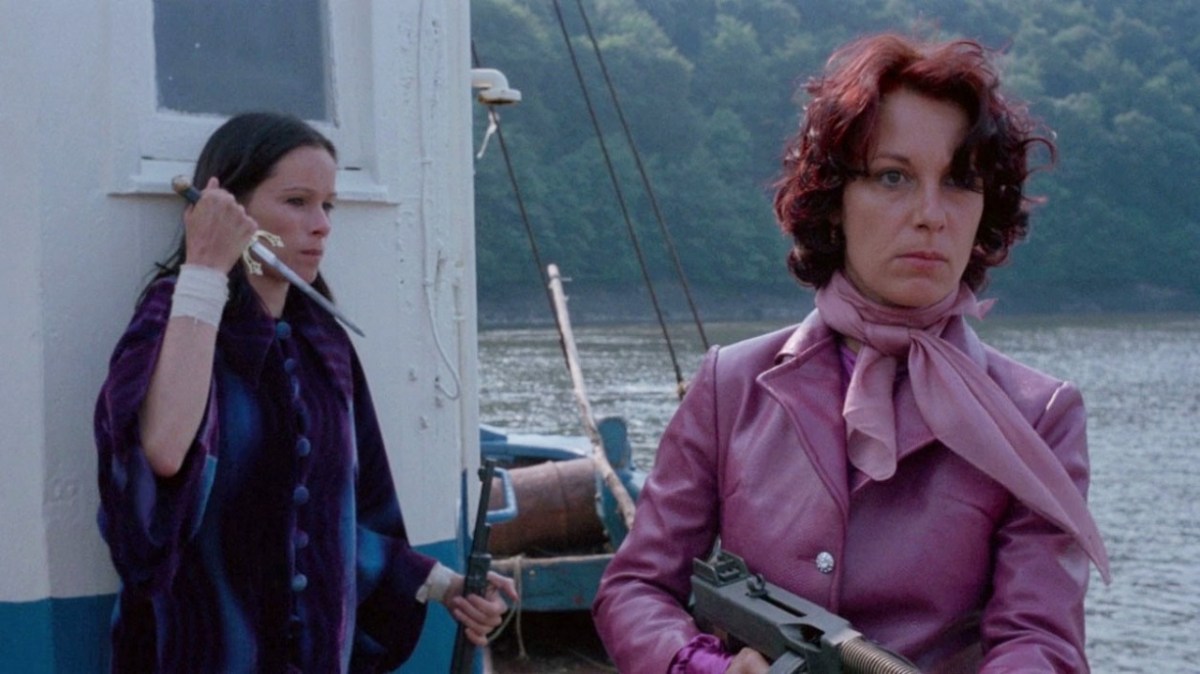
A man lies dead on the beach, while his sister, Morag, (Geraldine Chaplin in a brilliant performance) vows revenge on the pirate woman who killed him. An elaborate plan ensues with Morag attempting to get near to the pirate leader by being her bodyguard which could allow her to inflict the final blow.
Noroit is Rivette’s idea of a performative revenge tale featuring women pirates and sorceresses, the key word being ‘performative’.
“You weren’t expecting me. I’m the last one.”
It is at once cinematic as Rivette’s work is as picturesque as they come (some of its extreme wide shots won’t feel out of place in, say, Barry Lyndon (1975)), but unlike Kubrick’s masterpiece, Noroit feels very theatrical and its artifice is most pronounced in its acting, which is somewhat stilted, albeit intentionally as the characters seem aware that they are performing for somebody…
Like Duelle, the music in Noroit is diegetically performed as part of Rivette’s mise-en-scene, though he goes one step further by having these musicians play music according to the mood of the scene.
Rivette’s bold experiment in film form reaches its creative apex in the enigmatic and utterly phantasmagorical finale as dancing bodies in trance are rendered with different film stock and through red filters. The atmosphere turns occult-like and the inevitable violence that ensues becomes performative acts of catharsis.
Grade: A-
Trailer:
 Eternality Tan
[…] in Duelle (1976) and Noroit (1976), we see musicians playing the music for the film, though in this case, it has a non-diegetic […]
LikeLike
[…] like Jacques Rivette’s radically-mounted Noroit (1976), intertitles containing ‘Acts’ and ‘Scenes’ are inserted conspicuously, though this […]
LikeLike