








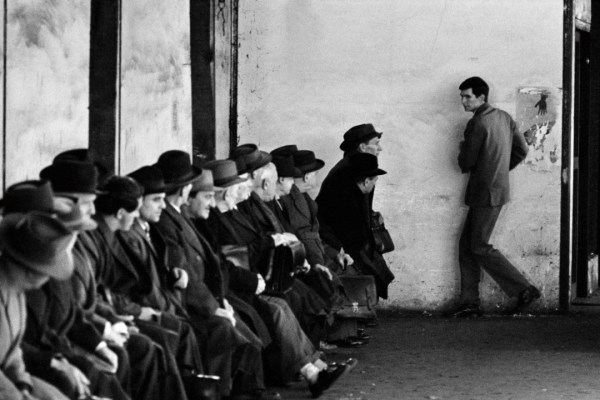


Suleiman’s strong debut has everything that we have come to know about his vignette storytelling style, which houses a mildly humorous if sometimes wistful take on the loss of Arab identity in Israel.

Review #2,640
Dir. Elia Suleiman
1996 | Occupied Palestinian Territory, Israel | Drama, Comedy | 88 min | 1.85:1 | Arabic, Hebrew, French & English
PG (passed clean)
Cast: Elia Suleiman, Nazira Suleiman, Fuad Suleiman
Plot: Told through a series of vignettes centred in and around Jerusalem, a look at how Israel’s Arab population is dealing with its constantly shifting and waning national identity.
Awards: Won Luigi De Laurentiis Award (Venice); Nom. for Tiger Award (Rotterdam)
International Sales: Pyramide Films
Accessibility Index
Subject Matter: Moderate – Arab Identity; Israel-Palestine Context
Narrative Style: Straightforward/Vignette Style
Pace: Slightly Slow
Audience Type: General Arthouse
Viewed: Netflix
Spoilers: No
Elia Suleiman announced himself as the Middle East’s answer to Jacques Tati and Roy Andersson with Chronicle of a Disappearance. In a career with just four features to date, this is to me stronger than Divine Intervention (2002) and It Must Be Heaven (2019). (I’ve yet to see 2009’s The Time That Remains).
Pretty much establishing his vignette storytelling style from the get-go, Chronicle is a Palestinian’s homecoming film as Suleiman, who is also a constant presence here as an actor, tries to make sense of being a Palestinian in Israel, lamenting the loss of Arab identity without being directly confrontational.
Still, it is hard to see it as non-political, and in the many little segments, we see the politics at work, however subtle or explicit, metaphorical, or perhaps satirical.
“Everything is political. Nothing is innocent.”
One extended vignette centres on a misplaced police walkie-talkie as several police cars are made to travel aimlessly by following prank instructions. That’s one way to ridicule law and order in a place notorious for its, well, enforcement of law and order.
While Suleiman is after some truths about the existential crisis of his people, his approach is never meant to be overly serious; in fact, his style may be described as dryly amusing if sometimes wistful.
Chronicle is a film from the heart of an outsider (Suleiman had lived in New York for years) who discovers a world unlike what he had envisioned, and through the process of art, tries to render that world alive—one that feels like a fairy tale for adults, an alternate reality of farce and bewilderment, a land imagined.
Grade: A-
 Eternality Tan