






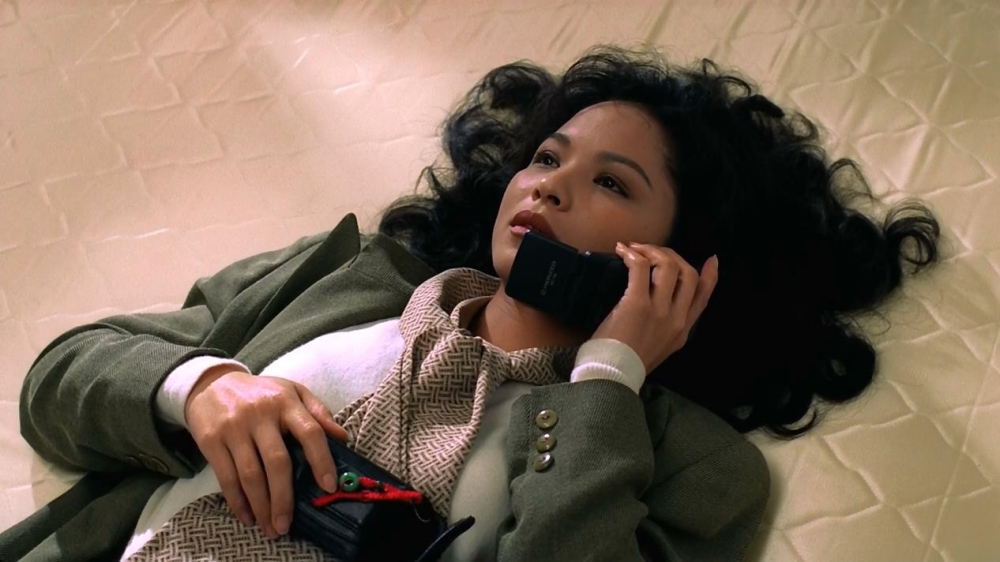
Tsai’s Venice Golden Lion-winning second feature may be sparse and silent, but it remains to be one of the deepest portrayals of existential loneliness in the director’s singular filmography.

Dir. Tsai Ming-liang
1994 | Taiwan | Drama | 118 mins | 1.85:1 | Mandarin
M18 (passed clean) for sexual scenes and mature themes
Cast: Chen Chao-jung, Yang Kuei-mei, Lee Kang-sheng
Plot: The film focuses on three city folks who unknowingly share the same apartment: May, a real estate agent who uses it for her sexual affairs; Ah-jung, her current lover; and Hsiao-kang, who has stolen the key and uses the apartment as a retreat.
Awards: Won Golden Lion (Venice). Won 3 Golden Horses – Best Film, Best Director, Best Sound Effects. Nom. for 2 Golden Horses – Best Leading Actor, Best Supporting Actor
Source: Central Motion Picture Corporation
Accessibility Index
Subject Matter: Mature
Narrative Style: Complex
Pace: Slow
Audience Type: General Arthouse
Viewed: CatchPlay
First Published: 2 Jun 2017
Spoilers: No
In only his second feature, Malaysian born Taiwanese filmmaker Tsai Ming-liang shows us why he is a master of silence and stillness.
Unlike his much more boisterous debut feature, Rebels of the Neon God (1992), Vive L’Amour operates with a kind of sparseness that is, on hindsight, a foreshadowing of his later, more formally minimalistic experiments like Goodbye Dragon Inn (2003) and Stray Dogs (2013).
In Vive L’Amour, a vacant apartment becomes the site of rendezvous for three strangers. May Lin (Yang Kuei-mei) is a middle-aged real estate agent with lots of keys, probably accumulated from the unsold properties in her uninspiring career.
Ah-jung (Chen Chao-jung) is a flirtatious young man who sells textiles on the roadside, whose encounter with May Lin one night leads both to the aforesaid apartment for sex.
And in the prologue, we see another young man, Hsiao-kang (Lee Kang-sheng), who steals the key to that same apartment, treating it as a place of retreat.
These three strangers occupy the large apartment with many rooms at different times, but when one comes ‘home’ while another is ‘in the house’, it becomes a game of extreme stealth. There’s the tension of being found out, while at the same time, Tsai plays with the absurdity of the situation.
I’m sure Tsai knew he had something fascinating in his hands when he was writing the screenplay to this unorthodox treatise on the triangular relationship.
It is through this empty apartment space—one that is devoid of presence—that the film’s themes of isolation and loneliness begin to develop. Of course, not all of the plotting occurs in this space.
Tsai gives us richly-realised characters through their interactions with the world outside, yet there’s a sense of existential crisis that each cannot seem to express or alleviate.
Ah-jung is probably in the best psychological condition of the trio—sex with May Lin seems to satisfy him. May Lin and Hsiao-kang, on the other hand, are the products of an urban city with no sign of promising future. They are also starved of real companionship and intimacy.
Sex and masturbation are temporary measures for them. In one absurd but strangely affecting scene, Hsiao-kang, hiding himself, masturbates under the bed, while May Lin and Ah-jung have sex above him.
The final ten or so minutes are especially haunting. To avoid revealing more than necessary, I can only say that I have never seen such a portrayal of a deep cry borne out of existential loneliness.
It is also a cry for empathy, but the city trudges on, its people and cars moving aimlessly, its buildings eerily still. If an apocalypse occurs, would anyone care?
Grade: A
Trailer:
 Eternality Tan
[…] but on the basis of his first three films (the other two being Rebels of the Neon God (1992) and Vive L’Amour (1994)), one could have made a fair claim at that point in time for the Taiwanese filmmaker to be […]
LikeLike
[…] period for Tsai Ming-liang, with a string of arthouse hits from Rebels of the Neon God (1992), Vive L’amour (1994), The River (1997), to this, The Hole, which was, at that point in time, a departure from […]
LikeLike