








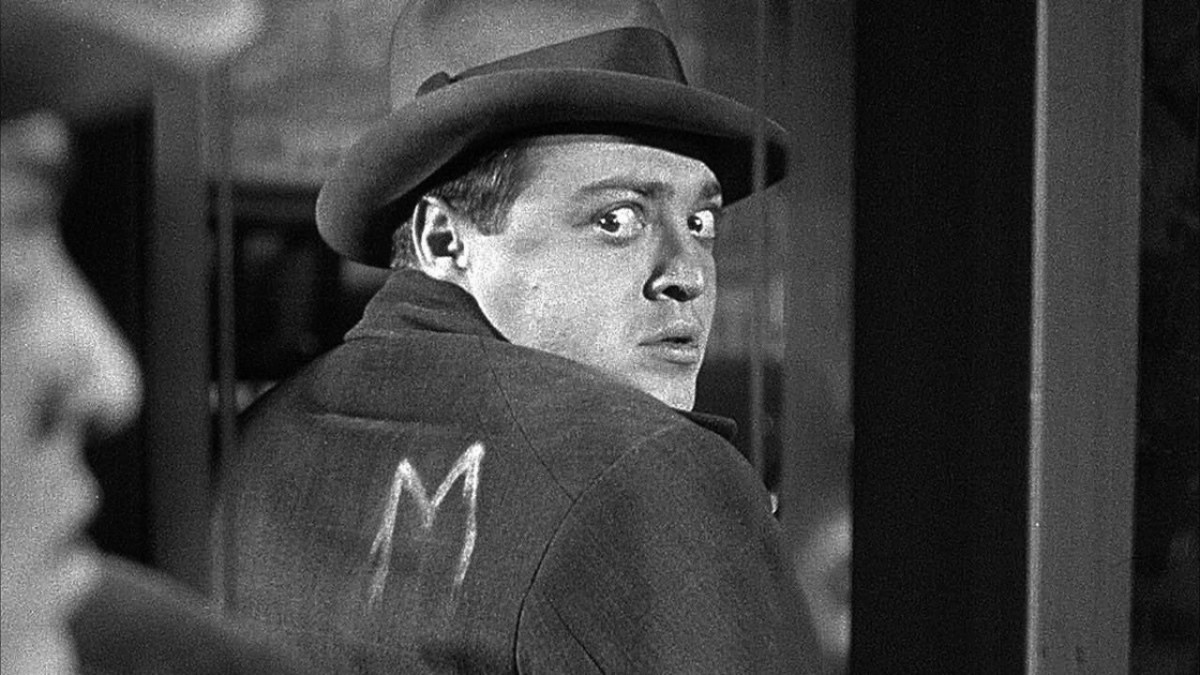
Lang’s blueprint for the psychological procedural thriller remains significant in cinema history, as was his influential use of sound, rendering his ghastly subject—a serial killer of children—in poetic, paralegal light.

Review #3,012
Dir. Fritz Lang
1931 | Germany | Drama, Crime | 110min | 1.19:1 | German
PG (passed clean)
Cast: Peter Lorre, Ellen Widmann, Inge Landgut, Otto Wernicke, Theodor Loos
Plot: When the police in a German city are unable to catch a serial killer of children, other criminals join in the manhunt.
Awards: –
Source: Atlantic Film
Accessibility Index
Subject Matter: Moderate – Serial Killer; Manhunt; Police Procedural; Organised Crime
Narrative Style: Slightly Complex
Pace: Slightly Slow
Audience Type: Slightly Arthouse
Viewed: Criterion Blu-ray
Spoilers: No
Another film I thought it was time to revisit after nearly two decades, M does hold up quite well, even though it will soon turn 100 in half a dozen years.
Probably Fritz Lang’s most famous work, M can sometimes feel like it has a tighter edit within it, but as an early template for the psychological procedural thriller, it remains significant in the history of cinema.
While many later films have been executed with more panache and polish, there is something about M’s decidedly unembellished fundamentals that ground it more disturbingly in the realm of non-fiction.
In fact, the film was controversially made at a time when the crimes of several serial killers were still fresh in the public’s mind.
Yet, Lang’s German Expressionist qualities, particularly his use of light and shadow in several key moments, render his ghastly subject in poetic light.
Peter Lorre’s panicky, squirrel-like facial expressions and bulging eyes when in distress are quite something to behold as he plays a serial killer who murders children.
“Just you wait, it won’t be long, the man in black will soon be here. With his cleaver’s blade so true, he’ll make mincemeat out of you.”
Another historical significance of M was its use of sound at a time when it was still novel. It was not just Lang’s first attempt with the new technology, but some of the techniques he had employed here have persisted till today, from the L-cut in connecting scenes seamlessly to the use of a recurring leitmotif, in this case, Lorre whistling Greig’s ‘In the Hall of the Mountain King’ to signify terror and foreshadowing.
In many of Lang’s works, he was interested in the deep psychology of human thought and action. With M, he posed several points of contention.
One, the notion of mental illness that certain people do suffer that is rarely discussed—does that make them culpable of crimes that they didn’t intend to commit?
Two, the crime-solving work of the police, and ironically, criminals belonging to organised underground factions—well, the latter also want the serial killer caught because heightened police surveillance is putting a huge dent in conducting their ‘activities’.
M becomes fully realised as a film when it enters its blistering climax. Without divulging too much, Lang asks us to think about a third point—paralegal approaches to crime and punishment.
It’s safe to say that, without M, the genre could have taken a longer time to develop and reinforce its conventions and codes, so some kind of appreciation for Lang’s blueprint here is worth highlighting from time to time.
Grade: A-
Trailer:
Promo Clip:
 Eternality Tan
[…] M (1931) […]
LikeLike