



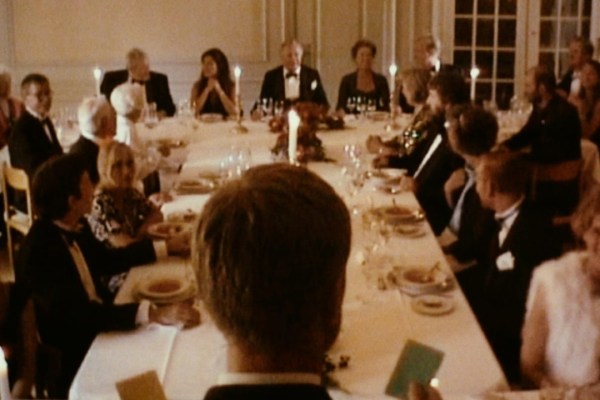


Sylvia Chang and Sally Yeh are a hoot together in this romantic triangle that sees Tsui Hark bringing the Hollywood screwball comedy to his home turf, marked by farcical setups and rewarding payoffs.

Review #2,978
Dir. Tsui Hark
1984 | Hong Kong | Comedy, Romance | 103min | 1.85:1 | Shanghainese, Mandarin & Cantonese
PG (passed clean) for some sexual references
Cast: Kenny Bee, Sylvia Chang, Sally Yeh, Tin Ching, Loletta Lee
Plot: In 1937, amid Shanghai’s bombings, aspiring songwriter Tung and showgirl Shu find solace under a bridge. Though unable to see each other clearly, the young couple fall in love and plan to meet again when the war ends. A decade later, Tung and Shu cross paths again, unaware of their past connection.
Awards: Nom. for 8 HK Film Awards – Best Picture, Best Director, Best Leading Actress, Best Supporting Actress, Best Film Editing, Best Art Direction, Best Original Score, Best Original Song; Official Selection (Venice)
Source: Film Workshop
Accessibility Index
Subject Matter: Moderate – Romantic Triangle; Unintended Consequences
Narrative Style: Straightforward
Pace: Normal
Audience Type: Slightly Mainstream
Viewed: MUBI
Spoilers: No
Made a year after the riotous special effects-laden action extravaganza Zu: Warriors from the Magic Mountain (1983), Shanghai Blues is decidedly saner in comparison.
Still, in the hands of Tsui Hark, expect wild and zany scenarios as the Hong Kong director brings the Hollywood screwball comedy to his home turf.
In one scene, which is obviously a homage to Howard Hawks’ Bringing Up Baby (1939), we see Sylvia Chang’s character, Shu-Shu, performing a dance with a hole in her skirt, oblivious to the wardrobe malfunction and then becoming embarrassed when she learns about it.
This is just the tip of the iceberg in Tsui’s arsenal of farcical setups and rewarding payoffs. In a new 4K restoration, Shanghai Blues will probably reach out to a younger generation of cinephiles, though it is clearly a product of its time.
“I only have one hope. If I give it to you, I’ll have none left.”
For one, it is incredibly sexist, but I guess one can still find some kind of unadulterated fun in watching these kinds of cinematic romps that seem nonchalantly ‘out of touch’ with today’s much more egalitarian approach to gender.
Chang and Sally Yeh (playing the boisterous Stool, who falls in love with the same man as Shu-Shu) are a hoot together, and their magnetic screen presence occasionally even outshines Tsui’s nimble if conspicuous editing style that amplifies the laughs.
The film is mostly set in post-WWII Shanghai as folks struggle to make ends meet. The rambunctious mix of Shanghainese, Cantonese and Mandarin also reflects Tsui’s rollicking, or to use our Singaporean slang, ‘rojak’ approach to filmmaking.
The Shanghai streets are laden with pickpockets, and prostitution is rampant. Tsui, however, treats everything as if it were beamed from another world, where feisty women and lewd old men are its two main pillars, and where deception and evasion are the unofficial laws of the land.
Grade: B+
Trailer:
Music:
 Eternality Tan