



Weir’s exceptional early career effort is a dreamlike tale about the baffling disappearance of several girls on a school outing as it enigmatically explores what it means to exist, even as forces threaten to erase—or accelerate—one’s fate.

Review #2,960
Dir. Peter Weir
1975 | Australia | Drama, Mystery | 115min | 1.66:1 | English & French
PG (passed clean)
Cast: Rachel Roberts, Vivean Gray, Helen Morse, Kirsty Child, Tony Llewellyn-Jones, Jacki Weaver, Anne-Louise Lambert
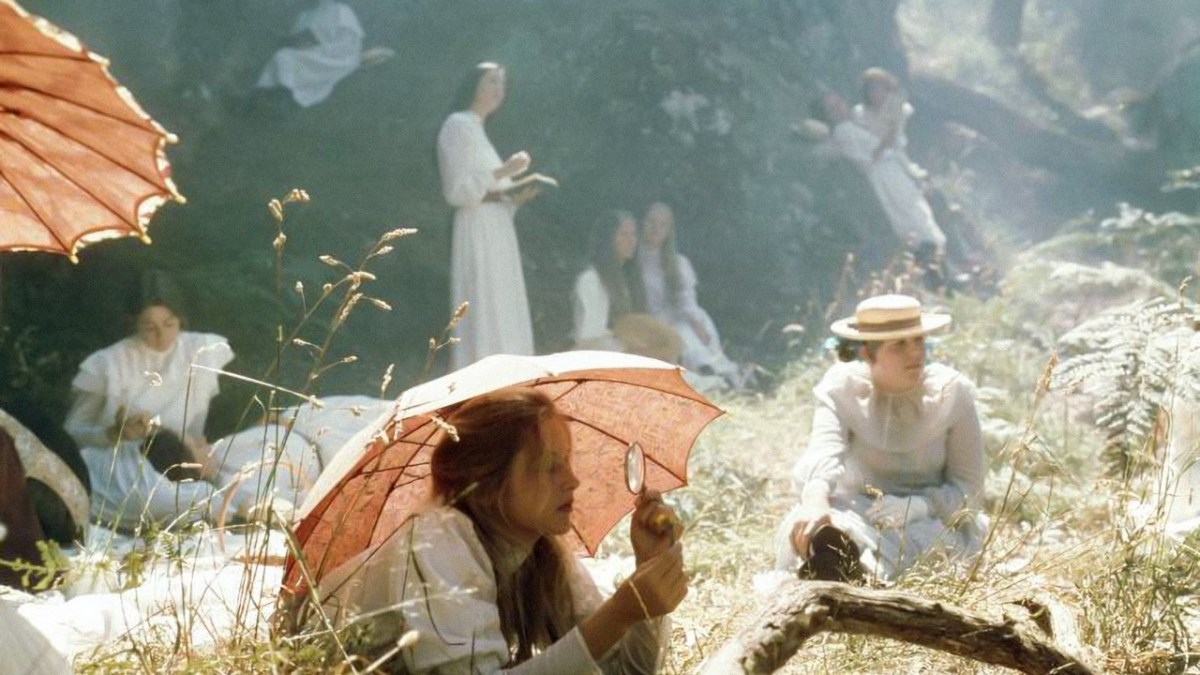
Plot: During a rural summer picnic, a few students and a teacher from an Australian girls’ school vanish without a trace. Their absence frustrates and haunts the people left behind.
Awards: Won Best Cinematography & Nom. for Best Costume Design & Best Soundtrack (BAFTAs)
Source: Picnic Productions
Accessibility Index
Subject Matter: Boarding School; Disappearance
Narrative Style: Straightforward
Pace: Slightly Slow
Audience Type: Slightly Arthouse
Viewed: Oldham Theatre (as part of Asian Film Archive’s Restored)
Spoilers: No
One of the key works of the Australian New Wave, Peter Weir’s early career effort, Picnic at Hanging Rock, celebrates its 50th anniversary at the Asian Film Archive with a stunning 4K restoration, which must be seen to be believed.
Weir is, of course, an exceptional director whose most well-known works include Dead Poets Society (1989), The Truman Show (1998) and Master and Commander: The Far Side of the World (2003).
Here in Hanging Rock, he delivers an atmospheric, dreamlike and occasionally nightmarish world set in 1900 as several girls from an Australian girls’ school disappear after an outing to the nearby ‘Hanging Rock’.
As the local police, townsfolk, teachers and students become baffled by their disappearance, both physical and spectral traces begin to haunt those affected.
A film about the exterior (the hostility and also beauty of nature), interior (psychological trauma), and the mysterious unknown, Hanging Rock is an enigmatic exploration of what it means to exist, as forces, supernatural or human-induced, threaten to erase—or accelerate—one’s fate.
“What we see and what we seem are but a dream, a dream within a dream.”
The fear of being subsumed into a rigid, highly controlled institutional system with no room for dissent or self-actualisation is contrasted with the free-spirited quest for self-discovery.
As such, Weir finds the inherent tension within not just the age-old dichotomy of tradition versus modernity, but also certainty and liminality.
His foregrounding of the pan flute (played by Romanian master Gheorghe Zamfir whose ‘The Lonely Shepherd’ was famously used in Tarantino’s Kill Bill Vol. 1), with its earthy yet flighty sounds, captures this tension vividly.
And so is the use of classical music from Bach, Mozart, and particularly, Beethoven’s exquisite 2nd Movement from his ‘Piano Concerto No. 5’, which made me teared up several times. I’ll be sure to revisit this exceptional film in the future.
Grade: A
Trailer:
Music:
 Eternality Tan