






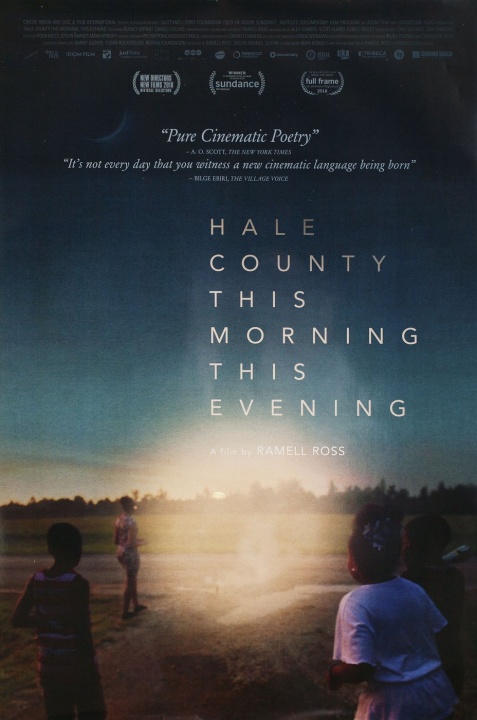
Nondescript and mundane at times, this Oscar-nominated documentary about the black community in Alabama transforms somewhat into a more interesting, free-association piece though it isn’t quite the resoundingly meaningful work of observational, diaristic cinema it thinks it is.
Review #2,919
Dir. RaMell Ross
2018 | USA | Documentary | 76min | 1.85:1 | English
PG13 (passed clean) for some coarse language
Cast: –
Plot: A kaleidoscopic and humanistic view of the Black community in Hale County, Alabama.
Awards: Won Special Jury Prize – Documentary (Sundance); Nom. for Best Documentary Feature (Oscars)
International Sales: Cinetic Media
Accessibility Index
Subject Matter: Moderate – Black Community; Alabama’s Hale County
Narrative Style: Straightforward
Pace: Slightly Slow
Audience Type: Slightly Arthouse
Viewed: Le Cinema Club
Spoilers: No
Nominated for the Oscar for Best Documentary Feature in the year Free Solo (2018) won, Hale County This Morning, This Evening appears to be a nondescript work about the daily lives of black folks living in Alabama, and for at least the first stretch of the film, it does seem like it—mundane with nothing particularly interesting.
Set this in another part of America with a similar milieu and shoot it in the handheld home video style that RaMell Ross (of 2024’s Nickel Boys) has adopted here, and we would pretty much get nothing significantly different.
It does get better if one were to put a little bit more faith in it (as I did), as Ross plays more with film language such as time-lapses and poetic editing as the documentary progresses.
“Can’t be worrying about what’s going on, what happened yesterday, what gonna happen tomorrow, ’cause I already had my trouble for the day, so I can’t worry about tomorrow.”
At some point, Hale County becomes more than just an amateurish series of montages—it somewhat transforms into a free association piece with visual echoes of Jonas Mekas and Terrence Malick, though Ross leaves it a tad too late with the experimentation.
But running at just 76 minutes, it is not difficult to make it through till the end, though if you ask whether it is a meaningful work of observational, diaristic cinema, I don’t think it is a resounding yes.
Still, it is a sincere attempt at a portraiture of a community with individual dreams and struggles—to one day make it as a black man or woman. For the time being, they work and train hard, and to stay safe.
Grade: B-
Trailer:
 Eternality Tan