


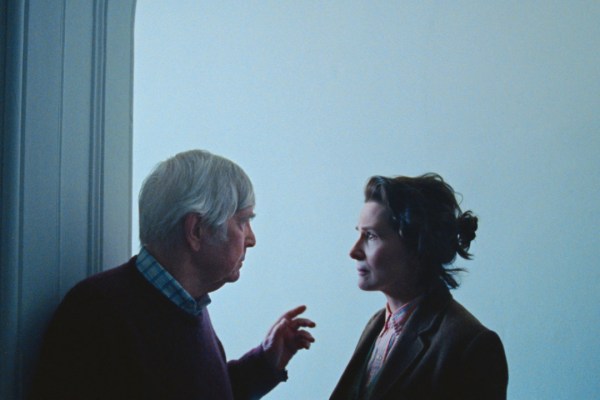
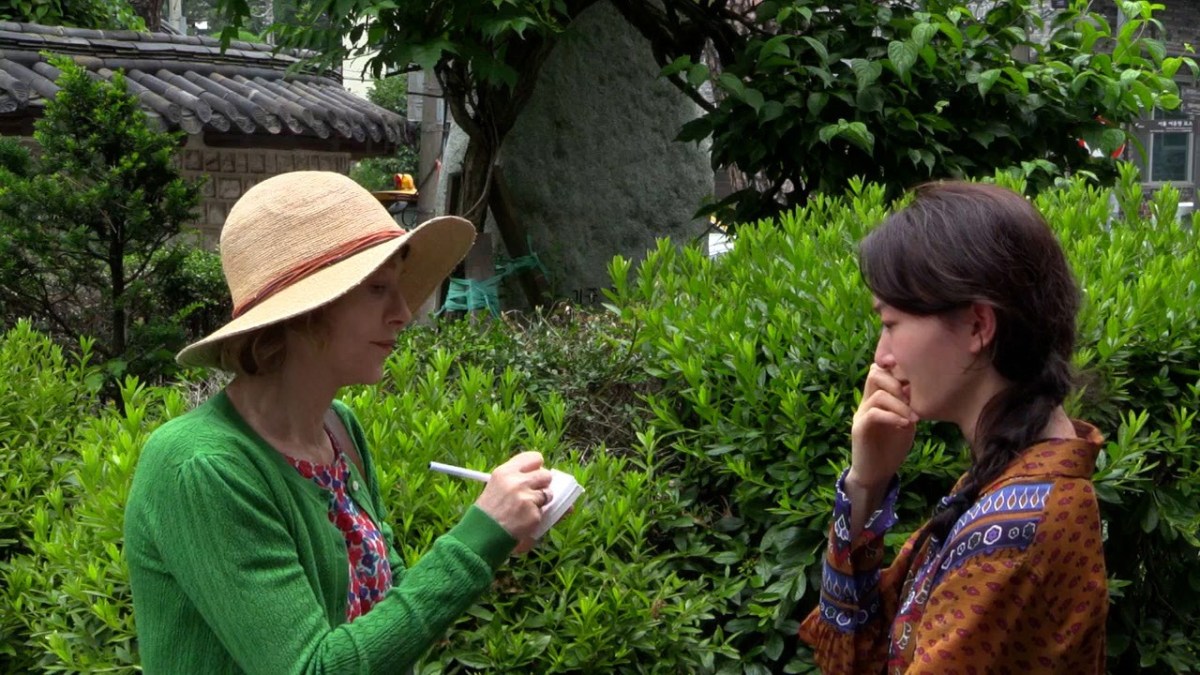
Huppert returns in front of Hong’s camera for the third time in this largely breezy drama about ‘learning’, ‘feeling’ and ‘sipping’ as a French woman uses an unorthodox method to teach French to several Koreans in their encounters with music or poetry.

Review #2,874
Dir. Hong Sang-soo
2024 | South Korea | Drama | 90 min | 1.78:1 | Korean, French & English
PG (passed clean)
Cast: Isabelle Huppert, Lee Hye-young, Kwon Hae-hyo
Plot: Drinking makgeolli (Korean rice wine) to comfort herself, a French woman, who finds herself without money or means to support herself, becomes a French teacher for two Korean women.
Awards: Won Grand Jury Prize (Berlinale)
International Sales: Finecut
Accessibility Index
Subject Matter: Moderate – Teaching French; Poetry; Human Connection
Narrative Style: Straightforward
Pace: Slightly Slow
Audience Type: Slightly Arthouse
Viewed: Oldham Theatre (as part of Asian Film Archive’s Rest & Relax programme)
Spoilers: No
Isabelle Huppert returns in front of Hong Sang-soo’s camera for the third time in this Berlinale Grand Jury Prize winner, after the amusing if oddly touching In Another Country (2012) and the disappointing Claire’s Camera (2017).
Here, she plays Iris, a French woman in South Korea who finds a new and much-needed source of income after being recommended to teach French to several Koreans.
Her method is unorthodox, devoid of the structure of a properly thought-out curriculum; instead, she engages one-on-one with her adult students by asking them to think about their feelings following an encounter with art, be it music or poetry.
She would then compose a poem in French and invite them to practice with it. Most of the time, however, Iris is happily sipping her makgeolli (a milky alcoholic drink).
It is this state of ‘learning’, ‘feeling’ and ‘sipping’ that marks Hong’s drama, which is lighter in tone than usual, though it contains moments of pure emotional heft, particularly pronounced in an extended conversation between a man and his visiting mother.
“Is this a poem?”
Huppert’s performance is mostly a free-spirited one, floating from one location to another. In one scene, she spontaneously removes her heels and dips her feet in a puddle of water. These little moments of grace are now part of Hong’s evolving canon.
In A Traveller’s Needs, music takes centre stage in several key scenes. For example, we see different characters play the piano, guitar and an electric keyboard.
They are all learning how to play a musical instrument. Even Iris herself has a go at the recorder in a local park, but she’s so woeful she catches the attention of someone who would revitalise her life.
It is interesting to note that in the first two instances (i.e. the piano and the guitar), we see Iris quietly if prematurely leaving the space and the performer—these are also the two sequences that mirror each other somewhat in terms of the conversations between the characters.
It may suggest the idea of progress through repetitive, unchanged and uninterrupted practice, but I think Hong might be implicitly hinting—when this is subverted in the third instance—that to know if a person is a genuine soulmate, one must stay, accept and navigate disruption.
Grade: B+
Promo Clip:


[…] a cameo from Isabelle Huppert, but we have In Another Country (2012), Claire’s Camera (2017) and A Traveller’s Needs (2024) to thank […]
LikeLike