









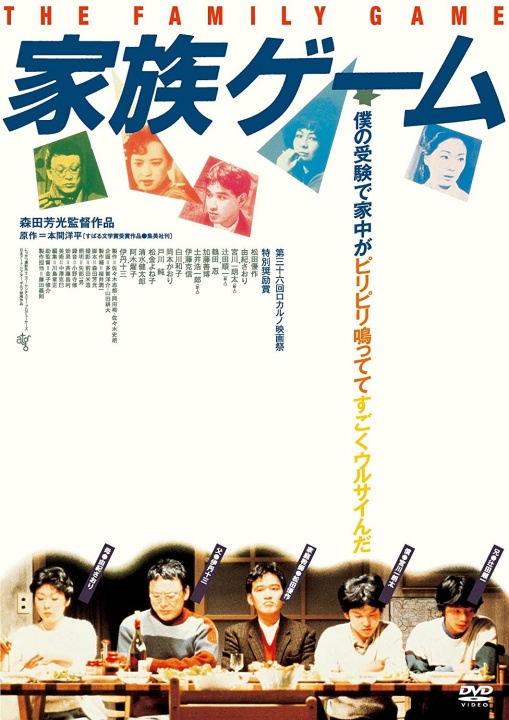
Morita’s creatively-shot and accomplished breakthrough film sees a tutor-outsider embrace and disrupt the status quo of a middle-class family with an underachieving child, with thought-provoking results.
Review #2,872
Dir. Yoshimitsu Morita
1983 | Japan | Drama, Comedy | 107 min | 1.66:1 | Japanese
NC16 (passed clean) for some nudity
Cast: Yusaku Matsuda, Juzo Itami, Yuki Saori, Ichirota Miyakawa, Junichi Tsujita
Plot: A sendup of the stereotypical Japanese family: dad is a salaryman jerk, unable to relate to anyone; mom is a hopeless housewife; the older son is a moderate academic success; but the younger son is a rebellious goof-off for whom a tutor must be hired.
Awards: Official Selection (Locarno)
Distributor: Toho
Accessibility Index
Subject Matter: Moderate – Tutoring; Family
Narrative Style: Slightly Complex
Pace: Slightly Slow
Audience Type: Slightly Arthouse
Viewed: Oldham Theatre (as part of the Yoshimitsu Morita Retrospective)
Spoilers: No
After nearly two decades dabbling in Japanese cinema, it’s still quite amazing that there are filmmakers whom I’ve yet to discover, and this is indeed the best thing about being a cinephile—that desire to keep exploring and wandering deeper into the rabbit hole.
So, thanks to the Asian Film Archive for introducing me to Yoshimitsu Morita. The Family Game is my first foray into his filmography, in a new 4K restoration no less, which looks pristine and crisp.
Morita’s creative attention to film language, employing a mix of editing tricks, sound symbolism, conspicuously high and low shot angles, and ‘unnatural blocking’, gives the film an unconventional sheen.
Even so, you haven’t yet seen a family dinner scene until you have watched what Morita has accomplished here, in a breathtakingly hilarious sequence which single-handedly elevates a work that occasionally threatens to dawdle into some kind of ‘good but not great’ territory.
The fact that the narrative revolves simply around a tutor who is hired by a family to help an underachieving child belies the layers of thematic complexity in this one.
“My son is not dumb because, as a little boy, he memorised an entire book about roller-coasters.”
From a commentary about Japanese middle-class families and their ‘mantra’ of having their children go to top schools (no different from Singapore’s context) to the ‘boredom’ of housewives who become mouthpieces for the ineffectual communicators that are their breadwinning husbands, The Family Game sees the tutor-outsider as both an embracer and disruptor of the status quo.
His unorthodox methods aren’t wasted on this family as they are made to wake up from their inevitable slumbering towards mediocrity.
In an interesting use of aural-visual association, Morita shows us in a montage that marks a pivotal narrative turning point a series of marbles rolling up and down a toy rollercoaster track (a hobby-obsession of the tutored child).
This is no different from the neurons in the human brain (or by symbolic extension, the mind of the tutee and his tutor) as one becomes smarter and the other outsmarts.
Grade: A-
Trailer:
 Eternality Tan
[…] Family Game, The (1983) […]
LikeLike
[…] Family Game, The (1983) […]
LikeLike
[…] Last year, thanks to the Asian Film Archive, I discovered Yoshimitsu Morita, whose films such as The Family Game (1983), Deaths in Tokimeki (1984) and Haru (1996) struck me […]
LikeLike