








The death of nine sheep at the jaws of a snow leopard incurs the wrath of a sheepherder in Tseden’s occasionally farcical take on small-town moralities as the ideals of ‘law’ and ‘justice’ are challenged.
Review #2,864
Dir. Pema Tseden
2023 | Tibet | Drama | 109 min | 1.85:1 | Tibetan & Mandarin
NC16 (passed clean) for some coarse language
Cast: Jinpa, Dylan Xiong, Tseten Tashi, Zhuo Cuo Wang, Losang Choepel
Plot: A father and son argue over whether they should kill a snow leopard that broke into their home and killed nine sheep.
Awards: Official Selection (Venice & Toronto)
International Sales: Rediance
Accessibility Index
Subject Matter: Moderate – Man vs. Nature; Morality & Justice; Violence vs. Non-Violence
Narrative Style: Straightforward
Pace: Slightly Slow
Audience Type: Slightly Arthouse
Viewed: The Projector Cineleisure (as part of the ‘Remembering Pema Tseden’ programme)
Spoilers: No
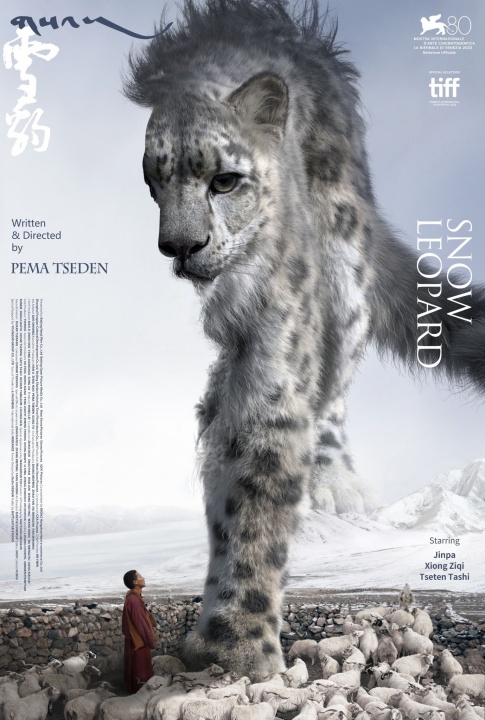
In a post-screening Q&A session with Jigme Trinley, the son of the late Pema Tseden, an audience member asked how the crew had trained the snow leopard featured in the film to be so well-behaved. If that wasn’t a great compliment on the impressive visual effects work, then I’m not sure what is.
Despite having the titular animal rendered in CGI, Snow Leopard works well in its numerous scenes of human-animal interaction—I can feel something not ‘emotional’ but ‘empathetic’ undergirding the rather straightforward narrative.
A TV news crew arrives at a rural village to document an incident that has incurred the wrath of the head sheepherder (Jinpa in an ultra-agitated performance): a snow leopard had jumped into his sheep enclosure and killed nine of them in the middle of the night.
He wants compensation and to exact revenge on the guilty party, but his aged father prefers a non-violent solution as snow leopards have been known to be mythical creatures for many centuries.
“Today I’m setting you free.”
The Chinese government, as represented by a handful of officials summoned to the crime scene, has a different perspective: the snow leopard ought to be let go (by legal obligation) into the wilderness as it is a first-class protected animal.
So, what ensues is both farcical and fiery as the ideals of ‘law’ and ‘justice’ are challenged. The struggle to communicate and translate between Mandarin and Tibetan is also foregrounded, particularly in its climax.
Snow Leopard ultimately doesn’t quite offer anything more for its ‘story type’ of man versus nature and small-town moralities apart from its exotic milieu.
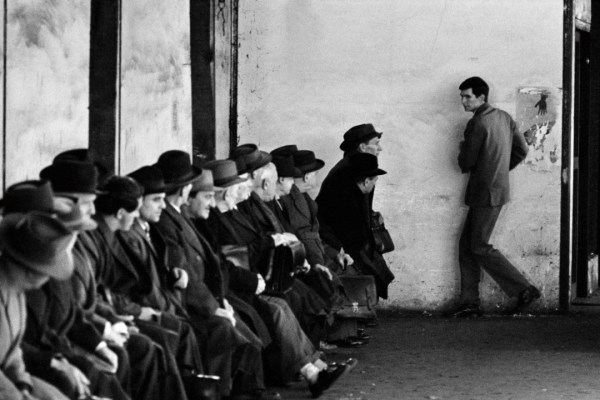
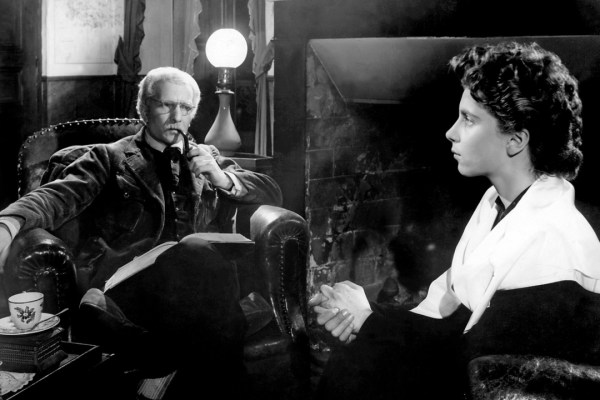
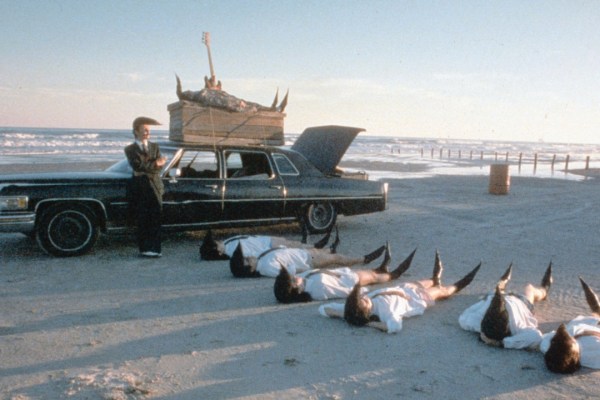
Its interplay between the surreal monochromatic sequences and day-to-day realism can feel jarring to some, though it signals some kind of creative risk (or is it a regression to the conservatism of a more ‘mainstream/popular’ aesthetics?) that Tseden was willing to pursue in expanding his style and visual vocabulary for what could have been a new, less esoteric phase in his filmmaking.
Grade: B
Trailer:
 Eternality Tan