






One of 2024’s most beguiling films as the relationship woes of a European couple bring us all over colonised Asia, but the always deceptive Gomes plays with time as an artificial construct, celebrating modern Asia and traditional Asian arts with hints of Jia Zhangke and Apichatpong Weerasethakul.

Review #2,855
Dir. Miguel Gomes
2024 | Portugal | Drama | 128 min | 1.66:1 | Portuguese
NC16 (passed clean) for some nudity
Cast: Goncalo Waddington, Crista Alfaiate, Claudio da Silva, Lang Khe Tran, Jorge Andrade
Plot: Edward, a civil servant, flees fiancee Molly on their wedding day in Rangoon, 1917. His travels replace panic with melancholy. Molly, set on marriage and amused by his escape, trails him across Asia.
Awards: Won Best Director & Nom. for Palme d’Or (Cannes)
International Sales: The Match Factory
Accessibility Index
Subject Matter: Moderate – Asian Colonisation; Existential Crisis; Tradition vs. Modernity; Meditation on Time
Narrative Style: Complex
Pace: Slow
Audience Type: General Arthouse
Viewed: Screener
Spoilers: No
Leave it to Miguel Gomes to give us one of the most beguiling films of 2024 in Grand Tour.
Winning the Best Director award at Cannes, the Portuguese auteur of such works as the ‘Arabian Nights’ trilogy (2015), The Tsugua Diaries (2021), and what could be one of the films of the 2010s decade, Tabu (2012), heads East to the continent of Asia, fashioning a film that some might accuse of having Orientalist or exoticist tendencies.
While that isn’t an invalid viewpoint, I feel there is so much more to Grand Tour than meets the eye (or ear). Whether sights or sounds, Gomes gives us a sensorial experience best encountered in the cinema, eschewing traditional narrative structure and form for something looser and untethered.
While its treatment can be sufficiently challenging, the film is rarely inscrutable. I would describe it as Tabu meets Chris Marker’s Sans Soleil (1983), largely functioning as a narrated travelogue as the characters transit from place to place, whether Japan, China, Vietnam, Burma, or even our own Singapore (Zhao Wei Films was involved in the project).
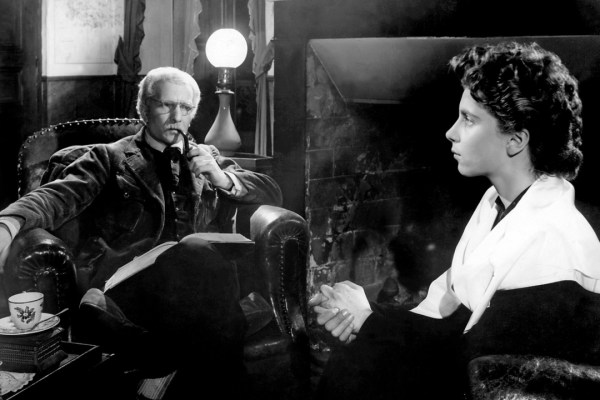
Centered on Edward, who on his wedding day in 1917 flees from his fiancée, Molly, Grand Tour sees a determined Molly attempt to track him down all across Asia.
“I’m running from a woman who’s following me.”
The Edward-Molly story might seem central to everything that happens in the film, but in Gomes’ dexterous (or shall we say, deceptive) hands, it is one of many sideshows.
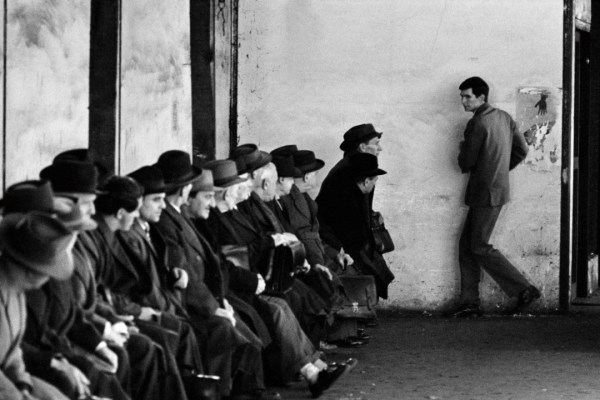
For one, time is merely an artificial construct, as Gomes presents to us in some extraordinary sequences the modern geographical and human landscape of Asian towns and cities, in the ‘documentary’ spirit of Jia Zhangke.
At the same time, Grand Tour also has echoes of Apichatpong Weerasethakul in its existential exploration of the human soul in the heart of light and darkness that is nature.
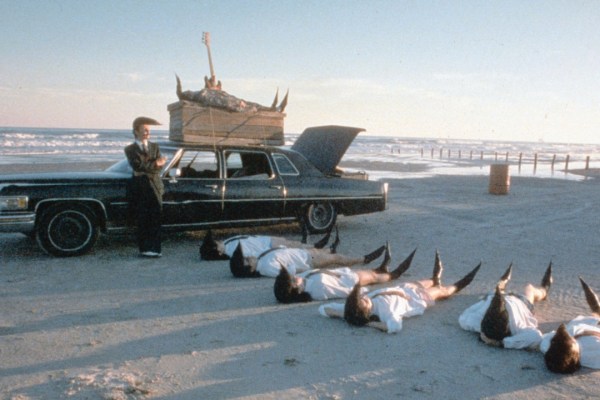
Although shot in black-and-white, colour segments are inserted occasionally that present the performative nature of traditional Asian arts such as shadow puppetry. So really, how do we make of Grand Tour’s idiosyncrasies, poetic stylings and perceived ‘cultural value’?
I personally think Gomes has done something quite remarkable, celebrating the incredible diversity inherent in Asian cultures through a story about the woes of two hapless Europeans.
Edward and Molly exist in an Asia that is long gone, colonialisation a faded memory. Asia is so different now, free from the old Western perceptions of ‘otherness’, full of life, vigour and promise. Grand Tour would make a fine double bill with Chantal Akerman’s Joseph Conrad adaptation, Almayer’s Folly (2012).
Grade: A-
Trailer:
Music:
 Eternality Tan
[…] Cinematography: GRAND TOUR. I fell in love with its dreamy, evocative look, yet the film is more than just dreamy or […]
LikeLike