










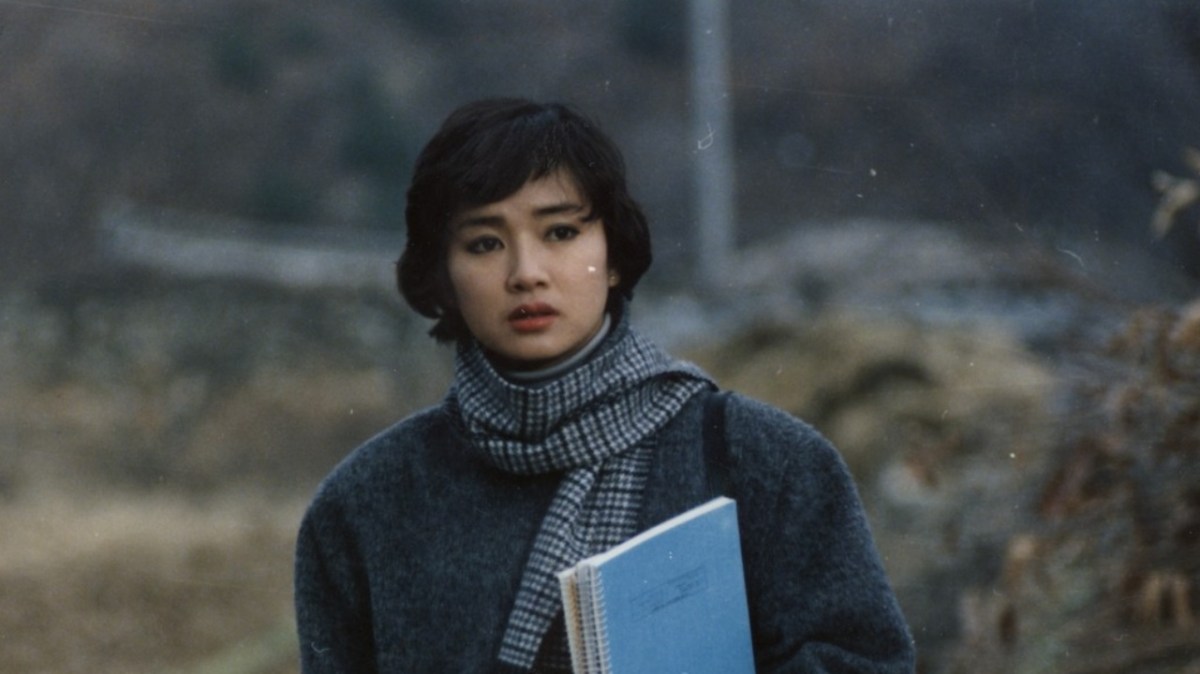
This mystery-drama set in a remote village alternates between blissfulness and the ominous, exploring the transgression of hidden desires through the lens of sexuality.

Review #1,121
Dir. Im Kwon-taek
1983 | South Korea | Drama, Mystery | 91 min | 2.35:1 | Korean
M18 (passed clean) for sexual scenes
Cast: Ahn Sung-kee, Cho Nam-kyeoung, Choi Dong-joon
Plot: Su-ok is a young teacher who arrives from Seoul to teach at an elementary school in an isolated mountain village. As the days pass, she soon discovers the entire village is harbouring a sinister and shocking secret.
Awards: –
Source: Korean Film Archive
Accessibility Index
Subject Matter: Moderate – Hidden Desires; Transgressions; Remote Village
Narrative Style: Slightly Complex
Pace: Slightly Slow
Audience Type: Slightly Arthouse
Viewed: Gallery Theatre, National Museum of Singapore (as part of Singapore International Film Festival 2014)
First Published: 1 Jan 2015
Spoilers: No
Im Kwon-taek claimed that he didn’t really make films that satisfied him until the late 1970s. Village in the Mist, together with Mandala (1981), both screened at the 25th Singapore International Film Festival, are excellent examples of Im’s mastery of his craft, particularly the latter, which I believe is his first true masterpiece.
Village in the Mist very much follows the same kind of aesthetics as Mandala – there are wide, landscape shots of nature; sometimes it rains, and sometimes it snows. A bus comes to the village once every few hours. There’s a feeling of isolation, of coming to terms with one’s own existence, or perhaps one’s faith in humanity.
I see Village in the Mist as a kind of spiritual sequel to Mandala. In the latter, the crisis of faith, profound humanism and material desire are explored through the lens of Buddhism. In the former, hidden desires and transgressive behaviour are viewed through the lens of sexuality.
Religion and sex often don’t mix, but Im’s cause for concern is to find out what makes us human. And through these two films, both similar and different to each other in their own right, Im provokes in ways rarely seen in Korean cinema, at least at that time.
The film begins with a teacher from town getting posted to a secluded village in the mountains. She finds a sense of normalcy but discovers something strange that is far beyond her understanding.
It comes in the form of a scruffy vagabond, whom the villagers treat rather nicely, occasionally giving him food and shelter from the pouring rain. He hovers around the village aimlessly but doesn’t speak much.
Im creates mystery and tension whenever ‘The Fool’, as he is called, appears on screen, through recurring low, ominous strings. Yet he varies the tone of the film in other scenes, such as when the teacher is dancing in the snow, with the blissful expectation of seeing her visiting boyfriend, all to an old cheesy American pop song.
But what is frightening in Im’s work is the protagonist’s steadfast conformance to the ethics of the village, of choosing pride over shame, of reasoning that collective integrity is far easier to swallow than individual injustice, of rationalising that men and women are forced to accept hidden desires, however perverse, if only to prevent his or her very own destruction.
Grade: B+
Watch on the Korean Film Archive’s YouTube Channel:


A great review. I haven’t heard of this film, but it does sound interesting to me. I have been a massive fan of South Korean Cinema. The concept for this movie reminds me a lot “Parasite”, a film I adore. So, I will keep this film on my watchlist for future. Here’s why I adored “Parasite”:
LikeLike