





Two young brothers hope to visit their estranged father who lives far away as this beautiful Tajik drama takes them on a picturesque train journey across the rural landscape of little villages and hills.

Review #2,764
Dir. Bakhtyar Khudojnazarov
1991 | Tajikistan | Drama | 90 min | 1.37:1 | Tajik & Russian
NC16 (passed clean) for brief nudity
Cast: Timur Tursunov, Firus Sasaliyev, N. Arifova
Plot: Farukh wants to go away. He takes a train with his little brother, Azamat, to visit their estranged father. Farukh intends to leave Azamat at his father’s before leaving.
Awards: Official Selection (Berlinale & Toronto)
Source: World Sales Christa Saredi
Accessibility Index
Subject Matter: Moderate – Siblings; Journey
Narrative Style: Straightforward
Pace: Slightly Slow
Audience Type: Slightly Arthouse
Viewed: Oldham Theatre (part of Asian Film Archive’s Restored programme)
Spoilers: No
Both Yasujiro Ozu and Hou Hsiao-Hsien taught me how to appreciate old railway trains in cinema, so much so that the sight of a train chugging along, particularly in Asian films, holds emotive qualities for me. Thus, it was to my utter delight when I realised at some point into Bratan that it was going to be a train movie.
I haven’t seen something like this for years and it also happened to be my first-ever encounter with a film from Tajikistan, so thanks to the Asian Film Archive for curating it as part of their regular ‘Restored’ programme.
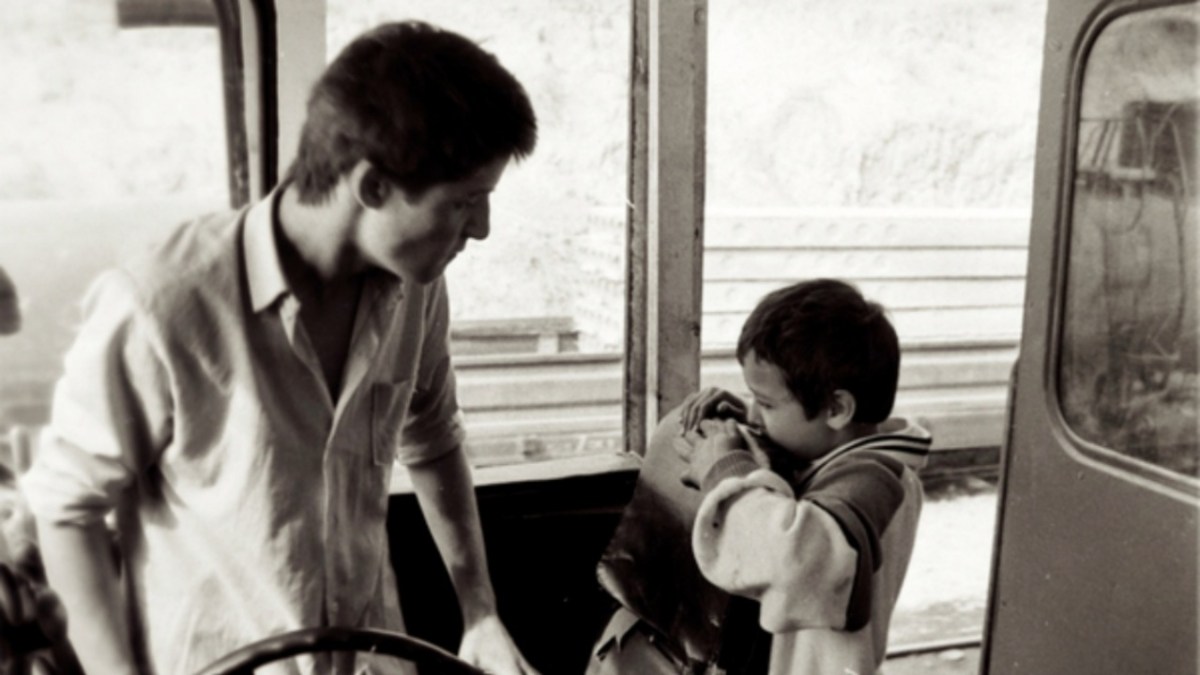
A teenage boy brings his younger brother along for the ride as they hope to make a rather long journey on tracks to visit their estranged father, who has separated and lives far away from them.
Bratan works like a classic ‘road movie’ and the joy of seeing it comes from the opportunity to traverse the picturesque rural landscape of little villages and hills, with wonderful guitar-tinged music to boot that reminds somewhat of Alberto Iglesias’ work for the much later The Kite Runner (2007).
“Did he eat the soil again?”
The train would stop occasionally where there is human activity—there’s mild humour in the interactions and a sense of physical risk that comes from seeing a child climb structures high above the ground.
In fact, the film begins with a shot that tells us all we need to know about the non-existent fear of heights inherent in these kids.
Released in 1991, a monumental year as far as the Soviet Union is concerned, this beautiful Tajik drama is poetic enough to ward off any perception of it being aligned with socialist realism.
The young actors are fantastic—the soil-eating little boy could have easily been cast in a Tajik version of Cinema Paradiso (1988) while the older one exudes Jean-Pierre Leaud vibes.
Grade: A-
Trailer:
 Eternality Tan