






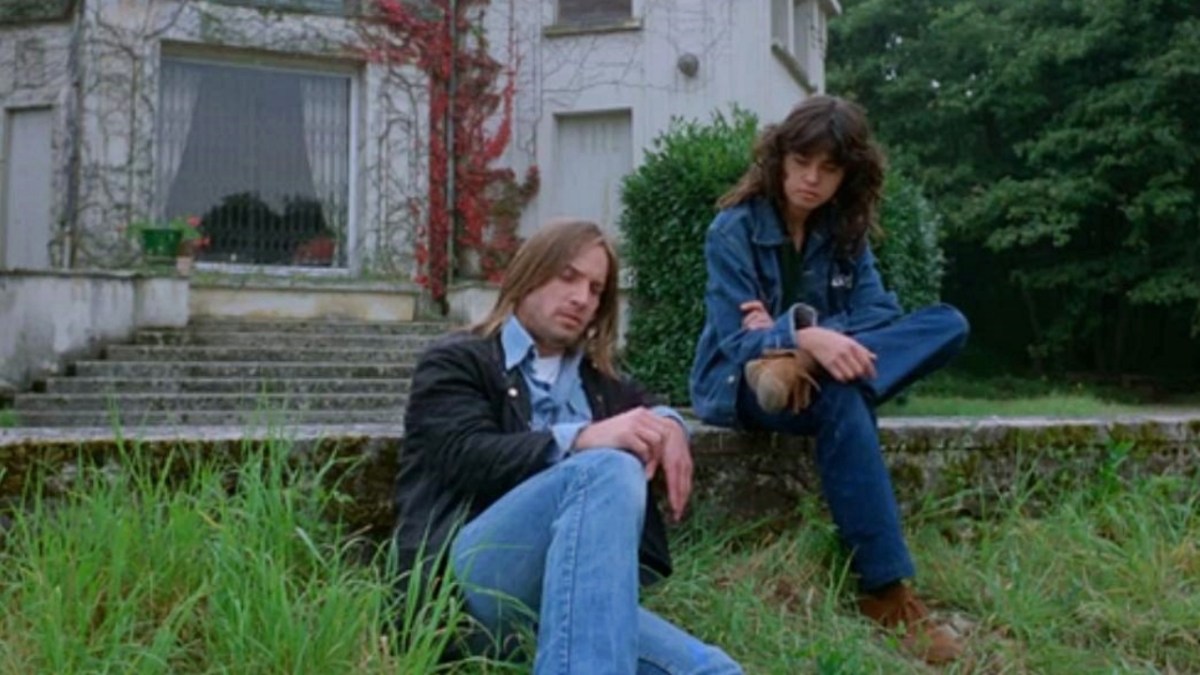
Freewheeling if repetitive, Rivette’s anti-thriller feels much emptier than usual as a woman’s sister and an ex-lover are asked to join her in mysterious circumstances.

Review #2,725
Dir. Jacques Rivette
1980 | France | Drama, Mystery | 160 min | 1.37:1 | French & English
Not rated – likely to be NC16 for coarse language
Cast: Joe Dallesandro, Maria Schneider, Hermine Karagheuz
Plot: Elizabeth sends telegrams to her old boyfriend Ben in NYC and to her younger sister Leo in Rome to join her in Paris, where she is selling her dead father’s estate. When Ben and Leo arrive, a mysterious adventure begins.
Awards: –
Distributor: Gaumont
Accessibility Index
Subject Matter: Moderate – Family Inheritance; Cat-and-Mouse; Personal Anxieties
Narrative Style: Slightly Complex/Elliptical
Pace: Slow
Audience Type: General Arthouse
Viewed: MUBI
Spoilers: No
Like Le Pont du Nord (1981), Merry-Go-Round sees two strangers moving from one place to the next with seemingly no end goal.
But unlike the former, which sees the characters touring the streets of Paris as a treatise on crime as an adventurous game of chance and consequence, Merry-Go-Round feels more like its dress rehearsal, or worse, a first or second draft of a raw, incomplete project. In Jacques Rivette’s exceptional body of work, it may be considered a nadir.
A woman named Elisabeth inexplicably requests for her sister, Leo (Maria Schneider), and an ex-lover, Ben (Joe Dallesandro), to join her at a short moment’s notice.
They travel from Rome and New York respectively to Paris but barely miss her at every juncture of trying to locate her. There is money at stake as Elisabeth is looking to sell her dead father’s estate.
“You call me. You need me. You are not here.”
However, in typical Rivette fashion, this is no ordinary genre film. Yet, his anti-thriller approach seems excessively lax, extending an already chronically meandering narrative to nearly three hours. The title, at least, proves fitting—freewheeling yet repetitive.
Merry-Go-Round oscillates between two narrative modes; one follows a plot-driven thread (though the notion of ‘plot’ holds little significance in a film of this nature) as Leo and Ben attempt to unravel the mysterious circumstances surrounding Elisabeth.
The other thread works more psychologically, a physical manifestation of personal anxieties (or is it perverse sexual attraction?) as a game of cat-and-mouse plays out between Leo and Ben deep in a remote forest.
Like in Duelle (1976) and Noroit (1976), we see musicians playing the music for the film, though in this case, it has a non-diegetic and scene transition function. Unless you are a Rivette completist, please skip this.
Grade: C+
 Eternality Tan
[…] the French auteur’s Le Pont du Nord (1981), or even the disappointing Merry-Go-Round (1980), topography is a critical narrative device, where characters move around a locale, often […]
LikeLike