



This slow-burner suspense classic, and one of Melville’s most influential works, is an excellent character study of the ‘hitman’.
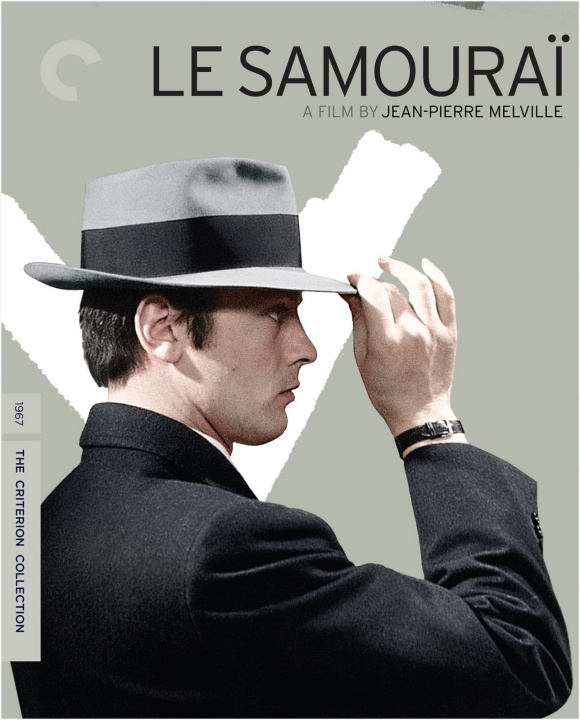
Review #779
Dir. Jean-Pierre Melville
1967 | France | Crime, Drama | 105 min | 1.85:1 | French
PG (passed clean) for some violence
Cast: Alain Delon, Nathalie Delon, Francois Perier
Plot: After carrying out a flawlessly planned hit, a contract killer finds himself caught between a persistent police investigator and a ruthless employer.
Awards: –
Source: Filmel
Accessibility Index
Subject Matter: Moderate – Professional Hitman; Existential Crisis; Isolation
Narrative Style: Straightforward
Pace: Slow
Audience Type: Slightly Arthouse
Viewed: Criterion Blu-ray
First Published: 27 Jul 2012
Spoilers: No
This is Hong Kong director Johnnie To’s favourite film. His fellow filmmaker John Woo calls it “the most perfect film” ever.
To and Woo, two of Hong Kong cinema’s most proficient directors, and masters of the crime-action genres, salute the legacy of Jean-Pierre Melville’s Le samourai, a film that is as influential as it gets, yet remains distinctively its own.
Melville, who made films such as Army of Shadows (1969) and Le cercle rouge (1970), was no stranger to the crime film. With Le samourai, he gave us a classic, to some for the ages, but for me, I must admit it is a film that I admire more than I like.
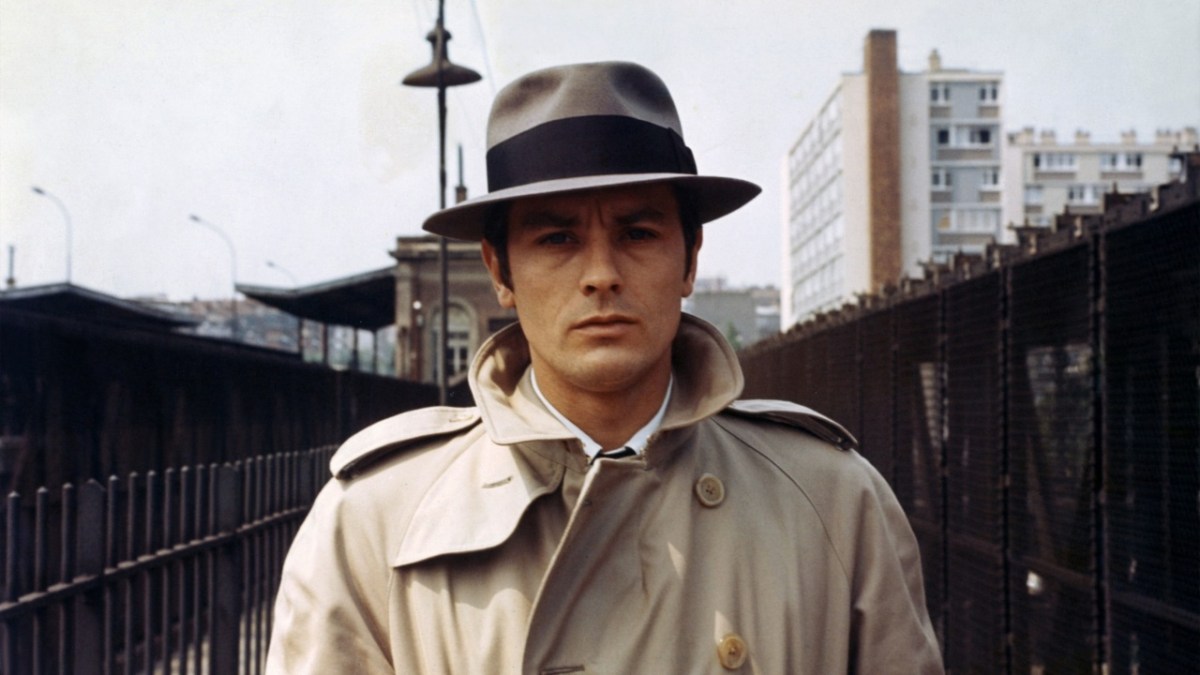
Le samourai is less of a crime film and more of a character study. The impossibly handsome Alain Delon plays Jef Costello, a hitman with samurai instincts. He operates like a lone wolf, ruthless and deliberate in his approach, and is never one for sentimentality.
He holds a set of common utility keys, patiently trying each one until he finds the right one for a Citroen he has stolen, or a house he will eventually break into.
He is cold and calculated, but above all, he is coolness personified. And that is what Le samourai is as well, a film that sees almost nothing ever happens, yet it feels too cool to be disliked.
Le samourai eschews genre conventions for a crime film. Melville chooses to focus on the mechanics – its meta-approach is quite refreshing, though curiously dull. There are plenty of scenes of Jef driving, stopping, parking, walking fast (he never runs), and simply standing still.
“I never lose. Never really.”
In other words, if you are looking for spectacular shootouts or tightly-paced action sequences, you have popped the wrong video into your player.
Melville’s direction is assured, perhaps too assured, for it lacks spontaneity. Every move seems to be planned, and the director summons up his voracious ability for patience by seeing every action or movement from start to end.
The result is a film with as slow a pacing you will ever see in a crime picture. Delon’s central performance is devoid of emotions. His facial expressions never change, but he has a strong screen presence.
Melville explores themes of isolation, and the idea of operating in isolation. They are two different things really. Jef is in his element in the latter, but struggles to cope with the burden of being isolated from society, and perhaps feels his life is lost out on human values such as freedom, hope, and love.
Still, he stubbornly follows a strict code of honour, and like a samurai, he never betrays himself. Melville never betrays himself too, delivering a film that is the antithesis of entertainment. Ever wonder why hitmen are so cool? Perhaps this is how it started.
Everything from Scorsese’s Taxi Driver (1976) to Anton Corbijn’s The American (2010) owes some kind of debt to Le samourai, an arthouse ‘hitman’ film that could have singlehandedly launched the Hong Kong new wave of crime films of the late 1980s and early 1990s. Well, I’m just sayin’.
Grade: A-
Trailer:
Music:
 Eternality Tan
[…] that it was intended to have more mainstream appeal than, say, another Delon vehicle, Melville’s Le samourai (1967), where stasis was fundamental to the film’s form and character […]
LikeLike
[…] later works by Jean-Pierre Melville like Le samourai (1967), Army of Shadows (1969) and Le Cercle Rouge (1970) remain highly regarded in the master […]
LikeLike
[…] gives the eponymous character a kind of nonchalant cool, much like Alain Delon in Melville’s own Le samourai […]
LikeLike
[…] he reached god-tier levels of filmmaking with Le samourai (1967), Army of Shadows (1969) and Le cercle rouge (1970), Jean-Pierre Melville made arguably his […]
LikeLike
[…] influenced by the likes of Melville’s Le samourai (1967), Ghost Dog would also be fascinating to view as the middle part of what I would propose as […]
LikeLike
[…] of Woo’s work. But The Killer was also inspired by Melville’s French arthouse classic, Le samourai (1967), a film that Woo has publicly professed his love […]
LikeLike
[…] Alain Delon’s character in Le samourai, these quiet rebels have a strong sense of code and honour. All these things make up most of […]
LikeLike
[…] has captured in his body of work that continues to seduce me into revisiting such films as Le samourai (1967) and Army of […]
LikeLike
Great review. I believe this film was the inspiration for Fincher’s “The Killer”. I haven’t had the chance to see it but I have a feeling I would enjoy it. Didn’t care much for “The Killer” though. Here’s my review for that movie:
LikeLiked by 1 person
Just saw this for the first time last week. The influences on Taxi Driver, The Driver and Drive are so clear to me now.
.
Loved the vintage French cars too.
LikeLiked by 1 person
Love the cars too!
LikeLiked by 1 person
I just wrote a silly little article on my website about the cars in the movie, since plot synopsis is not my strong suit:
.
LikeLiked by 1 person
Thanks for sharing the names of the cars!
LikeLiked by 1 person
[…] the likes of Jean-Pierre Melville’s Le samourai (1967) and perhaps even influencing the works of Takeshi Kitano such as Sonatine (1993), Tokimeki […]
LikeLike