




Suzuki’s middle entry of his arthouse ‘Taisho’ trilogy sees a playwright get bogged down by his own shifting realities, fictive or otherwise, spawning a spectral meta-theatrical experience that is largely inscrutable yet weirdly transfixing.
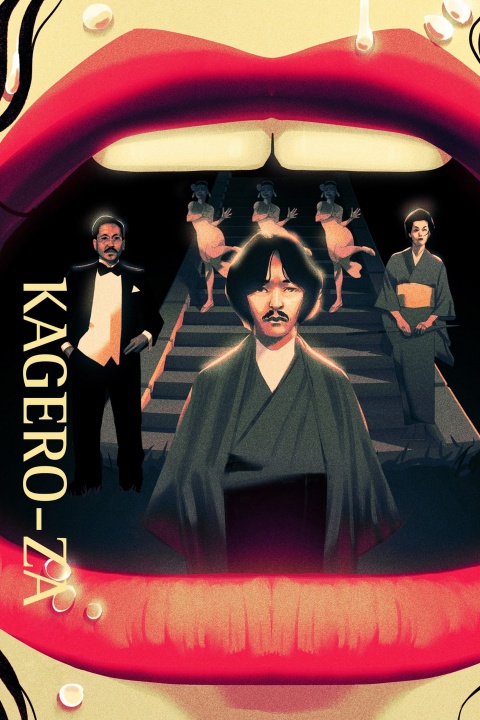
Review #2,691
Dir. Seijun Suzuki
1981 | Japan | Drama, Romance, Fantasy | 140 min | 1.37:1 | Japanese
M18 (passed clean) for some gore and sexual content
Cast: Yusaku Matsuda, Michiyo Yasuda, Eriko Kusuta
Plot: Matsuzaki is a playwright in 1926 Tokyo supported by a wealthy patron. One evening, Matsuzaki crosses paths with a beautiful and mysterious woman, leading to an odyssey of infidelity and obsession.
Awards: Official Selection (Venice)
Source: Japan Foundation
Accessibility Index
Subject Matter: Moderate – Spectrality; Art & Theatre; Existence & Death; Infidelity
Narrative Style: Complex
Pace: Slightly Slow
Audience Type: General Arthouse
Viewed: Screener
Spoilers: No
I didn’t find myself truly loving it, but Kagero-za has enough to enthral arthouse viewers who possess more adventurous tastebuds.
As part of his ‘Taisho’ trilogy, which includes Zigeunerweisen (1980) and Yumeji (1991), Kagero-za is considered by some critics to be the crowning achievement of director Seijun Suzuki’s late career phase.
Best known for his stylistic yakuza flicks such as Tokyo Drifter (1966) and Branded to Kill (1967), Suzuki’s artistic chops have rarely been questioned even in more mainstream modes of filmmaking.
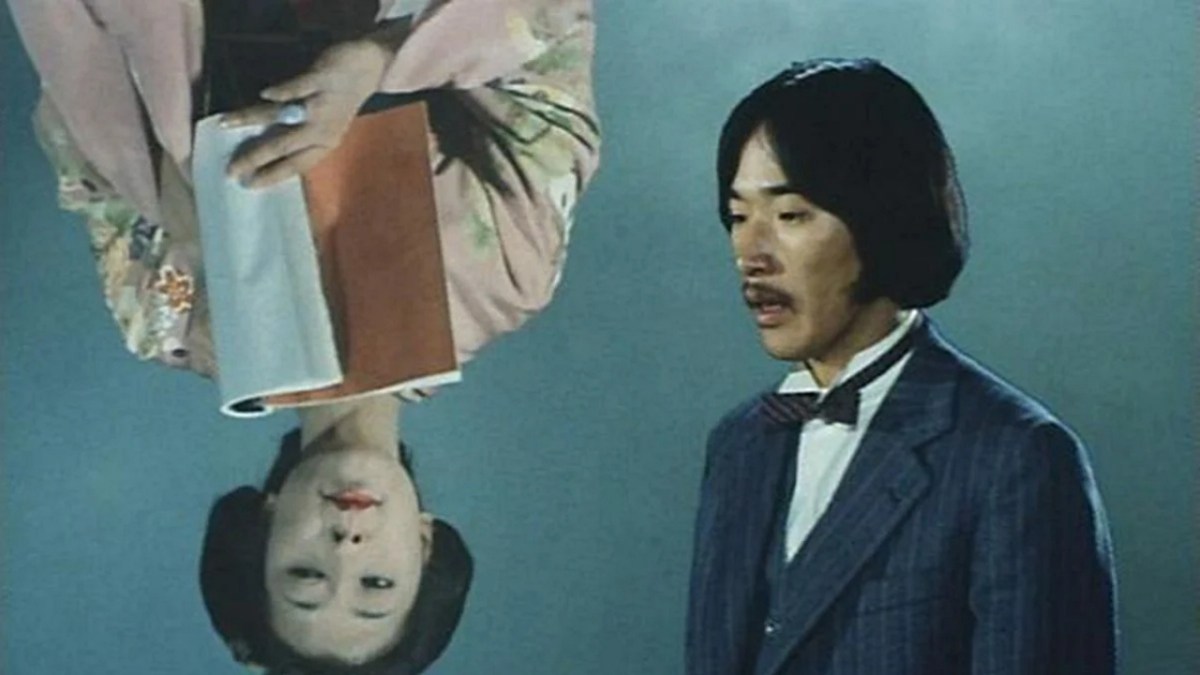
In Kagero-za, we see him pushing film language and storytelling to inscrutable levels as a playwright, Matsuzaki, becomes suspicious of his fleeting encounters with a mysterious woman who might be a ghost.
Suzuki’s work is one of shifting realities, fictive or otherwise, as the conceit of theatre and performance creates a meta experience, marked by an acute sense of spectrality as well as moments of surrealism that would impress even, say, Bunuel.
“Am I to consider this your soul?”
One ritualistic sequence sees two men looking through the holes at the bottom of what appears to be religious figurines, revealing some shocking images of writhing genitalia.
Another scene sees two women on a boat as it sails from left to right, but Suzuki repeats it with one tighter shot after another, in what seems like the cinematic equivalent of doing a ‘double’ or ‘triple’ take.
It is difficult to pinpoint what is unfathomable about the film’s bizarre visual and narrative logic but Suzuki’s bravura direction makes it at least weirdly transfixing for most of its rather long two-hour-plus runtime.
Set in the 1920s, the attention to period detail is excellent even if everything feels constructed and dreamlike; its music has echoes of Toru Takemitsu, and the art direction is eye-popping at times. Kagero-za is worth a look, a film that is aware of its own enigma.
Grade: B+
Trailer:
 Eternality Tan
[…] Kagero-za (1981) […]
LikeLike