







Antonioni’s first English-language film sees him in peak form, delivering a countercultural classic that is a masterclass in exploring the art and enigma of seeing, creating and deconstructing images.

Review #1,482
Dir. Michelangelo Antonioni
1966 | UK | Drama, Mystery, Thriller | 111 mins | 1.85:1 | English
M18 (passed clean) for some nudity
Cast: David Hemmings, Vanessa Redgrave, Sarah Miles
Plot: A London photographer finds something very suspicious in the shots he has taken of a mysterious beauty in a desolate park.
Awards: Won Palme d’Or (Cannes); Nom. for 2 Oscars – Best Director, Best Original Screenplay
Distributor: Warner
Accessibility Index
Subject Matter: Moderate – Loneliness & Alienation; Engima of Seeing; Photography
Narrative Style: Slightly Complex
Pace: Slightly Slow
Audience Type: Sightly Arthouse
Viewed: Criterion Blu-ray
First Published: 12 Aug 2017
Spoilers: No
Michelangelo Antonioni already had films like L’avventura (1960), La Notte (1961), L’eclisse (1962) and Red Desert (1964) to his name before he released Blow-Up in 1966, his first English-language film, and arguably his most accessible in his canon. Very rarely have we seen a filmmaker delivering such an enviable and astonishing stretch of films.
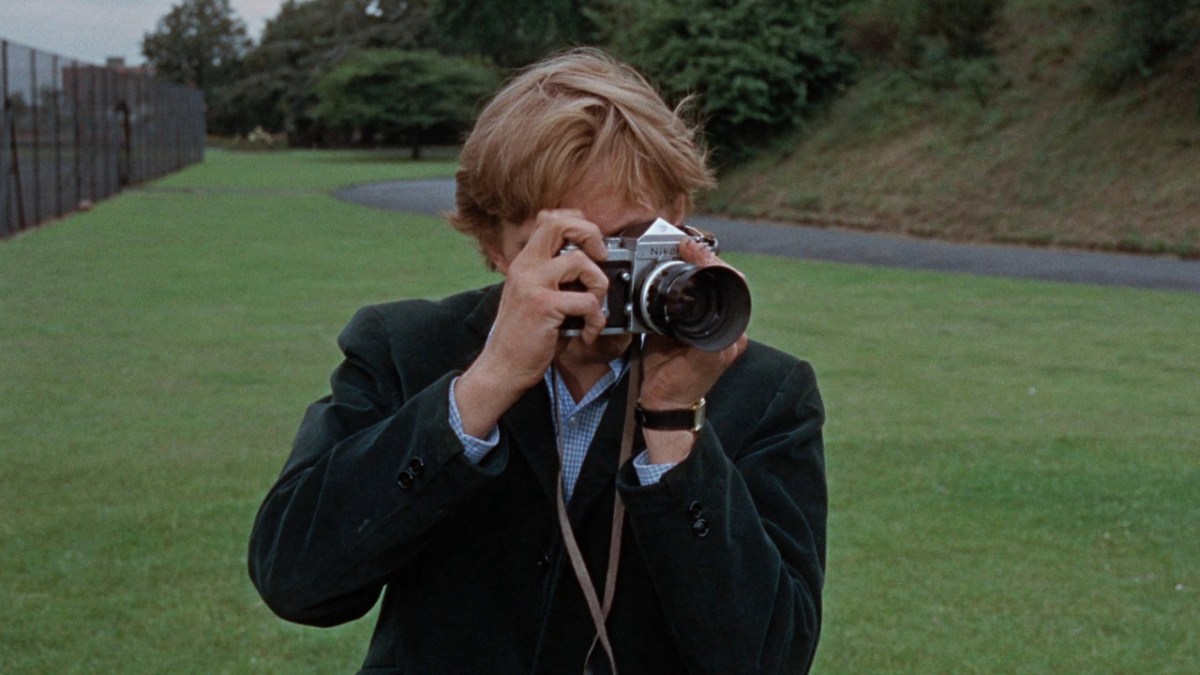
Winner of the Cannes Palme d’Or, Blow-Up stars David Hemmings as Thomas, a fashion photographer who works primarily with models in bizarrely-designed photoshoots.
As egotistical as he is an accomplished pro, Thomas chances upon a woman (played by a shifty Vanessa Redgrave) with a man in an empty park one day, and takes random shots of them. When he returns to his studio, he becomes convinced that there is something very suspicious in the photos he has taken.
Part haunting mystery, part free-wheeling countercultural classic, Antonioni’s work is also fairly erotic, with Thomas being seduced by Redgrave’s character, and in a later sequence, having his work cut out entertaining two young wannabe models dressed in revealing clothes.
But Antonioni balances this undercurrent of sexuality with the tension of a potential murder. All these make for a riveting watch, though the film takes a while to hook you.
“Nothing like a little disaster for sorting things out.”
The sequence where Thomas goes back to the park in the middle of the night is unbearably tense, and so is his obsession with blowing up his photos to try to confirm his suspicions of murder.
I don’t know about you, but seeing blown-up black-and-white images and trying to look for things that are or aren’t there scare the hell out of me. It is as if one is peering back in time to locate a single, specific moment of clarity—and trauma.
Blow-Up is undoubtedly a masterclass in exploring the art and enigma of seeing, and the creation and deconstruction of images. Its “tennis” epilogue is one of the most brilliant sequences of Antonioni’s oeuvre, evoking complex feelings of ambiguity, loss, irony and even existential dread.
Such is the film’s cultural influence that Brian De Palma loosely remade it as Blow Out (1981), changing the focus to sound rather than image. Even Edward Yang’s The Terrorizers (1986) owes some debt to Antonioni’s work.
Blow-Up remains an important cinematic representation—and to some degree, a culmination—of the director’s thematic preoccupations with the spatial and temporal elements of image making, and how the individual is often in a quandary, dwarfed or overwhelmed by unseen forces that threaten to pull him or her into oblivion.
Grade: A
Trailer:
Music:
 Eternality Tan
[…] of Italy), but was flanked by two other great features that were primarily shot in Western Europe—Blow-Up (1966) and The Passenger (1975)—that were part of the MGM […]
LikeLike
[…] with Blow-Up (1966), The Passenger represents a high watermark of Antonioni’s foray into […]
LikeLike
[…] La piscine sees Deray milking the sexual tension between two sets of people—a couple played by Alain Delon and Romy Schneider, both flaunting their tanned bodies, and a father-daughter duo played by Maurice Ronet and Taylor Swift-lookalike newcomer Jane Birkin (fresh from Antonioni’s 1966 countercultural classic, Blow-Up). […]
LikeLike