





Probably Miyazaki’s most epic film inasmuch as it is a pure fantasy-adventure with strong themes of peaceful co-existence as battles are waged among humans, animals and spirits.

Review #2,667
Dir. Hayao Miyazaki
1997 | Japan | Animation, Adventure, Fantasy | 133 min | 1.85:1 | Japanese
PG (passed clean) for images of violence and gore
Cast: Youji Matsuda, Yuriko Ishida, Yūko Tanaka
Plot: On a journey to find the cure for a Tatarigami’s curse, Ashitaka finds himself in the middle of a war between the forest gods and Tatara, a mining colony. In this quest, he also meets San, the Mononoke Hime.
Awards: –
Distributor: Studio Ghibli
Accessibility Index
Subject Matter: Moderate – Ecological Crisis; Humans vs. Animals vs. Spirits; Co-Existence
Narrative Style: Slightly Complex
Pace: Normal
Audience Type: Mainstream
Viewed: Netflix
Spoilers: No
Princess Mononoke is still Hayao Miyazaki’s most epic film to date, with a growing chorus of fans suggesting that it might be his greatest achievement.
Its deserved success in Japan and the West (it was probably the film that truly elevated Studio Ghibli—and Japanese anime—into mainstream popular consciousness) meant that Miyazaki’s planned retirement would be postponed. His follow-up, Spirited Away (2001), would win the Oscar for Best Animated Feature.
Princess Mononoke is like Castle in the Sky (1986) inasmuch as it is a pure fantasy-adventure, full of moments that are visceral and emotional as its grand world-building provides the setting needed for a story with equally unmodest aims.
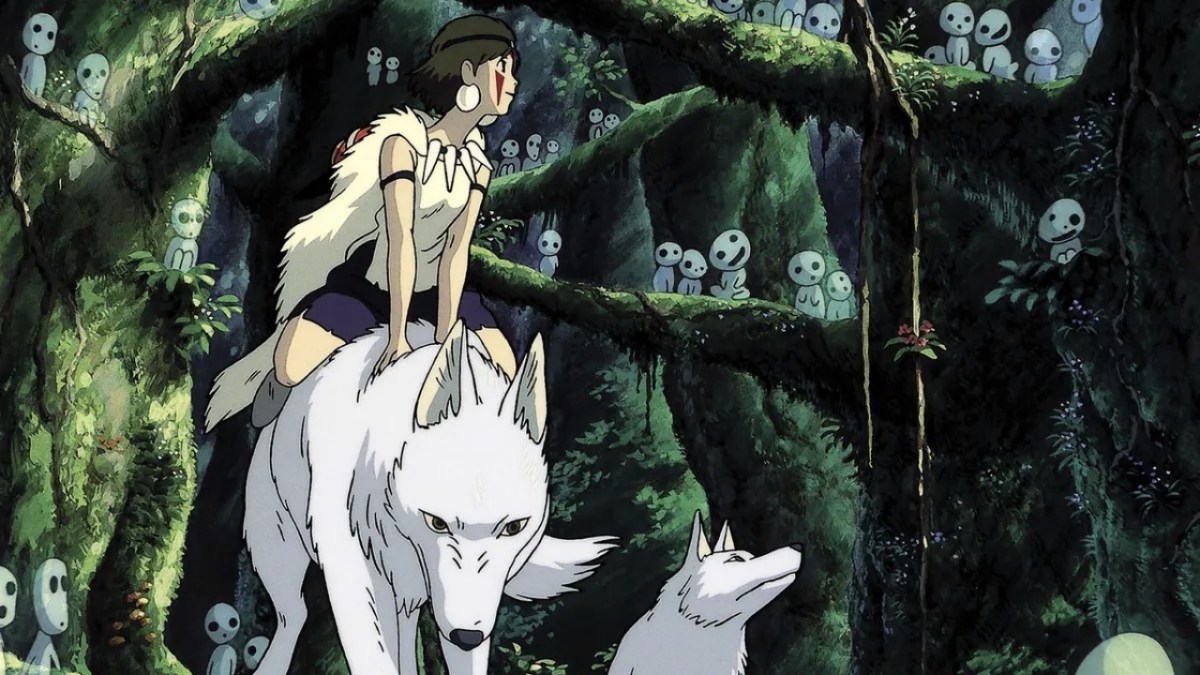
Prince Ashitaka is attacked by a demonic wild boar and has to find a way to evade the certainty of death. In his journey to find the Forest Spirit that might be able to cure him, he meets Lady Eboshi who runs a mining colony without sparing a thought for the environment, and more intriguingly, San, the titular Wolf Girl, who swears to protect the forest from human encroachment and the animals from genocide.
“Life is suffering. It is hard. The world is cursed. But still, you find reasons to keep living.”
It’s not easy to navigate the complex politics of greed, power and despair as battles are waged among humans, animals and spirits.
Like in many other films of his, Miyazaki’s fierce anti-war advocation for peaceful co-existence perhaps reaches its sharpest alignment here. At the same time, he doesn’t give us easy black-and-white answers and doesn’t depict any side as particularly good or evil.
Everyone’s a victim of circumstance in this cursed world—this is the thematic power of Princess Mononoke expressed in one stunning shot after another. It is also the closest—and perhaps the only time—that Miyazaki has channelled the spirit of Kurosawa, with visual influences from Ran (1985) particularly.
It also happens to be Miyazaki’s most violent film, what with instances of severed limbs and decapitations that seem more at home in cult anime than something more decidedly mainstream as this.
Grade: A+
Trailer:
Music:
 Eternality Tan
[…] Princess Mononoke (1997) […]
LikeLike
[…] Princess Mononoke (1997) […]
LikeLike
[…] Studio Ghibli, his subsequent works such as Castle in the Sky (1986), Porco Rosso (1992) and Princess Mononoke (1997) had more depth and nuance, and along with composer Joe Hisaishi’s iconic scores, […]
LikeLike