







Shot entirely on a soundstage in France, this Cannes Camera d’Or-winner put Vietnamese cinema on the world map, as Tran straddled between formal artistry and the artifice of cultural self-exotification in this quaint film about a quiet servant-girl working for an affluent family.
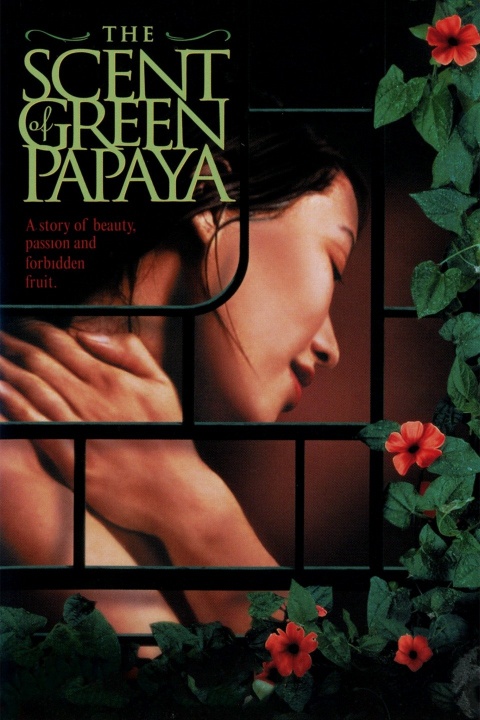
Review #2,652
Dir. Tran Anh Hung
1993 | Vietnam, France | Drama | 104 min | 1.66:1 | Vietnamese
PG (passed clean)
Cast: Tran Nu Yen, Khe Man San Lu, Thi Loc Truong
Plot: A Vietnamese servant girl, Mui, observes lives within two different Saigon families: the first, a woman textile seller with three boys and a frequently absent husband; the second, a handsome young pianist with his fiancée.
Awards: Won Camera d’Or & Award of the Youth (Cannes); Nom. for Best Foreign Language Film (Oscars)
International Sales: Le Pacte
Accessibility Index
Subject Matter: Moderate – Family, Wealth & Class
Narrative Style: Straightforward
Pace: Slightly Slow
Audience Type: Slightly Arthouse
Viewed: MUBI
Spoilers: No
Such was the cultural impact of Tran Anh Hung’s debut feature that it not only won the Camera d’Or prize at Cannes but also scored an Oscar nomination for Best Foreign Language Film for Vietnam in a year with Lee Ang’s The Wedding Banquet and Chen Kaige’s Farewell My Concubine (the Oscar eventually went to Belle Epoque, a Spanish film hardly anyone remembers today).
What will hit you from the first frame of The Scent of Green Papaya is its formal artistry marked by precise mise-en-scene and a cacophony of sounds that would never abate.
The sounds of insects and birds fill the air, and so are the melodies from someone plucking an ethnic string instrument; at the same time, we also hear the sounds of domesticity—cleaning, washing, cooking, etc.
For much of Tran’s beautiful work, we feel a sense of not just class differences but also the tension between tradition and modernity through sound.
In one scene, someone practises Debussy’s ‘Claire de Lune’ on the piano, signalling the prospect of Western self-realisation; in another, a woodblock is tapped regularly by another character in deep prayer, marking an inability to move on from one’s past.
“You’re lucky. At your age, you still have sweet dreams.”
In the film’s most enigmatic scene, we hear a fighter jet roaring past, a foreshadowing of the Vietnam War perhaps?
The story is straightforward: a quiet servant-girl works for an affluent family whose master is troubled. She is, however, more preoccupied with nature than man-made problems.
Tran’s quaint film was entirely shot on a sound stage in France—and in some way, it shows; in an attempt to (re)create Saigon, what might be intended as cultural authenticity may at once also appear to be cultural self-exotification.
This gives Green Papaya a visual dissonance that is amplified by the film’s original score, which may be described as tonally unsettling yet caressing, much like a spiritual antecedent to Jonny Greenwood’s music for P.T. Anderson’s The Master (2012) and Phantom Thread (2017).
I couldn’t care much about Tran’s work emotionally, but sensorially—and perhaps sensually—it is quite an experience to behold.
Grade: A-
Trailer:
Music:
 Eternality Tan
[…] Anh Hung hasn’t made many films since his auspicious Cannes Camera d’Or-winning feature debut The Scent of Green Papaya in 1993, but with his latest, The Taste of Things, only his seventh feature in 30 years, he […]
LikeLike