





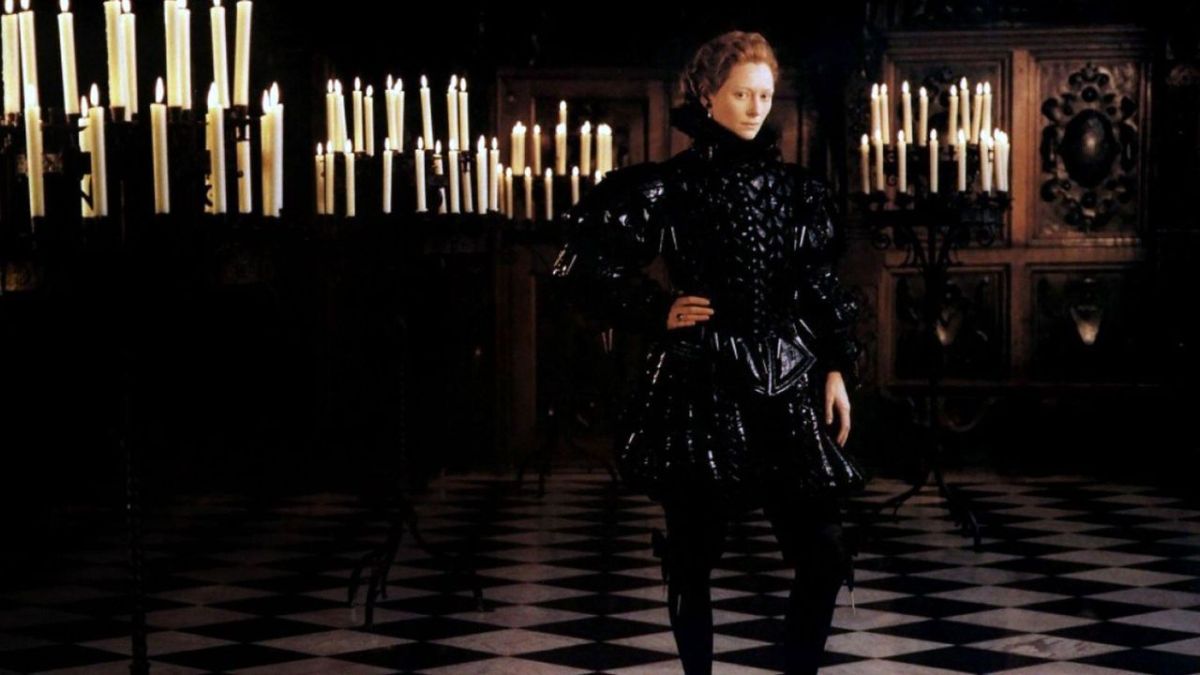
Swinton’s sublime gender-fluid performance is one for the ages (well, quite literally), giving Potter’s one-of-a-kind adaptation of the unfilmable Virginia Woolf novel its consistent anchor, as it explores the human mind’s preoccupation with both existential and corporeal torments and pleasures.
Review #3,051
Dir. Sally Potter
1992 | UK, Russia | Drama, Fantasy | 93min | 1.85:1 | English & French
M18 (passed clean) for nudity
Cast: Tilda Swinton, Billy Zane, Lothaire Bluteau, John Wood, Charlotte Valandrey
Plot: Young aristocrat Orlando begins a quest for love and freedom in the court of Elizabeth I as a man. He is granted favours and property by the queen, who commands the nobleman to never change. Orlando completes the search 400 years later as a woman, shaking off their biological and cultural destiny.
Awards: Won OCIC Award, Golden Ciak, Elvira Notari Prize & Nom. for Golden Lion (Venice); Nom. for 2 Oscars – Best Art Direction-Set Decoration, Best Costume Design
Source: The Sales Company
Accessibility Index
Subject Matter: Moderate – Gender; History & Society; Immortality; Torments & Pleasures
Narrative Style: Slightly Complex
Pace: Slightly Slow
Audience Type: Slightly Arthouse
Viewed: MUBI
Spoilers: No
I feel like I’ve been missing out on this for a long time, despite several opportunities to see it over the years. Now that I’ve seen it and finally realised that it is so good, it amplifies the hurt for not giving it a chance. Better late than never, I guess.
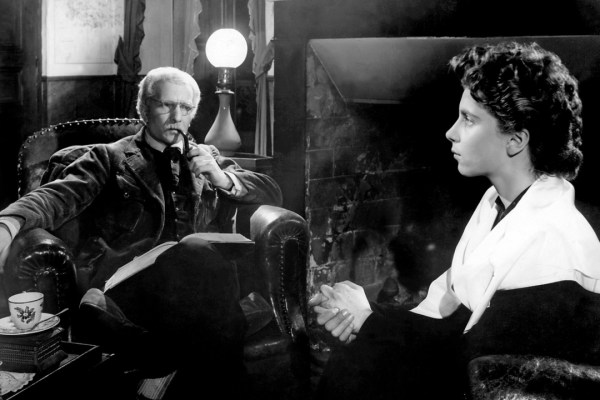
Tilda Swinton plays Orlando, a young man born into the aristocracy during the time of Elizabeth I. The queen bestows him with property and gifts, demanding that he should never change.
And indeed so, as Orlando moves through the centuries without ageing, in search of such notions as love and freedom, rendered in both tangible and abstract ways by director Sally Potter, whose one-of-the-kind adaptation of Virginia Woolf’s unfilmable 1928 book remains a high watermark in terms of creative visual storytelling vis-à-vis historical fiction.
Orlando is a figure ahead of his time, or her time, as he transitions into a woman in a sublime scene midway. Swinton’s gender-fluid performance is one for the ages (well, quite literally), and with the lavish costumes and production design, it is a visual feast for the eyes.
“I think you suffer from a strange melancholy.”
The ears as well, with David Motion’s highly instrumented music (his only feature film score) giving a fascinating soundscape by turns ethereal, stately, and even jivey.
Broken into several titled segments, such as ‘Death’, ‘Love’, ‘Poetry’, etc., and in one called ‘Politics’, shot beautifully in Uzbekistan, much of the human mind’s preoccupation with both existential and corporeal torments and pleasures is experienced wholly by Orlando.
It’s quite amazing to see Orlando work so well, despite the disparate elements and the rather heady themes. In fact, to say that Potter’s work is transcendental is not an overstatement.
It is also a cheeky film, with Potter giving Swinton the license to break the fourth wall multiple times, whispering to audiences what the character is momentarily thinking. At times, it is just a simple cosmic glance across time, space and the screen, revealing a whole universe of articulations.
Grade: A
Trailer:
Music:
 Eternality Tan