



A contemplative exploration of neediness and the transient nature of human connection, Hong’s drama about creative paralysis sees a film director having a fling with his friend’s girlfriend, sparking psychological clarity.
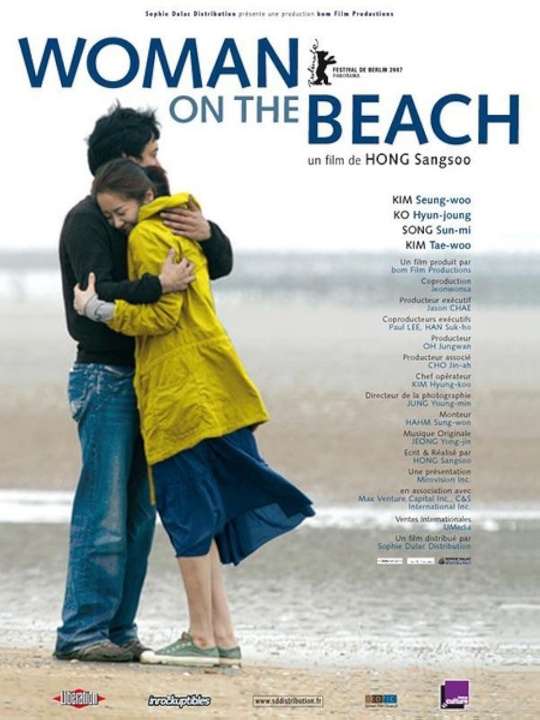
Review #3,025
Dir. Hong Sang-soo
2006 | South Korea | Drama, Romance | 127min | 1.85:1 | Korean
PG13 (passed clean) for some coarse language
Cast: Kim Seung-woo, Ko Hyun-jung, Song Sun-mi, Kim Tae-woo, Choi Ban-ya
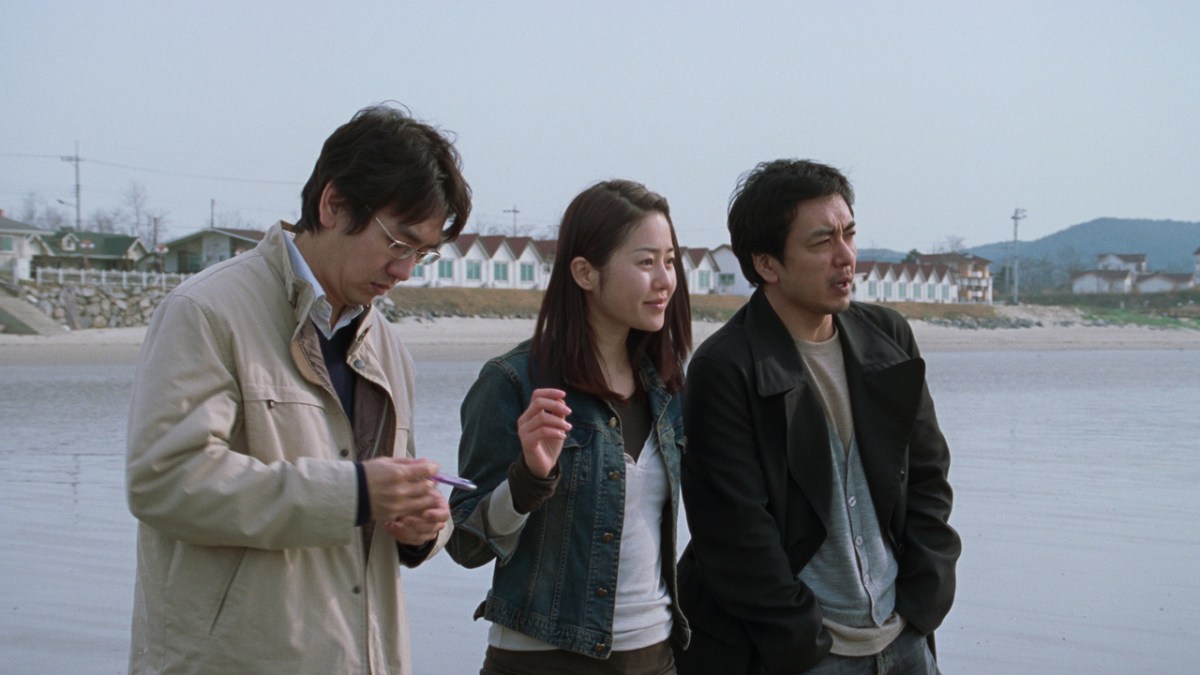
Plot: Stymied by writer’s block while crafting his latest script, director Kim Jung-rae persuades his friend Won Chang-wook to drive him to a beach resort where he promptly becomes involved with Chang-wook’s girlfriend. Abandoning her and taking up with another woman, Jung-rae winds up creating enough drama to inspire his writing.
Awards: Official Selection (Toronto)
International Sales: Finecut
Accessibility Index
Subject Matter: Moderate – Creative Paralysis; Scriptwriting; Love Triangle
Narrative Style: Slightly Complex
Pace: Slightly Slow
Audience Type: Slightly Arthouse
Viewed: Oldham Theatre (as part of Asian Film Archive’s ‘Twin Tales: Eric Rohmer x Hong Sang-soo’ programme)
Spoilers: No
A film director asks a friend to join him for a retreat at the beach, in hopes of overcoming a frustrating case of writer’s block. He needs to pen a script soon, but his treatment doesn’t seem to be reaching anywhere productive. They go together, but Chang-wook, the friend, brings along his girlfriend, Mun-suk.
As you can tell, a ‘love triangle’ is probably going to form in this scenario, and in true Hong Sang-soo fashion, Woman on the Beach (not to be confused with his On the Beach at Night Alone from 2017) becomes a case about the intricacies of romances (or more accurately, flings) and the highly transient nature of human connection.
People can be needy at certain points in their lives. They need companionship, away from familiar loved ones; they need sex with others to feel better; they also need a hard dose of reality to shake them awake from their psychological stupor.
Jung-rae, the director, must find a hook somewhere that will inspire him creatively again. That hook is in people. Why do they live? What do they look forward to? Why are they also on the beach?
“We’re repeating images imprinted on us by others.”
Hong’s style is conversational and poetic, as we already know, but there is something about setting a narrative against a large water body that makes any work a tad more contemplative. This is apparent in, say, Hong’s In Another Country (2012), and at a more experimental level, In Water (2023).
Perhaps ‘Women on the Beach’ might be more apt as the title, because Hong doesn’t just deal with a love triangle but a love quadrangle.
It is thus fitting that Jung-rae, in one extended scene, tries to explain the mysteries of life, impressions and images by drawing on a piece of paper. His diagrams have either more than three sides or look like wavy clouds as he connects dots with multidirectional lines.
Isn’t that how life appears to be—nebulous and indeterminate, and that it isn’t necessarily a bad thing?
Grade: B+
Music:
 Eternality Tan