








Enyedi’s dreamlike debut feature has a fabulist tone, though its thematic exploration of political and technological developments in modern human history never comes into full realisation, as the film charts the lives of a pair of orphaned twins who go their separate ways.
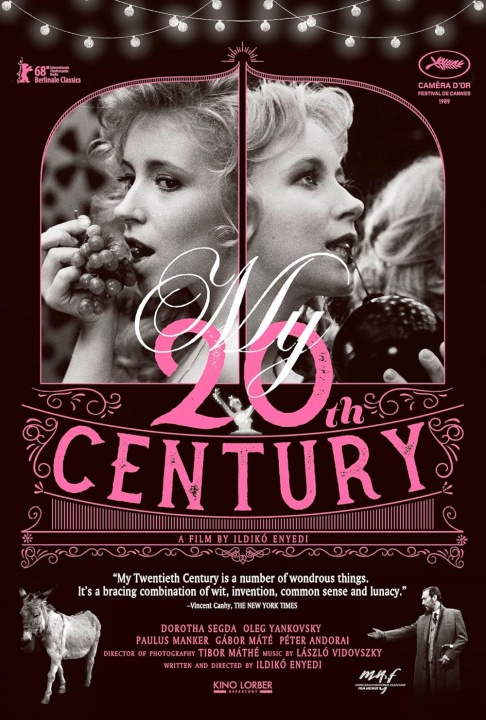
Review #3,015
Dir. Ildiko Enyedi
1989 | Hungary | Drama | 103min | 1.37:1 | Hungarian
Not rated – likely to be M18 for sexual scene and nudity
Cast: Dorota Segda, Paulus Manker, Peter Andorai, Gabor Mate, Eszter Kovacs
Plot: Born on the day Edison invented the light bulb, Dora and Lili are separated in childhood after their mother’s death, and follow different paths. They meet again on the Orient Express in 1899, one a con woman, scamming money from men, the other a member of a group of feminist revolutionaries.
Awards: Won Camera d’Or (Cannes)
Source: Hungarian Film Institute
Accessibility Index
Subject Matter: Moderate – Different Life Paths; Society & Politics; Inventions
Narrative Style: Slightly Complex
Pace: Slightly Slow
Audience Type: Arthouse
Viewed: Screener
Spoilers: No
Best known for winning the Berlinale Golden Bear for On Body and Soul (2017), Hungarian filmmaker Ildiko Enyedi first made some waves with her debut feature, the Cannes Camera d’Or-winning My Twentieth Century.
I’m not quite sure what to make of the film, but it will definitely appeal to, whilst at the same time, frustrating the arthouse crowd.
Enyedi’s artistry is impeccable, as her stylish, if occasionally surreal visuals, rendered in dreamy black-and-white, give us a fairy-tale-like effect.
The fabulist nature of My Twentieth Century somewhat helps in sustaining our interest, though it is clear after a while that, story-wise, there is no real thrust in this loosely-plotted, vignette-like piece centering on two women as they lead separate lives.
They are orphaned twins, but were born when Thomas Edison first presented his invention of the electric light bulb. Dora is a faux-aristocrat, scamming rich men into being with her, whereas Lili is a bomb-toting feminist anarchist.
“This is a wonderful world created by God. And so is Man, who is learning to mould this wonderful world.”
So, we have two different personalities and ideologies at play, which Enyedi doesn’t quite dive deeper into. A waste, I’d say.
Thematically, the film seems to grasp at something substantial and thought-provoking, perhaps a biting sociopolitical commentary on, as its title suggests, the 20th century. But that never comes into full realisation.
We even see someone playing Nikola Tesla, and with Edison’s technological inventions, we somewhat feel humanity is at the cusp of something epoch-changing, and indeed that is true, as the last century was really quite something in the history of modern civilisation.
At the same time, the two opposing women, as mentioned, suggest a foreshadowing of sorts of the political ideologies that would brutally divide humanity, namely the rise of Western exploitative capitalism, and in other parts of the world, Communist-leaning revolutions.
But you see, all these are being inferred by the assumedly critical viewer, though defenders of Enyedi’s work might argue that to explore these political and technological themes too head-on would be too didactic.
So there you go, it is an enigmatic film for sure, but with subtexts that feel way too slight. I’m still waiting for it to impress me.
Grade: B-
Trailer:
 Eternality Tan