





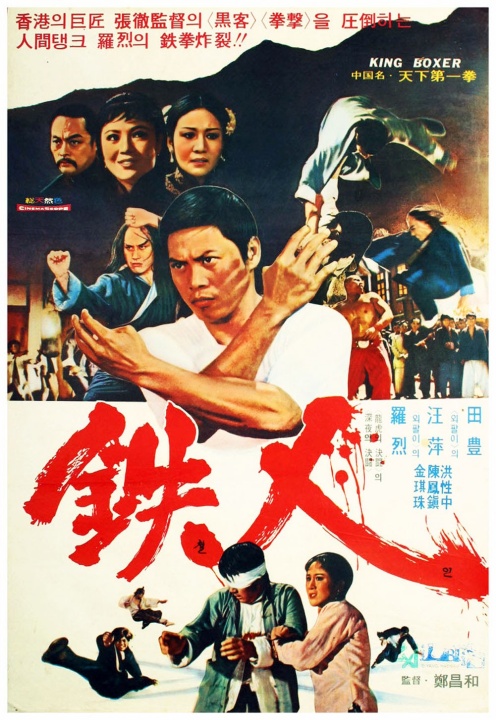
A great non-Bruce Lee entry point to the kung fu craze of the early ‘70s, this is fundamental viewing for fans of HK martial arts movies as Lo Lieh stars as a young man who becomes embroiled in a hostile school rivalry that turns increasingly brutal.
Review #3,011
Dir. Jeong Chang-hwa
1972 | Hong Kong | Action, Drama | 104min | 2.35:1 | Mandarin
NC16 (passed clean) for some strong violence
Cast: Lo Lieh, Wang Ping, Huang Chin-feng, Tien Feng, Tung Lam
Plot: As two martial arts schools prepare for an important tournament, one school’s master is a dishonourable man, and to ensure his son wins the title, he hires three Japanese samurai, who target the rival school’s best fighter.
Awards: –
Distributor: Shaw Brothers
Accessibility Index
Subject Matter: Moderate – Martial Arts Rivalry; Dishonour & Integrity
Narrative Style: Straightforward
Pace: Normal
Audience Type: Slightly Mainstream
Viewed: MUBI
Spoilers: No
Fundamental viewing for all fans of Hong Kong martial arts movies, King Boxer is a great entry point to the kung fu craze of the early ‘70s. Heck, I daresay that it is more intriguing than some of Bruce Lee’s films.
Starring Lo Lieh in one of his iconic roles, King Boxer is also director Jeong Chang-hwa’s best-known film, rebranded in the States as Five Fingers of Death.
Jeong is currently still alive at the time of this writing (believe it or not, he will turn 97 by the end of the year), and it is interesting to learn of a South Korean director making some headway during the heyday of the Hong Kong action film industry.
Lo Lieh stars as Chih-Hao, a young martial artist who hopes to level up his skills by training at a top school, only to become embroiled in a hostile rivalry with another school hoping to usurp him in a critical tournament.
“A martial artist must watch his every step carefully.”
Becoming increasingly violent and gory, King Boxer takes itself seriously as a work about the determination to overcome the worst evil tendencies of one’s opponent.
Chih-Hao learns the coveted Iron Palm technique, which not only makes his arms and fists glow red before using it, but also announces itself sonically with the iconic opening leitmotif taken from Quincy Jones ‘Ironside’.
This same leitmotif was most famously used (in a slightly fuller version) by Quentin Tarantino in his ‘Kill Bill’ movies.
Most of the time, story and character development take a backseat in these types of films, but King Boxer delivers not just finely choreographed action but also a well-constructed narrative to boot, one that compels you to follow Chih-Hao till the end as he meets one seemingly insurmountable obstacle after another.
Yet, Jeong doesn’t portray him to be invincible, and even with his hard-earned Iron Palm technique at his disposal, there is a sense of vulnerability at any given moment before a fight—that he might just meet his match.
Grade: B+
Trailer:
 Eternality Tan
[…] Lieh (yes, that guy from 1972’s King Boxer) has a supporting role as Pearl’s embittered police officer […]
LikeLike