









Love is a complicated, nebulous thing in Bresson’s minimalist, if surprisingly sensual, adaptation of Dostoevsky’s ‘White Nights’, about two wounded, disillusioned souls that can’t seem to operate beyond their present malaise.
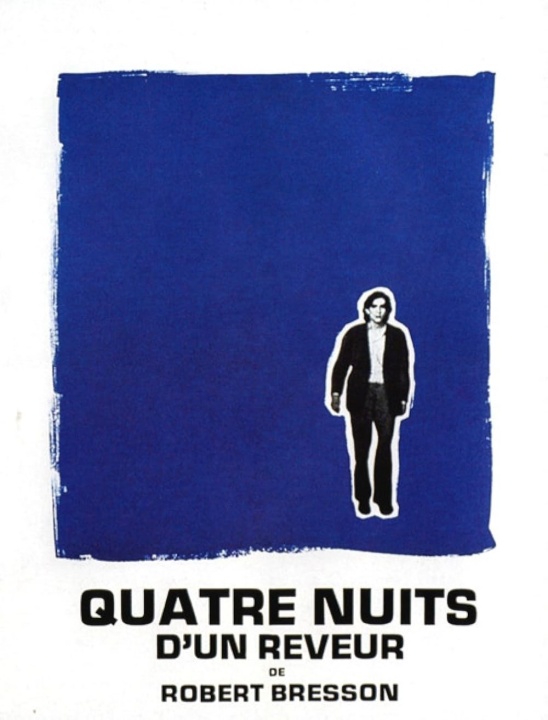
Review #3,008
Dir. Robert Bresson
1971 | France | Drama, Romance | 87min | 1.66:1 | French
Not rated – likely to be M18 for nudity
Cast: Isabelle Weingarten, Guillaume des Forets, Jean-Maurice Monnoyer
Plot: Jacques, a young man with artistic aspirations, spends four nights wandering Paris with a young woman whom he rescued from suicide.
Awards: Won OCIC Award & Nom. for Golden Bear (Berlinale)
Distributor: MK2
Accessibility Index
Subject Matter: Moderate – Wounded Souls; Romantic Complications
Narrative Style: Straightforward
Pace: Slow
Audience Type: General Arthouse
Viewed: MUBI
Spoilers: No
Made at the start of his post-Mouchette late career phase, the lesser-known Four Nights of a Dreamer may not be Robert Bresson at his peak, but it is still worth seeing if you are a completist or interested in Dostoevsky, particularly the Russian writer’s 1848 short story, ‘White Nights’.
Adapted more famously by Luchino Visconti as Le notti blanche (1957), Bresson’s treatise is unsurprisingly much less melodramatic.
Following his minimalist style, one that is stripped of the emotion and illusion of acting, Four Nights of a Dreamer sees Jacques, a painter, who prevents Marthe, a suicidal woman, from jumping off a bridge.
Over the course of several nights, their encounters reveal not just each individual’s backstory, but their ‘affection’ for each other. With Marthe waiting for a lover to turn up after a year, the promise doesn’t seem to have been kept, causing anxiety.
Jacques, who becomes increasingly obsessed with Marthe, offers a tantalising prospect—another possibility at love, with him. But what future does love bring, really, when two wounded, disillusioned souls can’t seem to operate beyond their present malaise?
“I would not blame you for forgetting me, but I know you could not cause such grief to one who loves you.”
Bresson wasn’t associated with sensuality in terms of his filmmaking, but with Four Nights of a Dreamer, he came close.
Scenes of graceful seduction and tasteful nudity aside, the film mostly comes alive at night, when diegetic music literally fades in and out of the frame, be it ethnically diverse musicians on a river cruise harmonising under the shimmering moonlight, or someone lightly strumming a guitar under a glowing street lamp.
These are the sensual moments of life, savoured quietly by Jacques and Marthe, as they momentarily forget about the future they must inevitably decide.
I came into Bresson’s work without knowing how it plays out in Dostoevsky’s original text, nor have I seen Visconti’s film yet. All I can say is that love is a complicated, nebulous thing, and it’s always all about timing.
Grade: B+
Trailer:
 Eternality Tan