








More political than it appears to be, Sora’s first narrative feature explores the punitive impact of heightened school surveillance as several students rebel against oppression in an increasingly destabilised Japanese society.
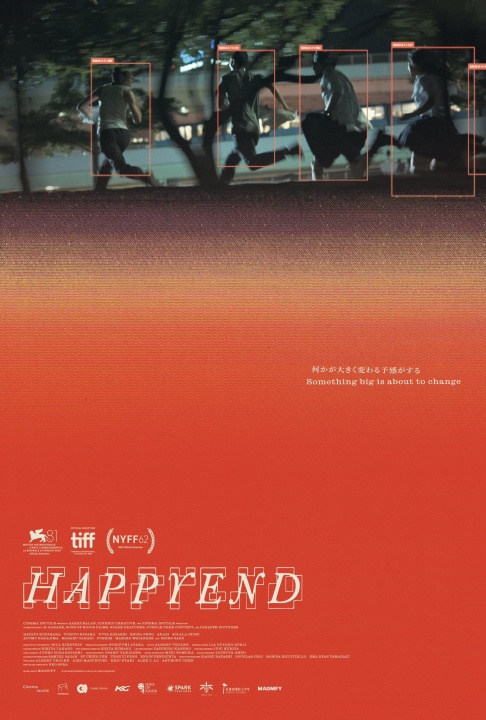
Review #2,983
Dir. Neo Sora
2024 | Japan | Drama | 113min | 1.85:1 | Japanese
PG13 (passed clean) for some coarse language
Cast: Hayato Kurihara, Yukito Hidaka, Yuta Hayashi, Shina Peng, Arazi
Plot: In near-future Tokyo, the threat of a catastrophic quake looms. Two friends prank their principal before graduation, leading to school surveillance installation.
Awards: Nom. for Orrizonti Award (Venice)
International Sales: Magnify (SG: Giraffe Pictures)
Accessibility Index
Subject Matter: Moderate – Rebellious Youths; Surveillance in School; Identity Politics
Narrative Style: Straightforward
Pace: Normal
Audience Type: Slightly Arthouse
Viewed: Screener
Spoilers: No
If Ryuichi Sakamoto were still alive, you could have bet your life savings on him scoring for his son’s debut narrative feature.
Fresh from giving his late father the best platform to perform for his fans one last time in the elegiac Ryuichi Sakamoto: Opus (2023), Neo Sora opens and closes Happyend with the kind of ‘80s style neo-synth music that Sakamoto would have been proud of producing, composed by Lia Ouyang Rusli.
The film also shares the same name as one of Sakamoto’s tracks. While sometimes it is a burden to have the legacy of a famous parent weigh on one’s shoulder, Happyend shows us exactly how an artist, in this case, a filmmaker, can chart his own path in a clear-eyed way.
Like the anti-establishment protagonists in the film, Sora isn’t afraid to imagine a Japan that is politically destabilised in the near future.
As protestors dutifully line the streets and the threat of a catastrophic megaquake looms, Sora situates his restless youths mostly in the school setting, as two of them exploit the principal’s car as a prank.
“It’s our school’s motto to properly listen to what our students have to say.”
As a result, cameras are installed in every nook and corner to deter the ‘security threat’, and linked to a system that awards students demerit points for every school rule flouted.
A coming-of-age work that feels naturalistic in its unadorned if carefree filmmaking style and performances, Happyend explores not just the punitive impact of heightened surveillance but also identity politics.
As certain groups of students question their discriminatory treatment because they aren’t full-blooded Japanese, the very ‘microcosm’ of the school becomes a barometer of how different factions of society think about privilege, authority and self-determination.
Perhaps that’s why the powerful sweep of Rusli’s music evokes, at least to me, the sonic echoes of the main theme in Hou Hsiao-Hsien’s A City of Sadness (1989).
Although both are different films—one looks back on post-WWII Taiwanese historical trauma, the other at a portentous Japanese neo-future—they tell us of oppressive societies where the right to belong can be unreservedly questioned by those in collusion with power.
Grade: B+
Trailer:
Music:
 Eternality Tan
Yup, I too thought of Hou’s “A City of Sadness” upon hearing that main theme – rather clear that Rusli (and Sora perhaps?) were paying homage to the maestro
LikeLiked by 1 person
Interestingly, the music in Hou’s film was by the Japanese new-age electronic group S.E.N.S.
LikeLike