






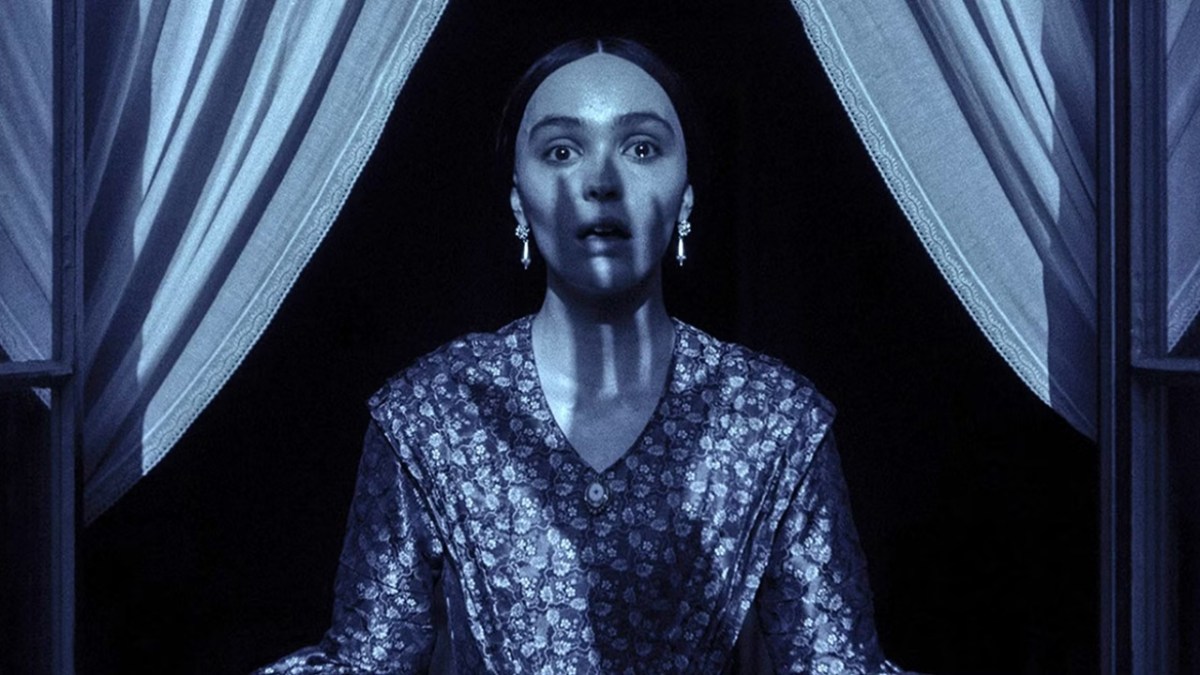
Eggers’ most commercial work has little to savour narratively, though it is backed by committed performances from Lily-Rose Depp and Bill Skarsgard, and immersive world-building, as the filmmaker regresses somewhat into self-parody and overindulgence.

Review #2,948
Dir. Robert Eggers
2024 | USA | Horror, Drama | 132min | 1.66:1 | English & other languages
M18 (passed clean) for bloody violent content, graphic nudity and some sexual content
Cast: Lily-Rose Depp, Nicholas Hoult, Bill Skarsgard, Aaron Taylor-Johnson, Willem Dafoe
Plot: A gothic tale of obsession between a haunted young woman and the terrifying vampire infatuated with her, causing untold horror in its wake.
Awards: Nom. for 4 Oscars – Best Cinematography, Best Production Design, Best Costume Design, Best Makeup & Hairstyling
Distributor: United International Pictures
Accessibility Index
Subject Matter: Vampire; Love & Obsession; Science vs. Supernaturalism
Narrative Style: Straightforward
Pace: Slightly Slow
Audience Type: Slightly Mainstream
Viewed: In Theatres
Spoilers: No
If The Northman (2022) had already shown some signs of an overindulgent Robert Eggers coming into light, Nosferatu is very much the logical endpoint for a filmmaker who started out with incredible promise with such works as The Witch (2015) and The Lighthouse (2019), but unfortunately has somewhat regressed into his stylistic brand of dark, brooding, gothic-like worlds of centuries past.
Yet Nosferatu, his most commercial work, will likely earn him newer fans drawn to horror movies with that bit of elevated heft and artistry that regularly elude many Hollywood studio pictures.
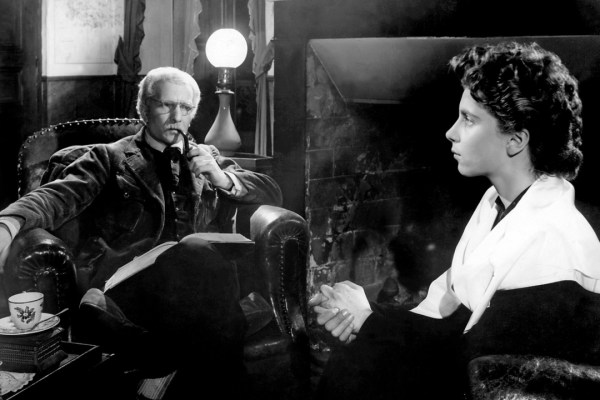
Eggers largely follows the plot beats of what had transpired before, notably Murnau’s eerie silent classic from 1922 and Herzog’s more naturalistic and organic 1979 version (both superior to Eggers’).
His workmanlike approach to storytelling, however, doesn’t add much to the canon. Hence, from a narrative point-of-view, there is little to savour, unless you are encountering the story for the first time.
There is a more noticeable commitment to the film language of modern horror filmmaking here, be it jump edits functioning as scares, or the ‘excesses’ of actors’ performances—cue Lily-Rose Depp channelling Isabelle Adjani in Possession (1981) as a woman tormented by Count Orlok, or the titular Orlok himself as cunningly played and boomingly voiced by Bill Skarsgard.
“Does evil come from within us or from beyond?”
However, one ought to recognise that these are amplified techniques (a continuation of what film scholar David Bordwell called ‘intensified continuity’) in order to appeal to the tastes of modern audiences who generally need more visual-aural stimuli to sustain their interest.
The fact that Eggers’ films so far operate at a slightly slower tempo than the usual Hollywood standard also means he has to succumb to ‘intensified continuity’ more often than not, especially with a known quantity—and hence imbued with audience expectations—like ‘Nosferatu’.
As curses, fears of the unknown, the tension between science and religion (and lots of plague-spreading rats) rear their ugly heads in Nosferatu, Eggers holds everything together like a seasoned filmmaker, though the film doesn’t quite land well as it draws to a close. Some might even find it rushed.
Or perhaps it could be the niggling feeling that after sufficiently terrifying audiences for the past two hours, the well has run dry and there is nothing more for him to offer.
His next feature, already his fifth, will be his most critical yet—an opportunity for reinvention or a spiral into deepening self-parody.
Grade: B-
Trailer:
Music:
 Eternality Tan
[…] Nosferatu (2024) […]
LikeLike
I completely agree with your analysis. I also thought that the film was too performative and “in your face”. It just made me want to re-watch the original silent film. I hope that Eggers won’t go down the route taken by Lanthimos and Aronofsky of pandering to the masses with their big commercial cinema projects that also meant that the magic and uniqueness of their earlier films remained forever in the past and they continue self-parody their trademarks. The modern audience doesn’t seem to know what a nuance is. In the first seconds of Nosferatu, I thought it would spoon-feed me every little detail than I can guess for myself. I was already exhausted and exasperated in the first minutes of the film. Oh, the modern cinema…Somehow watching Nosferatu, I kept thinking about Burton’s Sleepy Hollow maybe because of the aesthetics and Depp’s daughter but I enjoyed Burton’s film much more than Nosferatu.
LikeLiked by 1 person
Thanks for sharing! Indeed I was disappointed by Kinds of Kindness…
LikeLiked by 1 person