






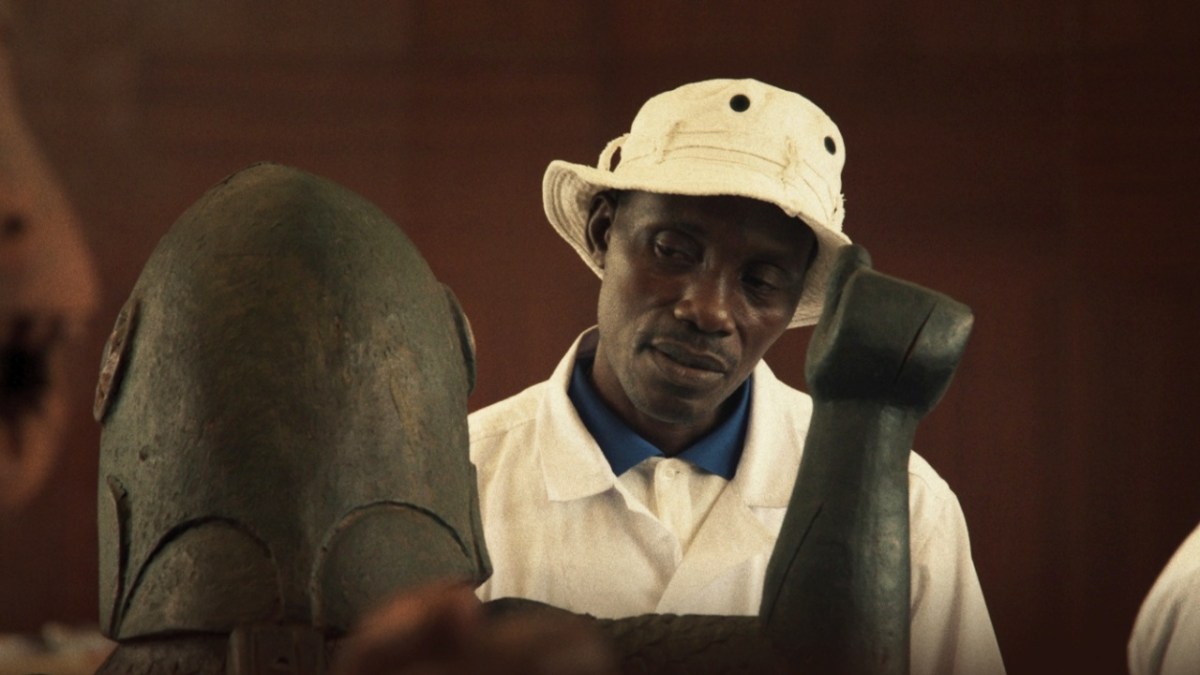
Some centuries-old Beninese treasures are returned by France, sparking debate over its neocolonial political posturing sublimating as cultural diplomacy as Diop’s quaint Berlinale Golden Bear-winning documentary highlights the dissonances inherent in this ‘homecoming’.

Review #2,938
Dir. Mati Diop
2024 | Senegal, France | Documentary | 68min | 1.85:1 | French, English & Fon
PG (passed clean)
Cast: –
Plot: In 2021, 26 objects from the Kingdom of Dahomey leave Paris and are returned to present-day Benin. How should these art treasures, stolen from ancestors, be received in a country which has reinvented itself in their absence?
Awards: Won Golden Bear & Nom. for Documentary Award (Berlinale)
International Sales: Les Films du Losange
Accessibility Index
Subject Matter: Historical Artefacts; African Colonialism; Museum
Narrative Style: Straightforward
Pace: Slightly Slow
Audience Type: Slightly Arthouse
Viewed: MUBI
Spoilers: No
A disembodied voice partly narrates this Berlinale Golden Bear winner from the French-Senegalese director of Atlantics (2019).
The relatively loud, booming and echoey voice comes from one of the artefacts plundered by the French a long time ago but is now returned to Benin, its country of origin.
That striking ‘sound design’ elevates this unorthodox documentary by Mati Diop into something operating at a subliminal level.
It is as if ancient spirits have spoken, lamenting their pitiful existence in these slabs of finely constructed art, displaced seemingly for eternity yet their ‘homecoming’ provokes more questions than expected.
Diop understands that this movement of national treasures is more than just a moral action; it may be construed as neocolonial political posturing sublimating as cultural diplomacy.
Dahomey has segments of invigorating student debate between those who think that this act of returning is only the beginning of ‘more to come’, whilst others feel it is merely a matter of paying lip service, an act of appeasement in an era of uncertain times.
“There are thousands of us in this night. We all bear the same scars.”
The French are finding their influence terribly waning in their former colonies, and with China strategically developing regions in Africa through the building of roads, infrastructure and bilateral trading, political winds of change are all but shifting significantly.
Hence, watching Dahomey at this point has given me a sense of how, in this case, Benin is thinking of herself. As these artefacts are displayed in a museum, we see the Beninese, or at least the more cultured ones, visit the site to learn more about their history and tradition.
At the same time, Diop reveals the class differences inherent in museum-going as such sites aren’t even in the vocabulary of those struggling to survive on a daily basis.
Hence, Dahomey, despite its rather short runtime, is an economical amalgamation of a new Benin, where its people see these artefacts as objects of curiosity, far removed from the historical memory that produced them, and without the language to ground them ontologically.
Similarly, these artefacts find themselves in a strange, new environment centuries later. If anything, Diop highlights these dissonances in an almost spectral way.
Grade: A-
Trailer:
 Eternality Tan
[…] interesting sound device used reminds of Dahomey (2024), where a disembodied voice represents the ‘dead’, speaking about the futility and enigma […]
LikeLike
[…] Sound Design: PEPE & DAHOMEY. For their use of haunting disembodied voices in the narrativisation of non-human objects, be it a […]
LikeLike