








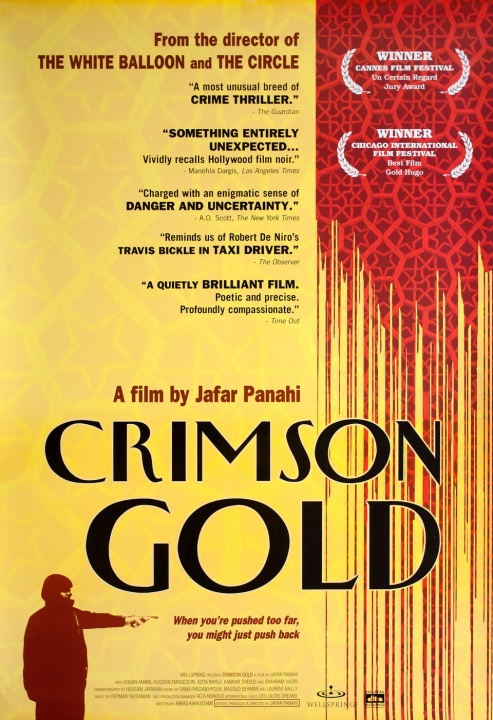
This Panahi-Kiarostami collab is an edgier though not always engaging part-‘thriller’, part-social critique about personal humiliation and vendetta as a delivery man is constantly reminded of his working-class status.
Review #2,925
Dir. Jafar Panahi
2003 | Iran | Drama, Crime | 96min | 1.66:1 | Persian
PG (passed clean)
Cast: Hossain Emadeddin, Kamyar Sheisi, Azita Rayeji
Plot: An Iranian pizza delivery man sees the worst of corruption and class inequality in his city and is driven to crime.
Awards: Won Un Certain Regard Jury Prize (Cannes)
International Sales: Celluloid Dreams
Accessibility Index
Subject Matter: Moderate – Class Inequality; Corruption & Crime
Narrative Style: Slightly Complex
Pace: Slightly Slow
Audience Type: Slightly Arthouse
Viewed: Oldham Theatre (as part of Singapore International Film Festival)
Spoilers: No
This is an interesting anti-genre ‘experiment’ by Jafar Panahi, written by his compatriot Abbas Kiarostami. Even then, I thought it wasn’t particularly a great piece, mainly because I wasn’t always engaged with the material at hand.
Not as hard-hitting or thought-provoking as some of the duo’s best works, Crimson Gold takes the story of Hossein, a delivery man who is constantly reminded of his working-class status.
He snaps one day in a bout of violence that Panahi forces us to imagine offscreen in the film’s opening long take. And so, it starts at the very end, and then takes us to the beginning of this journey of personal humiliation and vendetta.
That opening sequence recalls Haneke in its cold nihilism, but it also reminds me of the finale of Antonioni’s The Passenger (1975) in terms of its formal construct.
“Do you have a price in mind?”
In Crimson Gold, there is an extended segment where Hossein delivers some pizzas to a luxurious residence. He’s invited in by a lonely man who wants companionship after being stood up by two women, giving him illusions of grandeur as he imagines being this wealthy.
Crimson Gold is a tale of class inequality that is pervasive in Iran (and frankly, just about everywhere else), but what’s more troubling it seems is the ‘policing’ of citizens who are deemed to have too much fun.
The police lie in wait in the dark of night, ambushing men and women during nights out drinking, dancing and ‘socialising’. Some of these scenes work like a thriller, similar to the opening shot, which gives Crimson Gold a slightly edgier quality than the usual Iranian arthouse fare.
Perhaps this is what gives it that unique spark that many critics have acknowledged. Still, there is a lot of waiting and drifting in this one, and I found the film rather dull in those elongated moments of stasis that worked better narratively in other pictures.
Grade: B
Trailer:
 Eternality Tan