




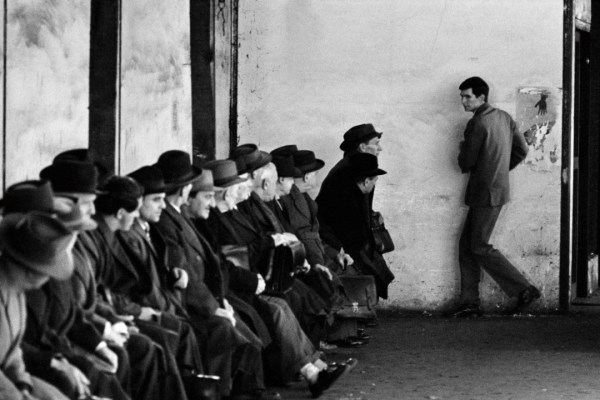

A work fundamentally rooted in voyeurism and the invasion of personal space in private and in public, Yeo’s part-mystery, part anti-thriller teases us with its form and structure as a young couple tries to find their missing child who has disappeared in mysterious circumstances.

Review #2,920
Dir. Yeo Siew Hua
2024 | Singapore, Taiwan | Drama, Mystery | 125min | 1.85:1 | Mandarin, English & Min Nan
NC16 (passed clean) for sexual scene
Cast: Wu Chien-Ho, Lee Kang-sheng, Anicca Panna, Vera Chen, Pete Teo
Plot: A man obsessively searches for his missing daughter after receiving disturbing videos exposing his secrets, leading to a chilling confrontation with the voyeur.
Awards: Nom. for Golden Lion (Venice); Won 1 Golden Horse – Best Original Score & Nom. for 5 Golden Horses – Best Narrative Feature, Best Director, Best Supporting Actor, Best Original Screenplay, Best Sound Effects
International Sales: Playtime (SG: Anticipate Pictures)
Accessibility Index
Subject Matter: Moderate – Voyeurism; Seeing & Being Seen; Missing Child; Strained Relationships
Narrative Style: Slightly Complex
Pace: Slightly Slow
Audience Type: Slightly Arthouse
Viewed: Screener
Spoilers: No
The first thing that struck me in the exceptional first half-hour of Stranger Eyes was the music by Thomas Foguenne. There is a reason it won the Golden Horse for Best Original Score.
It reminded me of a cross between Mowg’s percussive rhythmic beats on Lee Chang-dong’s Burning (2018) and the ‘bell-like’ bits of Thomas Newman’s score for Steven Soderbergh’s Side Effects (2013).
I niche-geeked out and was utterly entranced by the experience, which very much suited the mystery-thriller mode that Yeo Siew Hua’s sophomore feature was trying to operate in.
Yeo would, however, turn his film subsequently into an anti-thriller, which I appreciate, though some might find it a cop-out. I wouldn’t be so generous to say the ‘u-turn’ is a masterstroke, but it makes Stranger Eyes a more interesting film, structurally and mood-wise.
Foguenne’s tense musical motifs do recur again in certain later segments, teasing the film’s fluidity between the two states of ‘movement’ and ‘rest’, and of uncertainty and safety.
As a work fundamentally rooted in voyeurism and the invasion of personal space in private and in public, Stranger Eyes does recall the likes of, say, Rear Window (1954), Peeping Tom (1960), Cache (2005) and Red Road (2006), though it is also unlike any of these movies, which makes it an enigma in itself because there were times when I wasn’t quite sure what kind of film Yeo was trying to make.
“We just need to watch carefully and wait patiently.”
But perhaps it is this unchartered territory, one that is contextualised in the setting of Singapore, that affords Stranger Eyes the necessary guile in defining and becoming itself, imperfections notwithstanding.
When a young couple loses their child, the hunt is on to find the missing girl who might have been taken away by a stranger.
Mysterious DVDs are left at the doorstep of the couple’s residence, but with Singapore infamously known by locals as a ‘surveillance state’, Yeo makes it obvious in a series of shots of CCTVs installed in every nook and corner of the neighbourhood.
If he had been bolder, it could have been an extended montage like what Romanian auteur Radu Jude did with tombstones in the outrageous Do Not Expect Too Much from the End of the World (2024).
While I enjoyed A Land Imagined (2018) a tad more, Stranger Eyes is a unique oddity from a filmmaker who doesn’t like conformance. Likewise, we can approach his film, the first Singaporean picture to compete for the Golden Lion at the Venice Film Festival, without any kind of expectation.
Grade: B
Trailer:
 Eternality Tan