







An unsurprisingly quaint coda to Sokurov’s extraordinary career, as archive footage is combined with deepfake technology, resurrecting Hitler, Stalin, Mussolini and Churchill as spectral artefacts in a liminal, purgatorial space between death and death.

Review #2,868
Dir. Aleksandr Sokurov
2022 | Russia | Drama, Experimental | 78 min | 1.33:1 | Various languages
NC16 (passed clean) for some mature content
Cast: –
Plot: A civil and artistic statement about those who determined the fate of the planet: Stalin, Churchill, Mussolini and Hitler, according to a Russian newspaper.
Awards: Nom. for Golden Leopard (Locarno)
International Sales: Juno Films
Accessibility Index
Subject Matter: Moderate – Purgatory; Historical Figures; Deepfake
Narrative Style: Straightforward/Vignettes
Pace: Slow
Audience Type: Experimental Arthouse
Viewed: Screener (as part of Perspectives Film Festival 2024)
Spoilers: No
Purportedly Aleksandr Sokurov’s final film, Fairytale does feel like that unsurprisingly quaint coda to an extraordinary career as arguably Russia’s pre-eminent modern auteur, one who isn’t afraid of challenging storytelling conventions or pushing the boundaries in film form.
For instance, his Russian Ark (2002) remains one of the high watermarks of that rare category of ‘single-take’ films.
With Fairytale, which is banned in Russia, Sokurov returns to a subject that has long fascinated him—the dictators and fascists that had irreversibly changed the course of 20th-century politics and the extensive collateral damage that ensued from their rule.
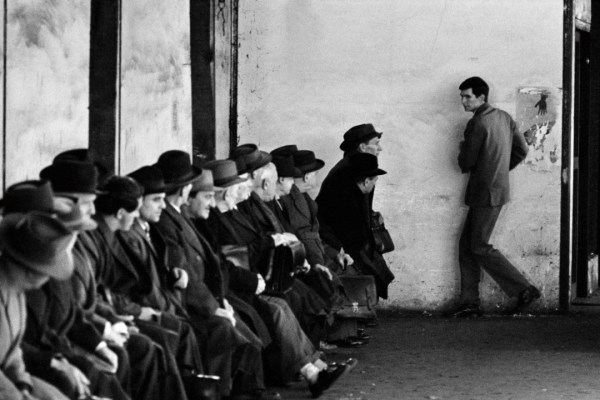
Here, the ‘stars’ are Stalin, Hitler and Mussolini, resurrected as haunting spectral artefacts that speak like little children lost in the wilderness.
This wilderness is best described as utterly purgatorial, rendered in ultra-bleak greyish tones, as these evil men find themselves still existing in the afterlife in some liminal space between not life and death, but death and death. One could say that Fairytale is the yin to the yang that is Kore-eda’s After Life (1998).
“We are now all immortal.”
Archival footage is combined with deepfake technology, but while the pacing of Sokurov’s work may be on the more deliberate side, the ‘strangeness’ of the cinematic experience, where there doesn’t seem to be any precedent, keeps it oddly compelling.
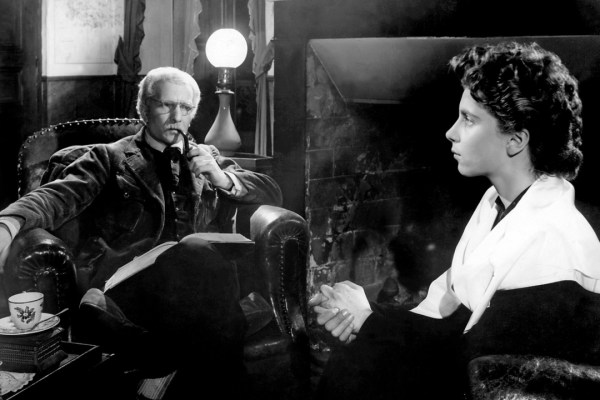
Churchill also has a prominent role as his adversaries try to guilt-trip him, but all he wants to know when he can finally meet God is if his Queen is okay. A frail-looking Jesus even has a cameo, hoping that Hitler and gang would repent for their sins, but their blindingly humongous egos scare him.
While Fairytale does take some time to build up any kind of narrative momentum, its midsection features a stunning audiovisual experience that sensorially overwhelms the viewer as ‘waves’ of spectral humans yearn for salvation, only to be scorned from above by the dictators and their spawned clones.
More avant-garde than a structured work of political and religious intent, Fairytale will reward viewers who can appreciate its satirical overtones.
Grade: B+
Trailer:
Music:
 Eternality Tan