






A film that flaunts its Korean-ness, from the classic tale of a governor’s son who secretly marries a courtesan’s daughter, to the use of pansori (traditional musical storytelling with a singer and drummer), all pegged to the effortless pacing of a master director.
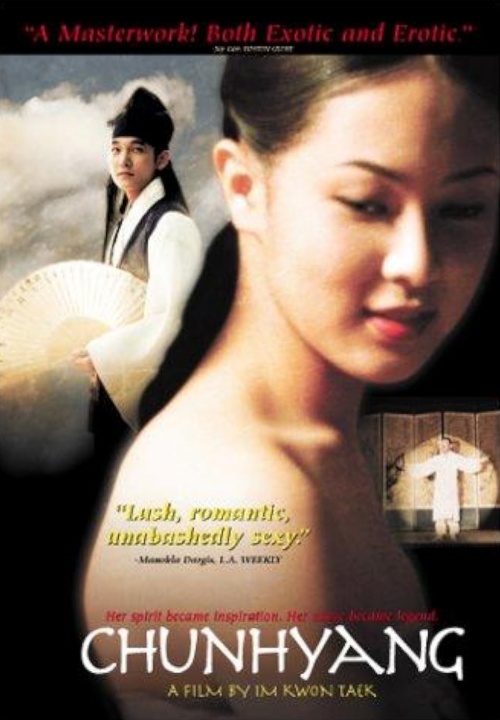
Review #2,818
Dir. Im Kwon-taek
2000 | South Korea | Drama, Romance | 137 min | 1.85:1 | Korean
M18 (passed clean) for some sexuality
Cast: Lee Hyo-jeong, Cho Seung-woo, Kim Sung-nyeo
Plot: A courtesan’s daughter’s fidelity to her husband, the governor’s son, is tested when he and his family leave for Seoul and the new governor attempts to possess her.
Awards: Nom. for Palme d’Or (Cannes)
Source: Korean Film Archive
Accessibility Index
Subject Matter: Moderate – Opposites Attract; Loyalty; Forbidden Love; Pansori Tradition
Narrative Style: Straightforward
Pace: Slightly Slow
Audience Type: Slightly Arthouse
Viewed: Korean Film Archive’s YouTube
Spoilers: No
My journey continues with Im Kwon-taek, one of the most important and prolific directors in the history of Korean cinema, whose daunting filmography is near impossible to complete.
Here, we have Chunhyang, a film made in his late phase, at an invigorating time when a new breed of Korean auteurs had begun to stake their claim in the Korean New Wave of the 2000s.
So what does the master filmmaker do? He goes back in time, flaunting the film’s Korean-ness by telling the classic tale of a governor’s son who secretly marries a courtesan’s daughter (the eponymous character).
With extravagant period design and shot with a shimmering glow (especially in its day scenes of courtly activities), Im’s work goes one further: he employs pansori, which is a form of traditional Korean musical storytelling normally performed by a singer and drummer to tell this story—and literally so, as the opening scene shows us a full auditorium of Korean urbanites, many of them youths, attending this minimalist art performance.
“I long to follow my lover, for one thousand miles, for even ten thousand miles.”
So, by a stroke of genius, Im links the young generation of the millennial turn to something rooted deeply in Korean mythology, as if to say: sure, the hallyu may be underway, but let us continue to take pride in our older traditions.
Chunhyang may be predictable (well, after all, it’s a classic) even for non-Korean viewers, but the pleasures come from seeing it all take shape simultaneously.
The filmed scenes of the period drama are intertwined with shots of the staged performance, as the dramatic pansori singing regularly fades in and out, sometimes overlapping with dialogue.
An effortlessly-paced film about the ruling classes’ battle with the opposite poles of corruption and moral justice, and how that affects the common folk, Chunhyang centers on the aforementioned forbidden love that, while painful for the characters, shows us that defiance towards authority can be a virtue.
Grade: A-
Trailer:
Korean Film Archive’s YouTube:
 Eternality Tan