





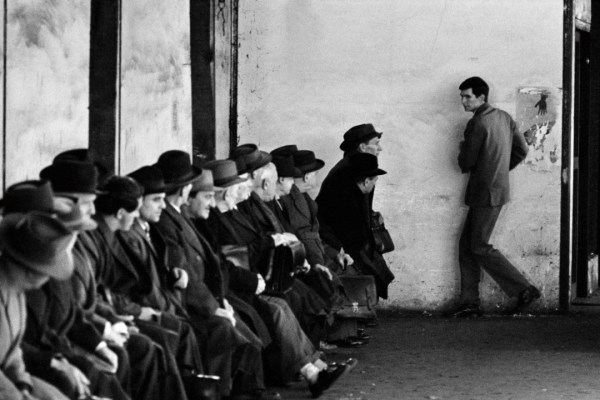

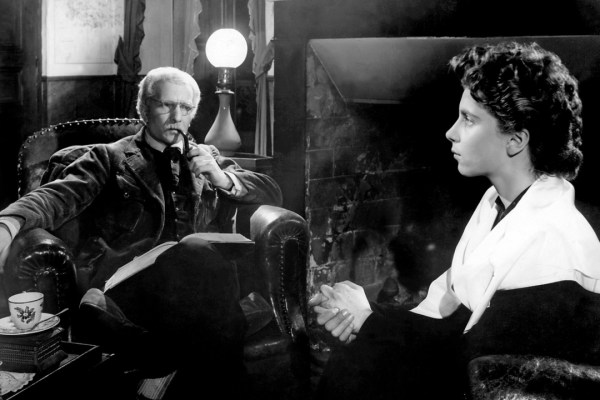
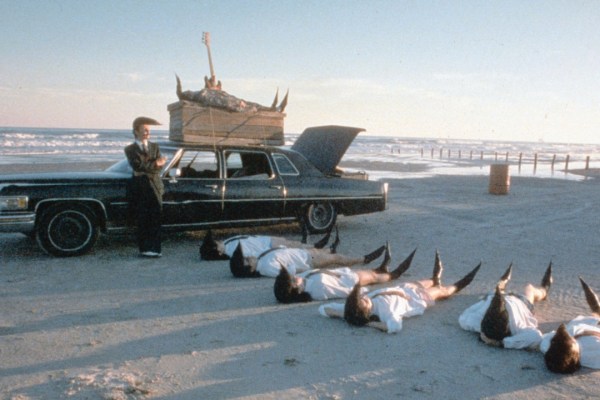


A significant work of Malayalam cinema, Aravindan’s work, by turns exuberant and elegiac, about a circus act coming to a rural Indian village teases out the hypnotic and exhibitionistic qualities of performative art in ways that challenge our unquestioned spectatorship.

Review #2,797
Dir. Govindan Aravindan
1978 | India | Drama | 129 min | 1.37:1 | Malayalam
PG (passed clean)
Cast: Jalaja, Nedumudi Venu, VK Sreeraman, Gopi, Sridharan Chambadu
Plot: The film chronicles the happenings (both inside and outside the tent) of three days when a circus visits a small village in Kerala.
Awards: Won Best Cinematography (National Film Awards India)
Source: Flair Communications
Accessibility Index
Subject Matter: Moderate – Art & Exploitation; Circus Performers; Village Life
Narrative Style: Slightly Complex
Pace: Slightly Slow
Audience Type: General Arthouse
Viewed: Oldham Theatre (as part of Asian Film Archive’s ‘Parallels’ programme)
Spoilers: No
In the tradition of cinema about circus acts coming to a town and leaving soon after (think of, say, Jacques Tati’s Jour de fete from 1949), Thamp draws from a similar thematic well but goes one further by abstracting elements of audio-visual expression and plot into what feels like a one-of-a-kind artistic experiment.
Directed by Govindan Aravindan (Kummatty, 1979), who wasn’t exactly the most well-known of Indian auteurs, but he continues to be regarded as an important pioneering figure of Malayalam cinema, Thamp is both exuberant and elegiac in tone.
It is through these oscillating ‘waves’ of exuberance and elegy that Aravindan finds the heart and soul of a rather formless work with hardly any reliance on narrative structure (except for the bookending scenes of the circus troupe’s arrival and departure).
Free-flowing dialogue-less scenes of circus performances, and later in a ceremonial festival, men performing traditional music and dance, tease out the hypnotic qualities of performative art in both entertainment and religious realms.
Thamp dazzles as much with these intoxicating sequences (one involves a goat precariously balancing on a tightrope) as it does with poetic scenes of daily life: children chasing vehicles, women washing clothes by the river, etc.
“The show is about to start.”
The film embodies realism from its ‘direct cinema’ style to using real-life circus performers young and old (a couple of them lament about a lifetime of suffering to make ends meet in jolting confessions to the camera). Art or exploitation?—this is the age-old question not just of circuses but of cinema.
While Thamp occasionally feels protracted and might be a tad too arthouse for some cinephiles, there’s enough contemplative material to last the course.
For one, it poses questions of unquestioned spectatorship. We lap up the film’s exhibitionistic qualities that harken back to the old days of the fairground as an attraction, as noted by scholar Tom Gunning in his seminal piece on the ‘cinema of attractions’.
As such, Aravindan, the intellectually provocative filmmaker that he was, chose to prolong and repeat certain ‘attractions’, enough to make us think about what we are really seeing.
Grade: A-
 Eternality Tan