








A milestone in revolutionary Latin American cinema, this dialectical Cuban docu-fiction explores the class-crossing romance between a schoolteacher and a factory worker with a vigorous ethnographic and political thrust.

Review #2,769
Dir. Sara Gomez
1977 | Cuba | Drama, Documentary | 74 min | 1.66:1 | Spanish
Not rated – likely to be PG13 for some coarse language and sexual references
Cast: Mario Balmaseda, Yolanda Cuellar, Mario Limonta
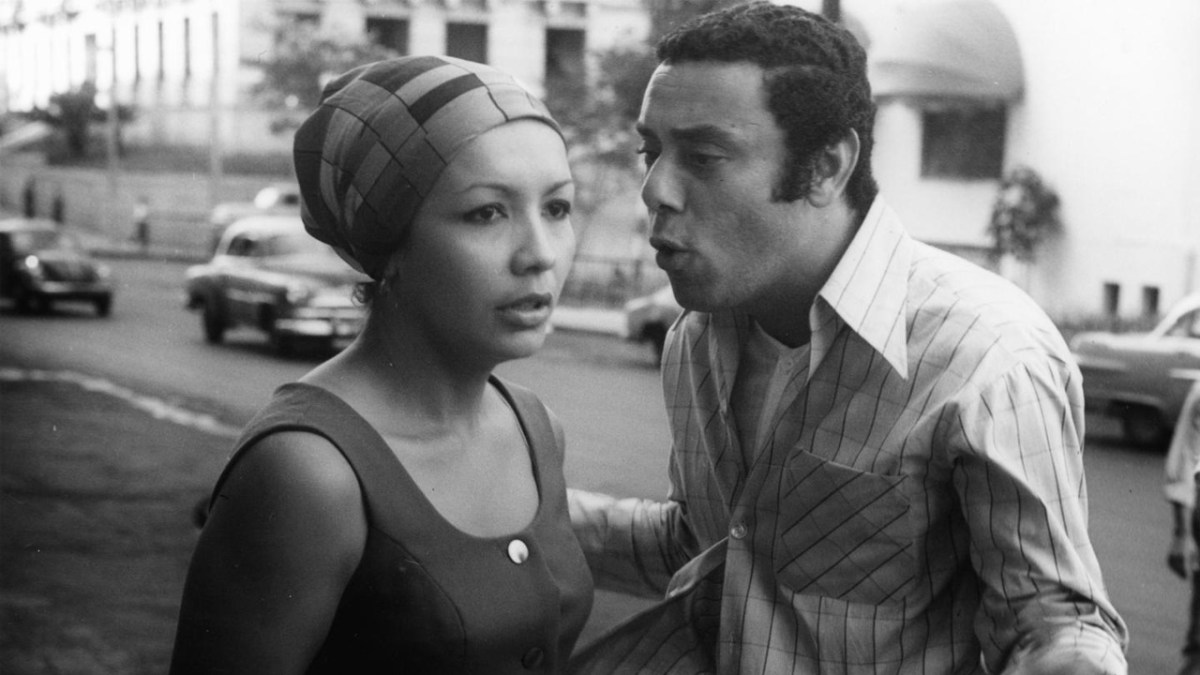
Plot: Middle-class teacher Yolanda falls in love with factory worker Mario but their relationship is challenged by their different views, values and prejudices. As Yolanda’s bias surfaces when teaching underprivileged children, Mario’s machismo is undermined by Yolanda’s sense of independence.
Awards: –
Source: Arsenal Institute for Film and Video Art
Accessibility Index
Subject Matter: Moderate – Cuban Politics & Society; Opposites Attract
Narrative Style: Slightly Complex
Pace: Slightly Slow
Audience Type: Slightly Arthouse
Viewed: MUBI
Spoilers: No
There has always been special recognition in cinema history for filmmakers who passed on way too soon, who would have tantalisingly made a slew of significant films if they had lived much longer.
For female filmmakers, the list is particularly pronounced, with the likes of Barbara Loden (Wanda, 1970) and Larisa Shepitko (The Ascent, 1977), to name a couple. Sara Gomez is another worth spotlighting in the context of Latin American filmmaking.
Her only feature is a milestone in revolutionary cinema, made in Cuba in a style that is best described as docu-fiction. A mix of class-conscious ethnography and romantic drama, One Way or Another is unclassifiable.
Seeing it today, it becomes a valuable historical record as well as an inspiring work brimming with dialectical possibilities for film form.
“I’m just as revolutionary as you.”
A schoolteacher and a factory worker fall in love despite seemingly incompatible personalities—she’s independent and opinionated while he takes pride in his lofty sense of machismo.
They bring us into Cuban politics, marked by a strong collective reverence toward socialism as the government sought to integrate marginalised groups with the larger population.
The political thrust can be felt throughout Gomez’s filmmaking, be it how fervently she asks her subjects questions, not just of the proverbial ‘man on the street’ but also her very own protagonists.
At the same time, there are scenes of vibrant cultural and educational activity as well as segments involving a ‘committee of inquiry’ by factory workers towards one of their own whom they suspect has been idling.
Free-flowing, potent but never didactic, One Way or Another is an excellent introduction to the more political side of Latin American filmmaking.
Grade: A-
Trailer:
 Eternality Tan